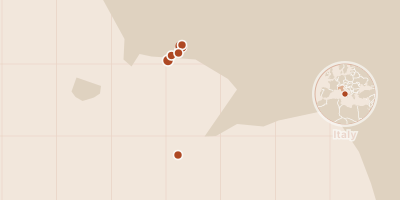
Parthenope (2024), Sorrentino's film, was shot in Naples and on Capri: Villa Lauro in Posillipo, the Galleria Umberto I, Federico II University, the Gardens of Augustus, Spaccanapoli, Naples Cathedral and Via Partenope. It follows a woman named after her city from her birth in 1950 to 2023.
The route runs in story order, from the sea at Posillipo to the seafront where the film ends.
Flaubert's Madame Bovary is set in the Normandy countryside around Rouen: Yonville-l'Abbaye is traditionally held to be based on the village of Ry, and the novel's city scenes play out in Rouen, around its cathedral, its opera and its old churches.
The route follows Emma Bovary from the couple's first home at Tostes, through the market town of Yonville, to an evening at the opera and the famous cab ride through Rouen. Several places are approximate, since the novel names few of them as they are today.
Fionn mac Cumhaill is the hero of Irish legend who gained all knowledge by burning his thumb on a salmon, saved Tara from a fire-breather and, in folk tales, built the Giant's Causeway to reach a Scottish rival. His stories are tied to real hills, rivers and rocks, many of them still named for him.
The route follows his legend from the Boyne of his boyhood through Tara, the Hill of Allen, Slieve Gullion and Benbulben, then to the tall tales of Lough Neagh, the Causeway and Fingal's Cave. Nothing here is history: pins mark where tradition places each tale.
In AD 79 a mountain above the Bay of Naples blew apart. Pliny the Younger watched from Misenum across the water, lost his uncle, the admiral Pliny the Elder, to the eruption, and years later described it for the historian Tacitus in two letters: the only eyewitness account that survives.
The route follows the eruption in the order of its events, from the mountain's first column to Pompeii, Herculaneum, the beach at Stabiae and back to Misenum. Pliny's letters never mention Pompeii or Herculaneum, so those stops come from archaeology. The traditional date is 24 August, but newer evidence points to the autumn.