The German Fairy Tale Route runs from Hanau, where the Brothers Grimm were born, to Sababurg, nicknamed Sleeping Beauty Castle, the Pied Piper's Hamelin and the Musicians' Statue in Bremen. The brothers grew up poor, studied law and became librarians.
The route follows the Fairy Tale Route from Hanau, where they were born, through the places they lived and worked, to Sleeping Beauty's castle and the Pied Piper's Hamelin, ending in Bremen with the animals' statue. The tale places are traditional associations, not the Grimms' own claims.
Dante wrote the Divine Comedy while banished from Florence. This route follows both the man and the people he put in the poem who were real: Francesca, Ugolino and Pia.
It runs from the Baptistery and the sentence of 1302, through the places tied to the poem's souls and the court of Verona, to Ravenna, where he died in 1321, and the empty tomb Florence built for him.
Bridgerton is set in London, but most of its streets are in Bath, its parks are in Wiltshire and its family home is in Greenwich.
This route follows the filming locations from the Royal Crescent and Lady Danbury's house in Bath, through London and Kent, to the country houses that played Clyvedon and Aubrey Hall in the first two seasons.
In September 1786 Goethe slipped away from Carlsbad at 3 in the morning, telling none of his friends, and headed for Italy. He was arrested for drawing a castle, met the ancient world at Verona, and shared a house in Rome with a painter.
The route follows his diary from Carlsbad over the Brenner and the Italian lakeshore to Verona, Venice and Rome, then to Vesuvius and Sicily. Some stops are towns or mountains rather than single buildings; the pin accuracy says which.
A seventeen-year-old heir is sold to a brig bound for the colonies, wrecked off Mull, and thrown into the heather beside a fugitive named Alan. Stevenson's chase carries them from the Firth of Forth through Appin and the Highlands to the bridge at Stirling.
The route follows David's journey in chapter order, from the Queensferry inn where he is handed over to the old bridge where the pair cross the Forth. Several scenes rest on real events, such as the Appin murder and Cluny MacPherson's hiding place.
Bruce Lee was born in San Francisco, but Hong Kong was the city that shaped him: a Nathan Road childhood, Wing Chun lessons with Ip Man, and the film studios that made him a star. This route follows his documented life and the places where his films and legacy meet.
It runs from a Kowloon flat and school days, through a surviving Enter the Dragon location and the hospital where he died, to the statue and museum that remember him. Where accounts differ, the stop says so.
In 1832 the printmaker Hiroshige travelled the Tōkaidō, the road from Edo to Kyoto, and made it into The Fifty-three Stations of the Tōkaidō. This route follows seven of his prints, from the bridge where the road began to the bridge where it ended.
Each stop pairs a print with what is there today: a rebuilt checkpoint, a long river bridge, a shrine, a preserved post town. Scholars debate whether Hiroshige saw every station himself, so the pins mark the places, not his exact viewpoints.
In April 1701 a lord drew a blade inside Edo Castle, and two years later forty-seven of his leaderless samurai stormed the mansion of the man he had attacked. The documented story runs from a corridor in Edo, through a surrendered castle and a quiet retreat near Kyoto, to a night raid and a temple cemetery in Tokyo.
The route sticks to dated events and places. The legend of Chūshingura, the later play, is kept to the final stop, where it is set apart from what happened.
In Ishin!, Sakamoto Ryōma flees Tosa as a murder suspect, hides in Kyoto under the name Saitō Hajime and joins the Shinsengumi to find the masked killer of his adoptive father. The game is fiction built on real history: its Ryōma, its plot and its twists belong to the game, while the Teradaya attack and the Ōmiya killing really happened.
The route follows the story from Kōchi Castle through the Shinsengumi's Mibu, Gion and Fushimi to the Ōmiya Inn, and each stop says what is the game and what is the record.
The anime Hyouka is set in a fictional town, but its backdrops are real streets in Takayama, in the mountains of Gifu. The author's home town became the model, and the local tourism board publishes an official pilgrimage model course.
This route follows six places from the opening title to the final episode: the river and morning market, the school-route crossing, the Old Town, the library, the hill shrine and the festival shrine outside town. Where the story renames a place, the pin marks the real one.
Team Ninja's open-world samurai game drops a masterless Blade Twin into the last years of the shogunate. Between 1858 and 1868 the story runs from Yokohama's foreign quarter through the killing of a Chief Minister to Kyoto's Shinsengumi and a plot to burn Edo.
This route follows the game's main story through seven places, from the port to the capital, pairing each scene with the real site that history ties to it. Where the game names only a district, the pin marks the nearest well-known landmark.
Assassin's Creed (2007) recreates the Holy Land of 1191: Masyaf, Damascus, Acre and Jerusalem, with Solomon's Temple and Richard's camp at Arsuf. Altaïr loses his rank after a botched mission and wins it back one target at a time: nine men in three cities, all secretly Templars.
The route follows the story from the Temple in Jerusalem to the Assassins' fortress of Masyaf, through Damascus, Acre and Jerusalem, to a duel in King Richard's camp. The game's cities are rebuilt for play, so every pin marks the real place the scene is anchored to.
A Cornish knight fetches an Irish princess for his uncle the king, and a love potion on the ship ruins everything. Tristan and Iseult is a medieval legend told in many versions since the 12th century, and every retelling sets it on a slightly different map.
This route follows the lovers from Tristan's drowned homeland to Dublin, Cornwall and Brittany, ending on the island that carries his name. Almost every site is a tradition rather than a fact, so each pin says how sure it is.
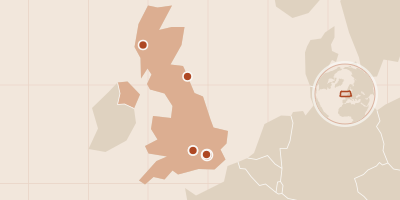
HBO's Game of Thrones prequel was filmed primarily in the United Kingdom, and its Velaryon world is Cornish: the island seat of Driftmark is a tidal island, and the Stepstones war camp is a cove on the Lizard peninsula. For the capital and the free city of Pentos, the crew went to western and southern Spain.
The route follows the story from the Stepstones war (season 1, episode 3) through the Driftmark episodes to King's Landing in season 2. Sources do not name the exact streets used in Cáceres, so that pin marks the old town.
Joan of Arc’s road runs from her family’s house in Domrémy, through Vaucouleurs, Chinon, Orléans and Reims, to Rouen, where she was burned in 1431. A peasant girl, she persuaded a doubting captain and then a doubting prince to give her an army, lifted the siege of Orléans in 1429 and stood beside Charles at his coronation.
The route follows her through nine places, from her family's house in Domrémy to the square in Rouen where she was burned. Where a building was rebuilt or the exact spot is unrecorded, the stop says so.
Fitzgerald set The Great Gatsby on two invented peninsulas, West Egg and East Egg, but he built them from the Long Island he knew in Great Neck, where he lived from October 1922. Behind the glamour sit a dump, a station and a hotel suite that were all real.
This route follows Nick from the Eggs through the valley of ashes, Penn Station, the Queensboro Bridge and the Plaza Hotel. The Eggs, the valley and Gatsby's house are invented, so their pins mark the real places the novel is read against.
In 1581 the African slave Diogo comes to Kyoto with a Jesuit delegation and is handed to the warlord Oda Nobunaga, who renames him Yasuke and makes him a samurai. That year Nobunaga's army crushes the ninja province of Iga, where the young shinobi Naoe loses her father and inherits his Hidden Blade.
From there the two hunt the same conspiracy across Kansai: the port of Sakai, the temple at Honnō-ji where Nobunaga dies, a kofun in Settsu, the castle of Shōryūji at Yamazaki, the shrines of Yamato, and the Templar recruiting ground of Kii. Most stops are real castles, temples and tombs that the game rebuilds.
December 1499: Cesare Borgia's army has struck the Auditore villa at Monteriggioni, killing Mario and seizing the Apple of Eden. Assassin's Creed Brotherhood sends Ezio to Rome, the center of Templar power, to take the fight to the Borgia-led Templars, and the hunt for the Apple runs from St Peter's Basilica to a temple hidden underneath the Colosseum.
This route follows Ezio from the villa at Monteriggioni through Borgia Rome — the Castel Sant'Angelo fortress, the Pantheon, St Peter's and the Colosseum — to Viana in Navarre, Spain, where his fight with Cesare ends on the battlements. Every stop is a real place you can visit.
Indiana Jones and the Last Crusade (1989) sends Indy from a Boy Scout outing in the Utah desert to the rock-cut façade of Petra, chasing the Holy Grail and his missing father. Three trials guard the cup at the end. The film borrows its scenery from half of Europe, the Middle East and the American West.
Nine stops, most of them still standing: the Arches canyons of the opening, the church façade in Venice's Campo San Barnaba that plays the library, an Eifel castle dressed as Brunwald, a San Francisco building that played Berlin's Tempelhof airport, the Almería beach where Henry brings down a fighter with an umbrella, a Granada station playing Alexandretta, the Tabernas tank chase, the Treasury that fronts the Grail's temple, and the Texas sunset the film ends on. Dates are story time; filming ran from May 1988 to early 1989.
Outlander's Scotland: the standing stones of Craigh na Dun near Kinloch Rannoch, Doune as Castle Leoch, Culross as Cranesmuir and Culloden moor. Claire, a twentieth-century nurse, touches a stone and wakes in 1743; a highlander knocks out the officer chasing her, and she marries Jamie Fraser to stay out of his reach.
They start near Kinloch Rannoch, where the production found its Craigh na Dun, then move to the real castles and villages playing Castle Leoch, Fort William, Cranesmuir and Lallybroch, and to a Fife castle standing in for a French abbey. The last stop is Culloden, the moor where Claire and Jamie say goodbye in the second-season finale.
One caveat: the standing stones on screen are a built set. The Bronze Age Clava Cairns near Inverness that fans often visit are said to have inspired them, but they are not where the circle was filmed.
Before Hogwarts there is London: a market alley off Gracechurch Street, a barrier between platforms, a staircase in Oxford, a castle in Northumberland and a steam train crossing a Highland viaduct. This route visits six real places that built the Harry Potter films, shot from September 2000 to March 2001 and returned to in the sequels.
You start where Harry buys his school supplies, run through the wall at King's Cross, climb the stairs down which McGonagall comes to meet him, wake in the hospital wing, take your first flying lesson at Alnwick and ride out over Glenfinnan — six real places, each tied to the scene it created.
The Boshin War ran from Kyoto to Hakodate in eighteen months: the battlefield at Toba, Edo Castle, the hill of Ueno, Aizu's castle and Goryōkaku. In January 1868 the young emperor was declared ruler in fact as well as name, ending more than 250 years of Tokugawa rule, and the last shogun's supporters fought on until a breakaway republic made its last stand.
The route follows that war in six places, all of them visitable: the battlefield at Toba, Edo Castle, the hill of Ueno, Aizu's castle and the hill where its teenage soldiers died, and Goryōkaku. Dates are given in the Western calendar, converted from the Japanese lunar dates used at the time.
In 1791 Saint-Domingue was France's richest colony, a sugar and coffee economy worked by hundreds of thousands of enslaved Africans under brutal conditions. Thirteen years later it was Haiti, the first nation born from a successful slave revolt and the first independent Black-led state in the Americas. The cost was enormous: some 200,000 Black Haitians died, and tens of thousands of French and British soldiers, most of them from yellow fever.
The route follows the turning points, from the ceremony that tradition places at Bois Caïman to the declaration at Gonaïves, with a detour to the French mountain fortress where Toussaint Louverture died. Fighting was savage on all sides, and the texts say so plainly. The route offers no travel advice for Haiti.
In May 1863 a Hamburg professor of mineralogy decodes a 300-year-old note in runes: go down the crater of Snæfell in Iceland and you will reach the centre of the Earth. Within days he drags his reluctant nephew Axel north by train, steamer and schooner, hires a silent Icelandic guide named Hans and climbs into the volcano.
Verne sets up the impossible with a timetable you could almost follow today — Altona station, Kiel, Copenhagen, Reykjavík, the hamlet of Stapi below the glacier. What happens underground is pure fiction, but the way out is real: three months later the travellers are spat out of Stromboli, an island volcano off Sicily, more than 3,000 km from where they went in.