Karl Bushby's Goliath Expedition is a walk from Punta Arenas, Chile, to his home town of Hull, England, via the Darién Gap, the Bering Strait, Siberia, Mongolia, the Caspian Sea and the English Channel. He started on 1 November 1998 and arrived in Hull on 2 November 2026.
The route follows twelve landmarks of the nearly 28-year journey, from the jungle of Panama to a frozen sea crossing in 2006 and two long swims. Positions are approximate except the start and the Dover beach, since the actual paths are not published stop by stop.
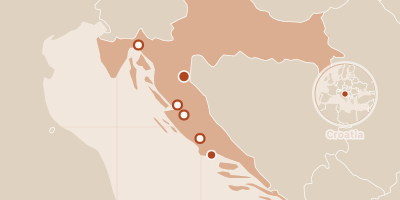
The Winnetou films of the 1960s are set in the Wild West but were shot in Croatia: the Silver Lake is Plitvice, the Apache pueblo stood above the Zrmanja canyon and Santa Fe is the town of Trogir.
This route follows three of the films (Der Schatz im Silbersee, Winnetou 1 and Winnetou 3, 1962 to 1965) from Plitvice and Paklenica to the Krka falls, Trogir and Mali Alan, where Winnetou dies. Most sets were torn down after filming, but the landscapes remain.
A Munich sightseeing route from Marienplatz and the Frauenkirche to the Residenz and Nymphenburg Palace, tracing six centuries of the city's Wittelsbach rulers, markets and churches.
The walk starts on the old market square, passes the cathedral, the Viktualienmarkt, the royal Residenz and the Theatine Church, then ends at the summer palace where King Ludwig II was born. Many buildings were rebuilt after World War II bombing.
Beethoven's life runs from Bonn, where he was born in 1770, to Vienna, where he lived from 1792, wrote the Eroica and the Fifth Symphony, and is buried in the Zentralfriedhof.
He was born in a small house on Bonngasse and moved to Vienna at 21. There he faced growing deafness, which he wrote about in the Heiligenstadt Testament in 1802, and composed in the Pasqualati House and the Theater an der Wien.
This route follows the composer from his Bonn birthplace through the Vienna addresses where his symphonies and Fidelio were written and first heard, to his grave and the 1845 Bonn monument.
Anne Frank wrote her diary in the Secret Annex at Prinsengracht 263 in Amsterdam, within sight of the Westerkerk tower. The route starts at the family's flat on the Merwedeplein, where she got the diary on her thirteenth birthday in 1942.
It follows the family from the Annex through the arrest of 4 August 1944 to Westerbork, Auschwitz-Birkenau and Bergen-Belsen, where Anne died in early 1945.
Good Bye, Lenin! is set in East Berlin and shot largely on Karl-Marx-Allee and around Alexanderplatz, where Alex hides the fall of East Germany from his coma-waking mother. Its famous flying Lenin statue was filmed on the avenue.
The route follows the plot through five places: the Kerners' flat on Berolinastraße, Alexanderplatz, the former Coca-Cola headquarters in Lichterfelde, Karl-Marx-Allee and the dacha in Finsterwalde. The flat's interiors were studio sets, so that pin is approximate.
Cut off from the rest of the country, Leningrad lived through the winter of 1941–42 on 125 grams of bread a day, half of it sawdust. This route follows the siege through the places that carried the city through: a fortress island, an ice road, a seed bank, a diary, a symphony.
It runs from the first day of the encirclement to the memorials that came after, and keeps to documented facts. Several stops are memorials: please visit with respect.
Daniel Craig's first Bond bleeds, loses at cards and gets his boss a dressing-down, and the film's geography plays tricks of its own: Montenegro is a Czech spa town, Madagascar is an abandoned building site in Nassau, and the House of Commons is a monastery library in Prague.
The route follows the film from the black-and-white opening in a Prague office block to the digger chase on a Bahamian building site, a Paradise Island resort, the casino and hotel of Karlovy Vary, the Lake Como villa where Bond recovers from poison, the Venetian palazzo that sinks with Vesper inside, and the Lake Como house where Bond finally gives his name. Two stops are hotels and one is a monastery library you can walk into; the digger site is now inside a military base.
In August 1914 France expels its German residents, and Karl is torn from his French wife Marie and their baby on a farm near Saint-Mihiel and drafted into the German army. Marie's father Emile is called up on the other side. Ubisoft Montpellier's hand-drawn 2014 game, made for the war's centenary, follows them, an American volunteer called Freddie, a Belgian nurse, Anna, and Walt the medic dog across four years of the Western Front.
The heroes are invented, but the battles are not, and every chapter is full of real objects and short historical notes. This route visits the places the story passes through, from the Marne in 1914 to the Chemin des Dames in 1917. Most are now memorials, museums or preserved battlefields.
The Grand Budapest Hotel's imaginary republic of Zubrowka is built from real Saxony: Görlitz's Art Nouveau department store as the lobby, Hainewalde and Waldenburg castles, Osterstein in Zwickau and Dresden's Zwinger. In Wes Anderson's comedy the concierge M. Gustave and his lobby boy Zero are caught up in a murder, a stolen painting and a war.
This route visits the real buildings: an empty Art Nouveau department store that became the hotel lobby, a shuttered concert hall, two castles that make up Madame D.'s estate, a former prison, the most beautiful dairy shop in the world and Dresden's baroque Zwinger. Zubrowka is fictional; these are the filming locations.