Two years after a pandemic turns millions of people into feral Freakers, outlaw biker Deacon St. John rides central Oregon as a drifter and bounty hunter. He believes his wife Sarah died when a NERO helicopter lifted her out of the outbreak — until he learns she was moved to a military outpost at Crater Lake.
Days Gone's Oregon is a compressed, renamed version of the real high desert: Bend becomes Farewell, Black Butte Ranch becomes Iron Butte Ranch, and the militia holds Crater Lake. The route follows Deacon's ride from the opening evacuation to the volcanic lake where the story ends, through the hot springs, small towns and logging country that Bend Studio used as its model.
In September 1978, an 18-year-old photographer named Reza Shirazi comes home to Tehran and is pulled into the last days before Black Friday. The developers built the game from interviews with forty Iranians who lived through the revolution and from photographs by Michel Setboun; the streets, the cinema hideout and the prison are real places, filled with a fictional cast.
This route follows the game's 1978 story in order, from a Hasanabad rooftop to the shooting at Jaleh Square, then ends in the Evin Prison interrogation that frames the whole game. It is a route through the city the game recreates, not a walking itinerary.
Age of Empires II follows Joan of Arc from a French army camp at Vaucouleurs to the stake at Rouen. The designers said they deferred to history wherever it did not interfere with gameplay, and the campaign's spine — Orléans, Patay, Reims, Paris — is close to the record. But the game also bends the story, placing Joan at a battle she missed and turning a failed assault on Paris into a betrayal. This route follows the campaign's stops in order and sets each one beside what the sources say happened there.
Lost Heaven, Illinois, never existed. The game's studio built it as a 1930s Chicago: an American city split by rivers, its downtown a wall of new skyscrapers, its West Side holding Italian and Chinese neighborhoods, its fortunes made on Prohibition bootlegging. The studio called Chicago of the 1920s and 1930s its real-world inspiration.
This route follows six real Chicago places that stand behind Lost Heaven's geography and mood: the river at Wolf Point, the elevated Loop, the Board of Trade, Taylor Street, Chinatown and a jazz club with Prohibition history. The pins mark real Chicago sites, not in-game locations; Lost Heaven is fictional and the game maps no district one-to-one onto the city.
The Driver series began in 1999 as a car-chase game and grew into a tour of real cities: Miami, Los Angeles and New York in the first game, Havana, Las Vegas and Rio de Janeiro in Driver 2, Nice and Istanbul in Driver 3, and a fictionalised San Francisco in the 2011 sequel. Tanner's undercover work runs from a Miami parking garage to a presidential car, a Rio climax beneath Christ the Redeemer and the Golden Gate Bridge.
This route follows the series city by city, from Ocean Drive's Art Deco hotels to the Las Vegas Strip and the Bosphorus. Some stops are city-level pins because the games recreate whole urban areas rather than single buildings; only Christ the Redeemer and the Golden Gate Bridge are pinned exactly.
Life is Strange is set on the Oregon coast and True Colors in Colorado: Arcadia Bay draws on Astoria and Garibaldi, Haven Springs on Idaho Springs and Georgetown. Max Caulfield comes home to a missing girl and a storm only she can see; Alex Chen arrives to meet the brother she barely knows, then stays to solve his death.
The route follows the games in order, from Cape Meares and the Oregon towns behind Arcadia Bay to Idaho Springs, Georgetown, Nederland and Marble, the Colorado towns behind Haven Springs.
In December 2021 private detective Takayuki Yagami comes to Isezaki Ijincho, a recreation of Yokohama's Isezakichō, to investigate bullying at Seiryo High School. The case grows into a murder inquiry that pulls him through the shopping street, Chinatown and the waterfront.
The route follows the game's Yokohama from Kannai Station, where Yagami and Masaharu Kaito arrive, along Isezaki Road, through the Chinatown meeting that starts the case, to Hamakita Park (the real Yamashita Park) and the Basha-kaidō drone races. The model blends Sakuragichō and Hinodechō with Isezakichō, so the map is no scale copy.
Test Drive Unlimited sent players around Oʻahu's 1,000 miles of roads in 2006; The Crew Motorfest returned to a scaled-down island in 2023, with a car-culture festival at its centre. Both treat the island as a stage, one for a free-roam lifestyle racer and the other for a themed racing playground.
This route follows a road-trip loop from Honolulu Airport through Waikiki, Diamond Head, Hanauma Bay and the North Shore to Haleʻiwa, then back south to Pearl Harbor. Pins mark the real places; the games shrink the island and invent some of the roads in between.
Horizon Zero Dawn and Forbidden West cross the American West from Colorado Springs and Denver to Yellowstone and drowned San Francisco. A thousand years after the old world fell to Faro's machines, Nora outcast Aloy travels to uncover what destroyed it.
This route follows both Horizon games from the red rocks above Colorado Springs to the drowned streets of San Francisco, pairing each stop with the real landmark behind it. Guerrilla compresses the map — in-game locations are not exactly where they are in the real world — so the pins mark real stand-ins, not exact game coordinates.
Akito wakes after a traffic crash in a Shibuya emptied by a masked occultist's fog, sharing his body with the spirit KK and able to see the Marebito that now fill the streets. Tango Gameworks built the district as a condensed, walkable stage rather than a straight copy, keeping landmarks, borrowing back streets and folding in a few districts from elsewhere in Tokyo.
The route follows the game from the scramble crossing and the station through Center Gai, Dōgenzaka and the 109 stand-in, then north to a borrowed Yanaka Ginza and across town to the Tokyo Tower finale. Pins mark the real places; the game's map moves some of them closer together.
In the spring of 1989, Henry leaves Boulder for a summer job as a fire lookout in Wyoming's Shoshone National Forest. His only company is Delilah, the voice on the other end of a walkie-talkie, until fireworks at a lake, a ransacked tower and a fenced research camp turn the job into a mystery.
The route follows the game's places and the real Wyoming behind them: the bar where Henry meets Julia, the Cody rodeo the characters talk about, the Shoshone forest still marked by the 1988 Yellowstone fires, and stand-ins for the fictional Two Forks tower, Jonesy Lake, Wapiti Station, Cave 452 and Thorofare Lookout.
Sean Devlin, an Irish race car driver, joins the French Resistance after the Nazis murder his best friend and turn occupied Paris black and white. Pandemic Studios' 2009 open-world game sends him across the city's landmarks on a campaign of sabotage and revenge, hunting the SS commander Kurt Dierker.
The five stops follow the landmarks the story uses, from the Arc de Triomphe and the Champs-Élysées to Notre-Dame, the Catacombs and the Eiffel Tower. Each carries the real occupation history of the site between 1940 and 1944, and what a visitor finds there today.
inFAMOUS 2 builds New Marais from real New Orleans: the French Quarter, Bayou St. John, Oak Alley, Fort Jackson and the Lower Ninth Ward. Cole MacGrath flees ruined Empire City to a Louisiana city ruled by the demagogue Joseph Bertrand and needs a scientist, a device and power cores to beat the Beast.
New Marais is Sucker Punch's New Orleans: a fictional city assembled from the French Quarter, above-ground cemeteries, plantation houses, a Civil War fort, the bayous and the flooded districts left by a hurricane. This route follows Cole's story through seven of those stand-ins, from the swamp where he lands to the cathedral tower where the game ends.
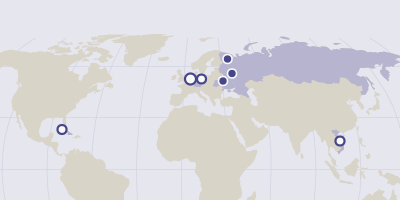
In January 1981 a CIA team led by Russell Adler hunts Perseus, a Soviet spy Adler believed dead. The trail runs from an Amsterdam bar and a Vietnam flashback to East Berlin, the KGB's Lubyanka and a Cuban firefight, before reaching the Solovetsky Islands. The route follows the campaign's real places in mission order and keeps the game's story apart from the real history of each place. A final stop marks the alternate ending at Duga.
Haikyu!! is set in Miyagi Prefecture, but its creator Haruichi Furudate grew up in Karumai, a small town in Iwate, and much of the manga's school and streetscape is drawn from it. Fans turned the town into a pilgrimage stop, and a town-made walking map marks the spots that "look just like" the story.
This route follows the real places behind Karasuno in story order: the electronics shop where Hinata first sees volleyball on television, the gymnasium where he loses to Kageyama and vows revenge, the school that became Karasuno High, the shop where coach Ukai minds the counter, the running-course slope, the supermarket behind Shimada Mart, the Sendai arena that hosts the Miyagi qualifiers, the junior high whose staircase became Shinzen High, and the diner behind the Karasuno canteen.
Thomas Cromwell rises from a Putney childhood to become Henry VIII's most trusted minister, then falls in the same Tudor politics he mastered. Hilary Mantel's trilogy follows him from Cardinal Wolsey's household through the Reformation, Anne Boleyn's rise and execution, and his own last years.
This route traces the places that anchor the story: Cromwell's birthplace and London house, Wolsey's palaces at York Place and Esher, the abbey where Wolsey died, Westminster Abbey for Anne's coronation, the Seymour seat that gives the novels their title, Hampton Court, and the Tower. The 2015 television adaptation used Dover Castle for the Tower of London and Penshurst Place for Whitehall.
Percy Jackson is a twelve-year-old boy in New York City who has just learned that the Greek gods are real — and that Zeus's master bolt is missing. With Annabeth and Grover, he has ten days to cross the country, find the bolt and reach the Underworld beneath Los Angeles before a war breaks out on Olympus.
Rick Riordan's 2005 novel turns real American landmarks into monster stops: the Metropolitan Museum of Art, a Montauk beach, the Gateway Arch, a Denver water park, a Las Vegas casino that eats time, the Santa Monica Pier and the Empire State Building. A Disney+ series adapted the story from December 2023 to January 2024.
The Banshees of Inisherin's island is fictional, but the film was shot on two real ones: Inishmore, where Pádraic's cottage and the cliffs stand in for it, and Achill, where the pub, the shop, the lake and Colm's house were found. In April 1923, Colm stops speaking to his oldest friend, Pádraic.
This route follows the film's story from Pádraic's cottage to Colm's beach. Because Inisherin does not exist, every pin marks a real filming location; the sets at Cloughmore and Purteen are gone, and Colm's cottage is a private home to be seen from outside.
Wim Wenders' Perfect Days follows Hirayama, a Tokyo toilet cleaner who keeps his days exactly the same: the same overalls, the same cassette tapes, the same sandwich under the trees. The city changes around him; he notices the light through the leaves.
This route follows the film's real Tokyo, from the old apartment east of the Sumida to four of the Tokyo Toilet project's designer facilities, the shrine bench where he eats lunch, the sento and Asakusa bar that fill his evenings, and the bridge where the story ends.
Where The Last Kingdom is set: Bamburgh Castle in Northumberland, Viking York, the Somerset marshes at Athelney and the battlefield at Edington, the real ground of Uhtred's wars. A Saxon boy raised by Danes, he fights for Alfred and against him, and each stop is set against what history records.
The television series adapts Bernard Cornwell's Saxon Stories; where a stop follows a particular novel or series, the point says so. The show was filmed mainly in Hungary, so the places below are the real settings of the events, not the filming locations.
Gereon Rath arrives from Cologne in 1929 to a Berlin of police headquarters, cabarets and armed conspiracies. The series follows him and Charlotte Ritter from the May Day riots through the fall of the Weimar Republic to Hitler's first weeks in power, mixing real streets with sets and stand-ins.
This route visits the places the story names and the buildings that played them: the Rotes Rathaus as the police headquarters, the real Moka Efti, the Anhalter goods yard, the Hermannplatz U-Bahn, a Duisburg steelworks, the Theater am Schiffbauerdamm, Schloss Drachenburg and the Volksbühne. Some stops are exact; others are stand-ins far from Berlin.
Wednesday Addams is sent to Nevermore Academy, a school for outcasts in the fictional Vermont town of Jericho. Netflix built that world in Romania: a castle above Bușteni, Bucharest interiors, a backlot town and a country mansion standing in for the Gates house. When season 2 moved production to Ireland in 2024, Nevermore gained a castle in County Offaly, a waterfall campsite and a Dublin cemetery. Much of the Irish shoot was based at Ashford Studios in County Wicklow.
This route follows the show's geography through the real places that played it, season by season. The pins mark filming locations, not invented Vermont addresses.
Crash Landing on You filmed its Swiss scenes on location at real places: Kleine Scheidegg, the piano pier on Lake Brienz, the Sigriswil gorge bridge and the First station above Grindelwald. Jeju's Ara-dong forest stands in for the North Korean DMZ, where a tornado carries the heiress Yoon Se-ri, and Ri Jeong-hyeok hides her as the two fall in love across the divided countries.
This route follows the story in episode order, from Se-ri's landing in a Jeju forest to the reunion above Grindelwald. Nothing was filmed in North Korea: the Pyongyang and Kaesong stations were played by Ulaanbaatar, and the DMZ scenes by several of Jeju's oreums.
Alice in Borderland begins with three friends running through Shibuya and ends with Arisu and Usagi fighting for the city itself. Between those points the series empties Tokyo, then lets it grow over. This route follows the real Shibuya landmarks the characters use — the scramble crossing, the Hachikō gate, Shibuya Stream, 109 and SHIBUYA SKY — and visits the two sets where the empty and overgrown city was built, in Ashikaga and Yokohama.
The story never leaves Tokyo; the production did. This route follows the Netflix series, not Haro Aso's manga, and each stop keeps the story place and its stand-in apart.