Assassin's Creed IV Black Flag sets its pirate Caribbean in Havana, Nassau, Kingston and Port Royal. Edward Kenway steals a dead Assassin's name, takes the Jackdaw, builds a brotherhood in Nassau, loses his friends and chases the Observatory, a device that can watch anyone on earth.
Black Flag sets all of it in real ports — Havana, Nassau, Kingston, Port Royal — and then leaves the Caribbean for the Maya ruins of Tulum, an island in the Gulf of Guinea and a final scene in London. The route follows Edward from the harbour where Torres's plot starts, through the pirate republic and the governor who ends it, to the Kingston house where Mary Read drops the disguise, the jail at Port Royal, Príncipe, where the Sage is waiting, and Covent Garden. Most stops mark a real landmark in the town the game rebuilds.
Troy has fallen. Aeneas, a Trojan prince, carries his old father out of the burning city and sets sail with the survivors to find the new homeland the gods have promised them. Virgil's Aeneid, written for Augustus in the 20s BC, follows years of wrong turns, storms and prophecies until the exiles land in Italy, where their descendants will one day found Rome.
This route follows the voyage in the order it happens, which is not the order Virgil tells it: the poem opens in Carthage and lets Aeneas recount the earlier wanderings to Queen Dido. Every stop is a real ancient site, most now open as archaeological parks; Aeneas himself belongs to legend. Quotations are from John Dryden's 1697 translation.
In August 1914 France expels its German residents, and Karl is torn from his French wife Marie and their baby on a farm near Saint-Mihiel and drafted into the German army. Marie's father Emile is called up on the other side. Ubisoft Montpellier's hand-drawn 2014 game, made for the war's centenary, follows them, an American volunteer called Freddie, a Belgian nurse, Anna, and Walt the medic dog across four years of the Western Front.
The heroes are invented, but the battles are not, and every chapter is full of real objects and short historical notes. This route visits the places the story passes through, from the Marne in 1914 to the Chemin des Dames in 1917. Most are now memorials, museums or preserved battlefields.
In December 1831 a 22-year-old Cambridge graduate with a passion for beetles and rocks sailed from Plymouth as an unpaid naturalist on HMS Beagle, a ten-gun survey brig. The voyage was meant to take two years and took five. Charles Darwin came home with crates of fossils, skins and notebooks — and with questions about the islands that would lead him, two decades later, to On the Origin of Species.
The route follows the ship around the world in order, using Darwin's own Journal of Researches for dates and details: the volcanic Cape Verde islands, the Brazilian forest, the fossil beds of Argentina, Tierra del Fuego, a great Chilean earthquake, the Galápagos, Cape Town and home to Falmouth.
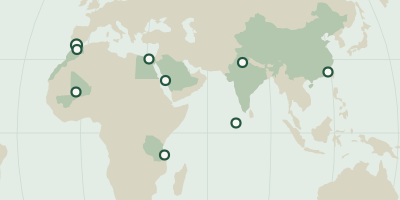
In June 1325 a 21-year-old law student left Tangier to make the pilgrimage to Mecca. He did not come home for 24 years. Ibn Battuta crossed the Islamic world and beyond — Arabia, East Africa, Anatolia, Central Asia, India, the Maldives, Sumatra and China — earning his keep as a judge and a guest of sultans, marrying and divorcing along the way. By some estimates he covered about 117,000 kilometres, more than any traveller before the age of steam.
Back in Morocco he dictated his memories, the Rihla, to a scholar who polished them and borrowed passages from older books, so not every scene was his own. The route picks out nine stops in the order he reached them; it is not one continuous road. There are no travel tips for Mecca or Mali.
In 1324 Mansa Musa, ruler of the Mali Empire, set out on the pilgrimage to Mecca with a caravan so rich in gold that Cairo talked about it for years. Arab chroniclers wrote of thousands of servants carrying gold bars and camels loaded with gold dust; historians today treat those numbers as a way of saying "more than anyone could imagine", not as a count. The Catalan Atlas of 1375 still shows him enthroned in the Sahara, holding up a piece of gold.
The route keeps to the places the sources actually record: the royal city of Mali, the camp below the pyramids, Cairo, Mecca, and Gao and Timbuktu on the way home. The road across the desert is not documented, so it is not drawn. The route offers no travel advice for Mali.
In 1791 Saint-Domingue was France's richest colony, a sugar and coffee economy worked by hundreds of thousands of enslaved Africans under brutal conditions. Thirteen years later it was Haiti, the first nation born from a successful slave revolt and the first independent Black-led state in the Americas. The cost was enormous: some 200,000 Black Haitians died, and tens of thousands of French and British soldiers, most of them from yellow fever.
The route follows the turning points, from the ceremony that tradition places at Bois Caïman to the declaration at Gonaïves, with a detour to the French mountain fortress where Toussaint Louverture died. Fighting was savage on all sides, and the texts say so plainly. The route offers no travel advice for Haiti.
Ifemelu and Obinze fall in love at secondary school in Lagos, in a Nigeria under military rule where everyone seems to be planning to leave. She gets a scholarship to Philadelphia; he, refused an American visa after 9/11, ends up working illegally in London. Over thirteen years in the United States Ifemelu discovers that she has become "black" — and writes a hit blog about it — before deciding to go home.
Chimamanda Ngozi Adichie's 2013 novel moves between real cities on three continents, and the route follows it in story order rather than in the book's flashback structure. Homes, salons and the university in Philadelphia are not identified, so most pins mark the city or campus.
In 218 BC the Carthaginian general Hannibal set out from Spain to attack Rome by the one route the Romans never expected: overland, across the Pyrenees, the Rhône and the Alps, with tens of thousands of soldiers, horses and 37 war elephants. Five months later he came down into the plain of the Po with a battered but unbeaten army, and within weeks had won his first two victories in Italy.
The route follows the march as told by the Greek historian Polybius, who wrote about seventy years later and walked the Alpine route himself. Nobody knows for certain where Hannibal crossed the Rhône or which pass he used, so several pins are marked speculative.