In December 1831 a 22-year-old Cambridge graduate with a passion for beetles and rocks sailed from Plymouth as an unpaid naturalist on HMS Beagle, a ten-gun survey brig. The voyage was meant to take two years and took five. Charles Darwin came home with crates of fossils, skins and notebooks — and with questions about the islands that would lead him, two decades later, to On the Origin of Species.
The route follows the ship around the world in order, using Darwin's own Journal of Researches for dates and details: the volcanic Cape Verde islands, the Brazilian forest, the fossil beds of Argentina, Tierra del Fuego, a great Chilean earthquake, the Galápagos, Cape Town and home to Falmouth.
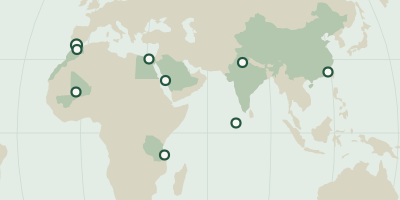
In June 1325 a 21-year-old law student left Tangier to make the pilgrimage to Mecca. He did not come home for 24 years. Ibn Battuta crossed the Islamic world and beyond — Arabia, East Africa, Anatolia, Central Asia, India, the Maldives, Sumatra and China — earning his keep as a judge and a guest of sultans, marrying and divorcing along the way. By some estimates he covered about 117,000 kilometres, more than any traveller before the age of steam.
Back in Morocco he dictated his memories, the Rihla, to a scholar who polished them and borrowed passages from older books, so not every scene was his own. The route picks out nine stops in the order he reached them; it is not one continuous road. There are no travel tips for Mecca or Mali.
In 218 BC the Carthaginian general Hannibal set out from Spain to attack Rome by the one route the Romans never expected: overland, across the Pyrenees, the Rhône and the Alps, with tens of thousands of soldiers, horses and 37 war elephants. Five months later he came down into the plain of the Po with a battered but unbeaten army, and within weeks had won his first two victories in Italy.
The route follows the march as told by the Greek historian Polybius, who wrote about seventy years later and walked the Alpine route himself. Nobody knows for certain where Hannibal crossed the Rhône or which pass he used, so several pins are marked speculative.