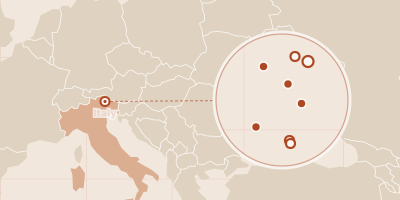
Un passo dal cielo, the Rai 1 series, is set in San Candido in South Tyrol and later in San Vito di Cadore in the Belluno Dolomites, but it was mostly filmed around Lago di Braies, Prato Piazza, Dobbiaco, Lago di Mosigo and Misurina.
This route follows the series from its South Tyrol seasons to its Cadore seasons, with eight places where scenes were set or shot. Where the sources only name a place, the pin marks the area.
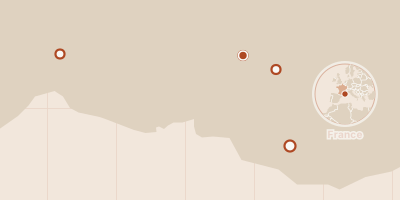
Jean de Florette was filmed around Riboux, Mirabeau and Vaugines, with market scenes in Sommières, for Claude Berri's 1986 adaptation of the Provence story.
The film follows Ugolin and his uncle Papet, who plug a spring to take over a neighbour's land, and the newcomer Jean de Florette, who farms without knowing it. The route runs from the farm of Les Romarins to the village church and bench; some stops are stand-ins for the story's places.
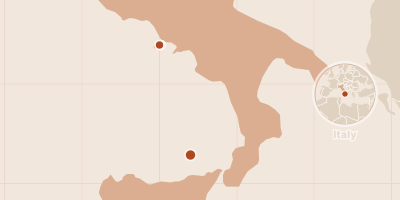
Il Postino (1994) was filmed on two islands: Procida in the Gulf of Naples, where Mario delivers Pablo Neruda's mail around Marina Corricella, Via San Rocco and Piazza dei Martiri, and Salina in the Aeolian Islands, whose Pollara bay hosts Neruda's house and a beach.
The film moves the story to Italy around 1950 and never names the island. This route follows the real places: the waterfront bar where Mario meets Beatrice, the village street, the post office square and the two beaches.
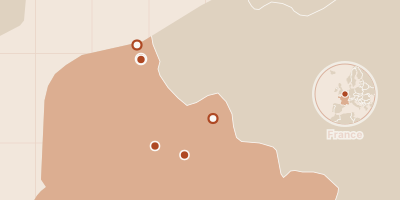
Welcome to the Sticks (Bienvenue chez les Ch'tis) is set in Bergues, near Dunkirk, and filmed there, with scenes in Lille, Lens, Malo-les-Bains and Bruay-la-Buissière.
A post-office manager from the south is sent north for two years and finds the warmest welcome of his life. The route follows the film from the café where Philippe crashes his bike to the belfry where the love story ends.
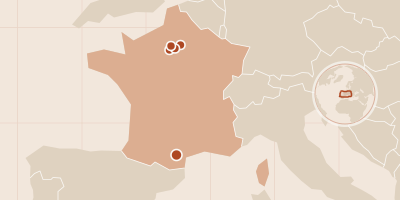
Les Visiteurs (1993) was filmed in Carcassonne, Thoiry, Ermenonville, Argenteuil and Vigny: the Château Comtal in the Cité de Carcassonne is the medieval castle, and the Château d'Ermenonville is Montmirail in the present day.
The route follows a 12th-century knight and his squire from 1123 to 1992, across five film locations, and notes where the film and the places differ.
Crazy Horse's story runs through six places: Fort Phil Kearny in Wyoming, the Rosebud and Little Bighorn battlefields in Montana, Fort Robinson in Nebraska, and the Crazy Horse Memorial in South Dakota. The Oglala Lakota war leader helped defeat the army from 1866 to 1876, then surrendered and was killed at Fort Robinson in 1877.
The route follows his campaigns in order, then turns to what remains: the burial legend near Wounded Knee Creek and the unfinished mountain carving that many Lakota oppose.
A Munich sightseeing route from Marienplatz and the Frauenkirche to the Residenz and Nymphenburg Palace, tracing six centuries of the city's Wittelsbach rulers, markets and churches.
The walk starts on the old market square, passes the cathedral, the Viktualienmarkt, the royal Residenz and the Theatine Church, then ends at the summer palace where King Ludwig II was born. Many buildings were rebuilt after World War II bombing.
Lourdes in the Pyrenees of France became a major pilgrimage town after Bernadette Soubirous reported 18 visions at the Grotto of Massabielle in 1858, and this route links the Boly mill, the Cachot, the grotto and the basilicas.
It follows Bernadette from her birthplace through the apparitions to the three basilicas and the church that grew around the grotto.
The visions are described as Bernadette reported them; the Church confirmed them in 1862.
Vauban's fortifications, a UNESCO World Heritage group, include the citadels of Lille and Besançon, the Mont-Louis citadel, the ramparts of Saint-Martin-de-Ré, Mont-Dauphin, Neuf-Brisach and the Asfeld Bridge at Briançon.
Louis XIV's military engineer drew a belt of strongholds around France. Each stop here is a place you can still walk through, and each shows a different way of making a border hard to cross.
Stops follow the date each fortress was begun. Some of them are still working towns, not just monuments.
Saint Paul's missionary journeys run from Paphos in Cyprus through Antioch of Pisidia, Philippi, Athens, Corinth and Ephesus to Malta and Rome, as told in the Acts of the Apostles.
The route follows Paul from his first journey with Barnabas to the shipwreck on Malta and his final years in Rome, with the ruins, hills and basilicas you can still visit.
Several spots, like the Areopagus and Paul's tomb, are traditional identifications, and each stop says how firm the evidence is.
Pablo Picasso was born in Málaga in 1881 and found his path in A Coruña, Barcelona, Madrid and Paris; the route visits his birthplace on Plaza de la Merced, Els Quatre Gats café, the Royal Academy of San Fernando and the Bateau-Lavoir in Montmartre.
It follows the young painter from his birth to the studio where he completed Les Demoiselles d'Avignon in 1907. Four of the five stops can still be seen today.
Vermeer's Delft is a short walk through the Dutch city where Johannes Vermeer was baptized, painted and was buried. The route runs from the Nieuwe Kerk and the Vermeer Centre to the Paardenmarkt, the Vlamingstraat of The Little Street, a view of the skyline from the south, and the Oude Kerk.
The stops follow his life, from baptism in 1632 and the guild in 1653 to the 1654 explosion and his burial in 1675. The exact site of The Little Street is still debated.
Rembrandt lived in Amsterdam from 1631 to his death in 1669, and his story runs from the Rembrandt House Museum and the Rijksmuseum's Night Watch to the Oude Kerk, Rozengracht, Westerkerk and Rembrandtplein.
The route follows the painter from the Jodenbreestraat house he bought in 1639, through his wife Saskia's burial, bankruptcy and the move to the Jordaan, to his rented grave in 1669. Several stops can still be visited today.
Elvis Presley's story runs from his birthplace in Tupelo, Mississippi, to Humes High School, Beale Street, Sun Studio, the Overton Park Shell and Graceland in Memphis, Tennessee.
The route follows him from a shotgun house in 1935 to the 1954 recording session and first paid concert that launched him, and the mansion he bought in 1957. Most stops can still be visited.
Beatles places in Liverpool and London: the church hall in Woolton where Lennon met McCartney, Penny Lane, Strawberry Field, the Cavern Club, the Savile Row rooftop and the Abbey Road zebra crossing.
The route follows the band from 1957 to 1969 in seven stops, from McCartney's family home in Allerton to the last public concert on a London roof and the cover photo of Abbey Road. Most stops can still be visited.
Tchaikovsky's life runs from his birthplace in Votkinsk through the School of Jurisprudence, the Saint Petersburg and Moscow conservatories, the Mariinsky Theatre and his house in Klin to his grave in Tikhvin Cemetery. Most of these places can still be visited.
The route follows the composer from his birth on 7 May 1840 to his death on 6 November 1893: childhood in Udmurtia, a civil-service training he gave up, music school, two opera premieres and the last symphony. The cause of his death is still debated, and the final stop says so.
Frédéric Chopin was born in Żelazowa Wola near Warsaw, lived in Warsaw until 1830, wintered on Mallorca, composed in Nohant and died in Paris; his body lies in Père Lachaise, his heart in Warsaw's Holy Cross Church.
This route follows the composer's life from his birthplace and the Warsaw home he left in 1830 to Valldemossa, Nohant, his last Paris apartment on Place Vendôme and the two resting places that split him between France and Poland.
Beethoven's life runs from Bonn, where he was born in 1770, to Vienna, where he lived from 1792, wrote the Eroica and the Fifth Symphony, and is buried in the Zentralfriedhof.
He was born in a small house on Bonngasse and moved to Vienna at 21. There he faced growing deafness, which he wrote about in the Heiligenstadt Testament in 1802, and composed in the Pasqualati House and the Theater an der Wien.
This route follows the composer from his Bonn birthplace through the Vienna addresses where his symphonies and Fidelio were written and first heard, to his grave and the 1845 Bonn monument.
Wyatt Earp's lawman years run from the cattle towns of Wichita and Dodge City, Kansas, to Tombstone, Arizona, where the gunfight at the O.K. Corral took place in 1881.
Earp wore a badge in Kansas, then followed his brothers to a silver boomtown. This route follows him from his first police job to the shootout, his brother Morgan's murder and the vendetta ride through Tucson, ending at his grave in Colma, California.
The real gunfight was not at the corral at all, and the stops say where it actually happened.
The Battle of Britain was fought over south-east England in 1940, and its places are still there: Dover, RAF Biggin Hill, RAF Kenley, RAF Hornchurch, RAF Tangmere and the underground Uxbridge bunker.
The route follows the summer of 1940 from the Dunkirk headquarters at Dover Castle through the Kent and Sussex fighter fields, which were bombed in August, to the operations room where Churchill watched 15 September. Many sites are now museums, parks or airports.
Pearl Harbor and Midway tell the Pacific war's first six months: the Japanese attack on Battleship Row and the USS Arizona Memorial in Hawaii on 7 December 1941, then the naval battle at Midway Atoll in June 1942 that sank four Japanese carriers.
The route runs from Ford Island and Hickam Field to the codebreakers of Station HYPO, the fighting at Midway and the wreck of USS Yorktown on the seabed. Pearl Harbor stops can be visited; Midway Atoll is remote and the Yorktown wreck lies on the deep seabed.
Boston's Freedom Trail is a 2.5-mile walking route past 16 sites of the American Revolution, from the State House and Old South Meeting House to Paul Revere's House, Old North Church and Bunker Hill.
This route covers nine stops in order: the Massachusetts State House, the Granary Burying Ground, the Tea Party meeting house, the Old State House, Faneuil Hall, Revere's home, the lanterns of Old North Church, USS Constitution and the Bunker Hill Monument.
Jamestown to Yorktown is the best-known stretch of Virginia's early American history: from the 1607 James Fort at Historic Jamestowne, via the Capitol in Williamsburg and St. John's Church in Richmond, to the Moore House and surrender field at Yorktown.
The route follows 174 years from England's first lasting colony to Cornwallis's surrender in 1781, with Patrick Henry's speeches along the way. Most stops can be visited; the Williamsburg Capitol is a reconstruction.
José Rizal, the Philippine national hero, was born in Calamba, exiled to Dapitan, imprisoned in Fort Santiago and shot at Bagumbayan, now Rizal Park in Manila, on 30 December 1896.
This route follows his life and death through six places: the reconstructed family house in Calamba, the shrine on his Dapitan estate, Fort Santiago in Intramuros, the execution ground at Luneta, his secret first grave at Paco Park and the monument that now holds his remains.