The Motorcycle Diaries follows Ernesto Guevara and Alberto Granado's 1952 journey from Buenos Aires across South America — Valparaíso, the Chuquicamata copper mine, Machu Picchu, the San Pablo leper colony on the Amazon — to Caracas. Their overloaded Norton died in Chile; the poverty they saw on the way changed Guevara.
Guevara's diary of the trip, published decades later as The Motorcycle Diaries, records how poverty, exploited miners and the lepers they worked with changed him; within a few years he was "Che", a leader of the Cuban Revolution. The route follows the journey from both men's accounts as summarised by historians.
In April 1947 the Norwegian Thor Heyerdahl and five companions pushed off from Peru on a raft of nine balsa logs, built in the style of old Spanish drawings of South American rafts. They meant to prove that ancient people could have drifted from South America to Polynesia. After 101 days and almost 7,000 kilometres on the open Pacific, they crashed onto a coral reef in the Tuamotus — and all six walked ashore.
The voyage became a bestselling book and an Oscar-winning documentary. Heyerdahl's theory, though, has not survived: archaeology, language and genetics show that Polynesians came from the west, from Island Southeast Asia, as master navigators. The route follows the raft from Callao to Tahiti.
Ida Pfeiffer's 1846–1848 journey around the world passed through Hamburg, the Brazilian forest, Tahiti and Baghdad, as her own book A Woman's Journey Round the World recounts. A 48-year-old Viennese widow with little money, she travelled mostly alone by cargo ship, horseback and caravan, and came home to a Vienna in revolution.
The route follows her first world journey in order, from her own book, A Woman's Journey Round the World: Hamburg, the Brazilian forest, Cape Horn and Valparaíso, Tahiti, Canton, Baghdad, Persia and home. There are no visitor tips for Iraq or Iran.
Xuanzang's search for the original Buddhist scriptures runs from Chang'an across the Taklamakan's edge, the Tian Shan and the Hindu Kush to the Buddhas of Bamiyan, then on to Taxila, Kashmir and Nalanda. The monk left in 629 despite a Tang ban on foreign travel, and his record inspired Journey to the West.
His travel record, the Great Tang Records on the Western Regions, is still a key source for the history of Central Asia and India, and his journey inspired the classic novel Journey to the West. The route follows him there and back. There are no travel tips for Afghanistan.
In December 1831 a 22-year-old Cambridge graduate with a passion for beetles and rocks sailed from Plymouth as an unpaid naturalist on HMS Beagle, a ten-gun survey brig. The voyage was meant to take two years and took five. Charles Darwin came home with crates of fossils, skins and notebooks — and with questions about the islands that would lead him, two decades later, to On the Origin of Species.
The route follows the ship around the world in order, using Darwin's own Journal of Researches for dates and details: the volcanic Cape Verde islands, the Brazilian forest, the fossil beds of Argentina, Tierra del Fuego, a great Chilean earthquake, the Galápagos, Cape Town and home to Falmouth.
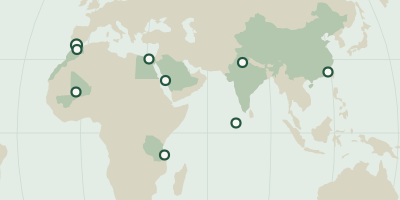
In June 1325 a 21-year-old law student left Tangier to make the pilgrimage to Mecca. He did not come home for 24 years. Ibn Battuta crossed the Islamic world and beyond — Arabia, East Africa, Anatolia, Central Asia, India, the Maldives, Sumatra and China — earning his keep as a judge and a guest of sultans, marrying and divorcing along the way. By some estimates he covered about 117,000 kilometres, more than any traveller before the age of steam.
Back in Morocco he dictated his memories, the Rihla, to a scholar who polished them and borrowed passages from older books, so not every scene was his own. The route picks out nine stops in the order he reached them; it is not one continuous road. There are no travel tips for Mecca or Mali.
In 1977 Robyn Davidson, then in her twenties, walked about 2,700 kilometres from Alice Springs to the Indian Ocean with four camels and her dog, crossing some of the emptiest desert on earth. She had spent two years in Alice Springs learning to train wild camels. She had no plan to write about it, but a National Geographic article and photographs by Rick Smolan made her famous, and her 1980 book Tracks became a classic, filmed in 2013.
The route follows her line west across the Northern Territory and Western Australia in order. Much of it crosses Aboriginal land, where she travelled with a Pitjantjatjara elder, Mr Eddie; pins mark communities and stations, not sacred sites.
In spring 1689 the poet Matsuo Bashō gave up his hut in Edo and set off on foot with his friend and disciple Kawai Sora into Oku, the remote north of Japan. For about 156 days and some 2,400 kilometres they walked to the places the old poets had made famous — a barrier gate, a bay of pine islands, a battlefield, a mountain temple — and Bashō answered them with haiku.
The travel diary he made of it, Oku no Hosomichi, published in 1702, is one of the classics of Japanese literature, and its stops are still pilgrimage sites. Bashō polished the facts for art; Sora's own diary shows where. Dates follow the old lunar calendar, so they are given here by season.
In November 1095 Pope Urban II, answering a Byzantine emperor's plea for help against the Seljuk Turks, called western Christians to an armed pilgrimage to Jerusalem. Tens of thousands answered — knights, foot soldiers and poor pilgrims. Their armies took separate roads to Constantinople, then marched together across Anatolia and Syria. Almost four years after the call, they stormed Jerusalem and massacred much of its population.
The route follows the main armies in order, from Clermont to Jerusalem, using the participants' own chronicles as summarised by modern historians. Violence against Jews in the Rhineland and against the people of the cities on the way is part of the story and is named plainly. There are no travel tips for Syria or the Lebanese border area.
On a Sunday evening in May 1857 Indian soldiers of the East India Company's army mutinied at Meerut and rode for Delhi. Within weeks much of northern India was in revolt — soldiers, princes dispossessed by the Company, and villagers with their own grievances. It took the British more than a year to crush it, and afterwards the Company itself was abolished and India placed under the Crown.
The rebellion goes by many names, from the Sepoy Mutiny to the First War of Independence. It was not one army on one road but a chain of uprisings, and the route visits its main centres in order: Meerut, Delhi, Kanpur, Lucknow, Jhansi, Kalpi and Gwalior. Both sides committed atrocities against civilians, and the texts name them plainly.
In October 1934 the Chinese Communists' main army, beaten by Chiang Kai-shek's Nationalists, broke out of its base in Jiangxi and fled west. A year and some 9,000 kilometres later, after river crossings under fire, snow passes and a high-altitude swamp, a few thousand survivors reached northern Shaanxi. On the way, Mao Zedong rose to lead the party, and the retreat became its founding legend.
The route follows the Central Red Army, the best-known of several Long March columns, in date order. Official histories have polished some episodes, and historians still argue about how much fighting there was at Luding Bridge; the texts note where accounts disagree. Most stops now have memorials and museums.
In 1324 Mansa Musa, ruler of the Mali Empire, set out on the pilgrimage to Mecca with a caravan so rich in gold that Cairo talked about it for years. Arab chroniclers wrote of thousands of servants carrying gold bars and camels loaded with gold dust; historians today treat those numbers as a way of saying "more than anyone could imagine", not as a count. The Catalan Atlas of 1375 still shows him enthroned in the Sahara, holding up a piece of gold.
The route keeps to the places the sources actually record: the royal city of Mali, the camp below the pyramids, Cairo, Mecca, and Gao and Timbuktu on the way home. The road across the desert is not documented, so it is not drawn. The route offers no travel advice for Mali.
The Boshin War ran from Kyoto to Hakodate in eighteen months: the battlefield at Toba, Edo Castle, the hill of Ueno, Aizu's castle and Goryōkaku. In January 1868 the young emperor was declared ruler in fact as well as name, ending more than 250 years of Tokugawa rule, and the last shogun's supporters fought on until a breakaway republic made its last stand.
The route follows that war in six places, all of them visitable: the battlefield at Toba, Edo Castle, the hill of Ueno, Aizu's castle and the hill where its teenage soldiers died, and Goryōkaku. Dates are given in the Western calendar, converted from the Japanese lunar dates used at the time.
In 1791 Saint-Domingue was France's richest colony, a sugar and coffee economy worked by hundreds of thousands of enslaved Africans under brutal conditions. Thirteen years later it was Haiti, the first nation born from a successful slave revolt and the first independent Black-led state in the Americas. The cost was enormous: some 200,000 Black Haitians died, and tens of thousands of French and British soldiers, most of them from yellow fever.
The route follows the turning points, from the ceremony that tradition places at Bois Caïman to the declaration at Gonaïves, with a detour to the French mountain fortress where Toussaint Louverture died. Fighting was savage on all sides, and the texts say so plainly. The route offers no travel advice for Haiti.
On 12 March 1930 Mahatma Gandhi, aged 60, walked out of his ashram in Ahmedabad with 78 followers, heading for the sea. His target was the British monopoly on salt, a tax that touched every Indian household. Twenty-four days and about 385 kilometres later, on a beach at Dandi, he picked up a lump of salty mud and broke the law — and millions followed.
The route follows the march south through Gujarat in its real order, with the dates from the day-by-day itinerary: the ashram, the first night's halt, the Kheda country, Borsad, Surat and Dandi, where a memorial now stands. The final stop covers what came next: Gandhi's arrest and the beatings at the Dharasana salt works that shocked the world.
In 1989 communist rule in Central and Eastern Europe came apart in a few months — through round-table talks in Poland, a picnic on the Hungarian border, candlelit marches in Leipzig, a muddled press conference in Berlin, students in Prague and a bloody uprising in Romania. Each country had its own causes, but every crack made the next one easier.
The route visits the exact places where it happened, most of them marked today by a memorial, a museum or a plaque: the shipyard gate where Solidarity was born, the palace of the Round Table, the old border road near Sopron, the church in Leipzig, the bridge at Bornholmer Straße, a street corner in Prague, a pastor's flat in Timișoara and the balcony in Bucharest.
The Grand Budapest Hotel's imaginary republic of Zubrowka is built from real Saxony: Görlitz's Art Nouveau department store as the lobby, Hainewalde and Waldenburg castles, Osterstein in Zwickau and Dresden's Zwinger. In Wes Anderson's comedy the concierge M. Gustave and his lobby boy Zero are caught up in a murder, a stolen painting and a war.
This route visits the real buildings: an empty Art Nouveau department store that became the hotel lobby, a shuttered concert hall, two castles that make up Madame D.'s estate, a former prison, the most beautiful dairy shop in the world and Dresden's baroque Zwinger. Zubrowka is fictional; these are the filming locations.
Exit West sends Saeed and Nadia through magic doors from a city at war to a tent camp on Mykonos, an empty mansion in Kensington, London, and Marin County, north of San Francisco. Mohsin Hamid's 2017 novel skips the refugees' dangerous journeys and keeps only the arrivals.
The doors are magic, but Hamid calls the book "geographically autobiographical": every stop is a place he has lived in or loved. The home city is never named, though he says it was based in many ways on Lahore, so that pin is speculative.
John Buchan's The Thirty-Nine Steps sends Richard Hannay from a flat behind London's Langham Place onto the 7.10 from St Pancras and north to Galloway's Cairnsmore of Fleet and the spa town of Moffat, while a German spy ring hunts him. Hannay has three weeks to survive before he can warn the government. The title comes from a real stair in Broadstairs: 78 steps, not 39.
This is John Buchan's 1915 novel, not Hitchcock's very different film. London, St Pancras, Cairnsmore of Fleet and Moffat are named in the book; Hannay's hiding places on the moors and the Kent resort of Bradgate are not real, but the steps that gave the book its title are.
Barcelona, 1945. A bookseller leads his ten-year-old son Daniel through a dark alley off the Ramblas to the Cemetery of Forgotten Books, a secret library where every child may adopt one book. Daniel chooses a novel by Julián Carax — and discovers that someone has spent years hunting down and burning every other copy.
Carlos Ruiz Zafón's 2001 bestseller is a love letter to the old city, and its mystery runs through real streets: the Ramblas, the Gothic Quarter, the Ribera, Tibidabo and Montjuïc. The library, the bookshop, the hospice and the Aldaya mansion are invented, so those pins mark the streets where Zafón put them; the café, squares and castle are real and open to visitors.
Ifemelu and Obinze fall in love at secondary school in Lagos, in a Nigeria under military rule where everyone seems to be planning to leave. She gets a scholarship to Philadelphia; he, refused an American visa after 9/11, ends up working illegally in London. Over thirteen years in the United States Ifemelu discovers that she has become "black" — and writes a hit blog about it — before deciding to go home.
Chimamanda Ngozi Adichie's 2013 novel moves between real cities on three continents, and the route follows it in story order rather than in the book's flashback structure. Homes, salons and the university in Philadelphia are not identified, so most pins mark the city or campus.
In 1970s Kabul, Amir, the son of a rich merchant, and Hassan, the son of his father's Hazara servant, grow up as near-brothers and fly fighting kites together. In the winter of 1975 Amir wins the city's kite tournament — and fails Hassan at the moment Hassan needs him most. War sends Amir into exile in California; a phone call from Peshawar a quarter of a century later sends him back into Taliban Kabul to make amends.
Khaled Hosseini's 2003 debut follows real places in Afghanistan, Pakistan and California. Homes and alleys in the story are not identified, so those pins mark neighbourhoods; the route offers no travel advice for Afghanistan or Peshawar.
In May 1863 a Hamburg professor of mineralogy decodes a 300-year-old note in runes: go down the crater of Snæfell in Iceland and you will reach the centre of the Earth. Within days he drags his reluctant nephew Axel north by train, steamer and schooner, hires a silent Icelandic guide named Hans and climbs into the volcano.
Verne sets up the impossible with a timetable you could almost follow today — Altona station, Kiel, Copenhagen, Reykjavík, the hamlet of Stapi below the glacier. What happens underground is pure fiction, but the way out is real: three months later the travellers are spat out of Stromboli, an island volcano off Sicily, more than 3,000 km from where they went in.
Dracula crosses Transylvania's Borgo Pass and Whitby's harbour, steps and churchyard, then Purfleet on the Thames and London Zoo. A young English solicitor becomes the Count's prisoner; Dracula ships himself to England in fifty boxes of earth and is hunted back to his mountains by Van Helsing's band.
Stoker never visited Transylvania; he built its geography from books and maps, and the English half from places he knew. The route follows the novel's diaries and letters stop by stop: the inn at Bistritz, the Borgo Pass, the Black Sea port of Varna, the harbour, steps and churchyard of Whitby, Purfleet on the Thames, London Zoo and the final race up the Danube at Galatz.