In 1977 Robyn Davidson, then in her twenties, walked about 2,700 kilometres from Alice Springs to the Indian Ocean with four camels and her dog, crossing some of the emptiest desert on earth. She had spent two years in Alice Springs learning to train wild camels. She had no plan to write about it, but a National Geographic article and photographs by Rick Smolan made her famous, and her 1980 book Tracks became a classic, filmed in 2013.
The route follows her line west across the Northern Territory and Western Australia in order. Much of it crosses Aboriginal land, where she travelled with a Pitjantjatjara elder, Mr Eddie; pins mark communities and stations, not sacred sites.
In spring 1689 the poet Matsuo Bashō gave up his hut in Edo and set off on foot with his friend and disciple Kawai Sora into Oku, the remote north of Japan. For about 156 days and some 2,400 kilometres they walked to the places the old poets had made famous — a barrier gate, a bay of pine islands, a battlefield, a mountain temple — and Bashō answered them with haiku.
The travel diary he made of it, Oku no Hosomichi, published in 1702, is one of the classics of Japanese literature, and its stops are still pilgrimage sites. Bashō polished the facts for art; Sora's own diary shows where. Dates follow the old lunar calendar, so they are given here by season.
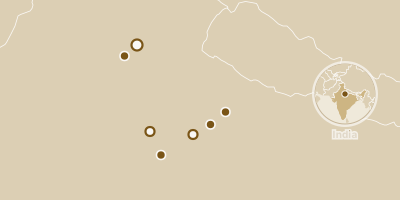
On a Sunday evening in May 1857 Indian soldiers of the East India Company's army mutinied at Meerut and rode for Delhi. Within weeks much of northern India was in revolt — soldiers, princes dispossessed by the Company, and villagers with their own grievances. It took the British more than a year to crush it, and afterwards the Company itself was abolished and India placed under the Crown.
The rebellion goes by many names, from the Sepoy Mutiny to the First War of Independence. It was not one army on one road but a chain of uprisings, and the route visits its main centres in order: Meerut, Delhi, Kanpur, Lucknow, Jhansi, Kalpi and Gwalior. Both sides committed atrocities against civilians, and the texts name them plainly.
On 12 March 1930 Mahatma Gandhi, aged 60, walked out of his ashram in Ahmedabad with 78 followers, heading for the sea. His target was the British monopoly on salt, a tax that touched every Indian household. Twenty-four days and about 385 kilometres later, on a beach at Dandi, he picked up a lump of salty mud and broke the law — and millions followed.
The route follows the march south through Gujarat in its real order, with the dates from the day-by-day itinerary: the ashram, the first night's halt, the Kheda country, Borsad, Surat and Dandi, where a memorial now stands. The final stop covers what came next: Gandhi's arrest and the beatings at the Dharasana salt works that shocked the world.
Barcelona, 1945. A bookseller leads his ten-year-old son Daniel through a dark alley off the Ramblas to the Cemetery of Forgotten Books, a secret library where every child may adopt one book. Daniel chooses a novel by Julián Carax — and discovers that someone has spent years hunting down and burning every other copy.
Carlos Ruiz Zafón's 2001 bestseller is a love letter to the old city, and its mystery runs through real streets: the Ramblas, the Gothic Quarter, the Ribera, Tibidabo and Montjuïc. The library, the bookshop, the hospice and the Aldaya mansion are invented, so those pins mark the streets where Zafón put them; the café, squares and castle are real and open to visitors.
Jake Barnes, an American newspaperman wounded in the war, spends his Paris nights in the cafés of Montparnasse with Lady Brett Ashley — the woman he loves and cannot have. Then the whole crowd heads south: trout fishing in the Pyrenees, then a week of San Fermín in Pamplona, where drink, jealousy and a nineteen-year-old matador break everything open.
Hemingway built the novel from his own trips of 1924 and 1925, and almost every stop can still be visited: the café on the Boulevard du Montparnasse, the inn at Burguete, the arcade café on Pamplona's main square, the bullring, the beach at San Sebastián and the Madrid restaurant where the book's last meal is eaten.
Peter Jackson shot all three Lord of the Rings films at once, in 438 days between October 1999 and December 2000, at more than 150 locations across New Zealand's North and South Islands. Farmland became the Shire, a regional park became Rivendell, a lonely hill in Canterbury became the capital of Rohan, and a volcano in Tongariro National Park stood in for Mount Doom.
This route follows Frodo's story through eight of those places, most of them easy to visit. Some sets were rebuilt for visitors; others were removed and the land returned to how it was. The mountains of Tongariro are sacred to local Māori, so please admire the summits from below.
Before the Minotaur, there was the road. Theseus grew up in Troezen, never knowing his father; when he was old enough to lift a great stone and take the sword and sandals hidden beneath it, he set out to find him in Athens. The safe way was by sea. He chose the coast road round the Saronic Gulf instead, which was infested with bandits, and dealt with each one in the way they had treated travellers.
The route follows the six labours of that journey as Plutarch tells them in his Life of Theseus, written around AD 100 from much older tales. The places are real; the giants and robbers belong to myth, and several sites are traditional guesses.
After ten years at Troy, Odysseus sets sail for his island home of Ithaca and takes another ten to get there: blown off course, he meets a man-eating Cyclops, a witch who turns his crew into pigs, the Sirens, Scylla and Charybdis and a nymph who will not let him go, losing every ship and every companion on the way. Homer's Odyssey, composed around the late 8th century BC, has been read as a map for as long as it has been read.
Already in antiquity the poem's places were linked to real coasts, mostly around Sicily and southern Italy. Those identifications are traditions, not facts, and the ancient geographer Eratosthenes doubted them all — so most pins here are marked speculative.