In April 1947 the Norwegian Thor Heyerdahl and five companions pushed off from Peru on a raft of nine balsa logs, built in the style of old Spanish drawings of South American rafts. They meant to prove that ancient people could have drifted from South America to Polynesia. After 101 days and almost 7,000 kilometres on the open Pacific, they crashed onto a coral reef in the Tuamotus — and all six walked ashore.
The voyage became a bestselling book and an Oscar-winning documentary. Heyerdahl's theory, though, has not survived: archaeology, language and genetics show that Polynesians came from the west, from Island Southeast Asia, as master navigators. The route follows the raft from Callao to Tahiti.
Xuanzang's search for the original Buddhist scriptures runs from Chang'an across the Taklamakan's edge, the Tian Shan and the Hindu Kush to the Buddhas of Bamiyan, then on to Taxila, Kashmir and Nalanda. The monk left in 629 despite a Tang ban on foreign travel, and his record inspired Journey to the West.
His travel record, the Great Tang Records on the Western Regions, is still a key source for the history of Central Asia and India, and his journey inspired the classic novel Journey to the West. The route follows him there and back. There are no travel tips for Afghanistan.
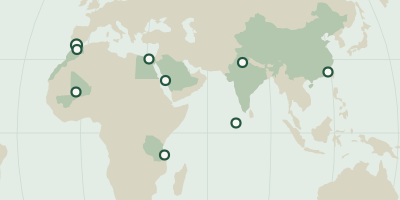
In June 1325 a 21-year-old law student left Tangier to make the pilgrimage to Mecca. He did not come home for 24 years. Ibn Battuta crossed the Islamic world and beyond — Arabia, East Africa, Anatolia, Central Asia, India, the Maldives, Sumatra and China — earning his keep as a judge and a guest of sultans, marrying and divorcing along the way. By some estimates he covered about 117,000 kilometres, more than any traveller before the age of steam.
Back in Morocco he dictated his memories, the Rihla, to a scholar who polished them and borrowed passages from older books, so not every scene was his own. The route picks out nine stops in the order he reached them; it is not one continuous road. There are no travel tips for Mecca or Mali.
In 1324 Mansa Musa, ruler of the Mali Empire, set out on the pilgrimage to Mecca with a caravan so rich in gold that Cairo talked about it for years. Arab chroniclers wrote of thousands of servants carrying gold bars and camels loaded with gold dust; historians today treat those numbers as a way of saying "more than anyone could imagine", not as a count. The Catalan Atlas of 1375 still shows him enthroned in the Sahara, holding up a piece of gold.
The route keeps to the places the sources actually record: the royal city of Mali, the camp below the pyramids, Cairo, Mecca, and Gao and Timbuktu on the way home. The road across the desert is not documented, so it is not drawn. The route offers no travel advice for Mali.
In 1989 communist rule in Central and Eastern Europe came apart in a few months — through round-table talks in Poland, a picnic on the Hungarian border, candlelit marches in Leipzig, a muddled press conference in Berlin, students in Prague and a bloody uprising in Romania. Each country had its own causes, but every crack made the next one easier.
The route visits the exact places where it happened, most of them marked today by a memorial, a museum or a plaque: the shipyard gate where Solidarity was born, the palace of the Round Table, the old border road near Sopron, the church in Leipzig, the bridge at Bornholmer Straße, a street corner in Prague, a pastor's flat in Timișoara and the balcony in Bucharest.
Ifemelu and Obinze fall in love at secondary school in Lagos, in a Nigeria under military rule where everyone seems to be planning to leave. She gets a scholarship to Philadelphia; he, refused an American visa after 9/11, ends up working illegally in London. Over thirteen years in the United States Ifemelu discovers that she has become "black" — and writes a hit blog about it — before deciding to go home.
Chimamanda Ngozi Adichie's 2013 novel moves between real cities on three continents, and the route follows it in story order rather than in the book's flashback structure. Homes, salons and the university in Philadelphia are not identified, so most pins mark the city or campus.
In 1970s Kabul, Amir, the son of a rich merchant, and Hassan, the son of his father's Hazara servant, grow up as near-brothers and fly fighting kites together. In the winter of 1975 Amir wins the city's kite tournament — and fails Hassan at the moment Hassan needs him most. War sends Amir into exile in California; a phone call from Peshawar a quarter of a century later sends him back into Taliban Kabul to make amends.
Khaled Hosseini's 2003 debut follows real places in Afghanistan, Pakistan and California. Homes and alleys in the story are not identified, so those pins mark neighbourhoods; the route offers no travel advice for Afghanistan or Peshawar.
The Oregon Trail follows real landmarks of the 2,170-mile trail: Independence, Missouri, Chimney Rock in Nebraska, Independence Rock in Wyoming and Oregon City at the end. Three student teachers in Minneapolis wrote it in 1971; the 1985 Apple II version, set in 1848, made buying oxen, fording rivers and dying of dysentery a classroom staple, and the series has sold more than 65 million copies.
The route follows the game's stops from Missouri to the Willamette Valley, with what stands at each place today.