Ernest Shackleton set out in 1914 to cross Antarctica on foot. He never even landed. His ship, Endurance, was trapped in the pack ice of the Weddell Sea, drifted for ten months and was crushed and sunk, leaving 28 men on the ice with three lifeboats. What followed — months on drifting floes, a landing on Elephant Island, an 800-mile voyage in an open boat and a march across the mountains of South Georgia — ended with every one of them coming home alive.
The route follows that escape from South Georgia to the wreck and back, with dates from Shackleton's own account, South. Most of these places can only be reached by expedition ship.
In 218 BC the Carthaginian general Hannibal set out from Spain to attack Rome by the one route the Romans never expected: overland, across the Pyrenees, the Rhône and the Alps, with tens of thousands of soldiers, horses and 37 war elephants. Five months later he came down into the plain of the Po with a battered but unbeaten army, and within weeks had won his first two victories in Italy.
The route follows the march as told by the Greek historian Polybius, who wrote about seventy years later and walked the Alpine route himself. Nobody knows for certain where Hannibal crossed the Rhône or which pass he used, so several pins are marked speculative.
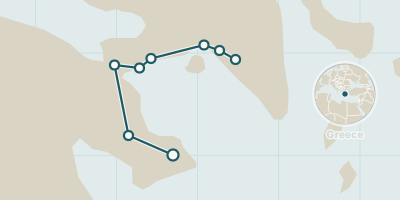
Before the Minotaur, there was the road. Theseus grew up in Troezen, never knowing his father; when he was old enough to lift a great stone and take the sword and sandals hidden beneath it, he set out to find him in Athens. The safe way was by sea. He chose the coast road round the Saronic Gulf instead, which was infested with bandits, and dealt with each one in the way they had treated travellers.
The route follows the six labours of that journey as Plutarch tells them in his Life of Theseus, written around AD 100 from much older tales. The places are real; the giants and robbers belong to myth, and several sites are traditional guesses.