In December 1831 a 22-year-old Cambridge graduate with a passion for beetles and rocks sailed from Plymouth as an unpaid naturalist on HMS Beagle, a ten-gun survey brig. The voyage was meant to take two years and took five. Charles Darwin came home with crates of fossils, skins and notebooks — and with questions about the islands that would lead him, two decades later, to On the Origin of Species.
The route follows the ship around the world in order, using Darwin's own Journal of Researches for dates and details: the volcanic Cape Verde islands, the Brazilian forest, the fossil beds of Argentina, Tierra del Fuego, a great Chilean earthquake, the Galápagos, Cape Town and home to Falmouth.
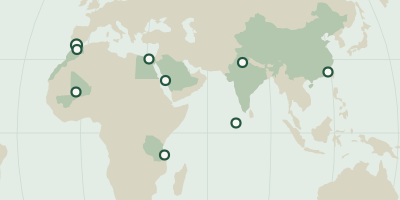
In June 1325 a 21-year-old law student left Tangier to make the pilgrimage to Mecca. He did not come home for 24 years. Ibn Battuta crossed the Islamic world and beyond — Arabia, East Africa, Anatolia, Central Asia, India, the Maldives, Sumatra and China — earning his keep as a judge and a guest of sultans, marrying and divorcing along the way. By some estimates he covered about 117,000 kilometres, more than any traveller before the age of steam.
Back in Morocco he dictated his memories, the Rihla, to a scholar who polished them and borrowed passages from older books, so not every scene was his own. The route picks out nine stops in the order he reached them; it is not one continuous road. There are no travel tips for Mecca or Mali.
In spring 1689 the poet Matsuo Bashō gave up his hut in Edo and set off on foot with his friend and disciple Kawai Sora into Oku, the remote north of Japan. For about 156 days and some 2,400 kilometres they walked to the places the old poets had made famous — a barrier gate, a bay of pine islands, a battlefield, a mountain temple — and Bashō answered them with haiku.
The travel diary he made of it, Oku no Hosomichi, published in 1702, is one of the classics of Japanese literature, and its stops are still pilgrimage sites. Bashō polished the facts for art; Sora's own diary shows where. Dates follow the old lunar calendar, so they are given here by season.
In November 1095 Pope Urban II, answering a Byzantine emperor's plea for help against the Seljuk Turks, called western Christians to an armed pilgrimage to Jerusalem. Tens of thousands answered — knights, foot soldiers and poor pilgrims. Their armies took separate roads to Constantinople, then marched together across Anatolia and Syria. Almost four years after the call, they stormed Jerusalem and massacred much of its population.
The route follows the main armies in order, from Clermont to Jerusalem, using the participants' own chronicles as summarised by modern historians. Violence against Jews in the Rhineland and against the people of the cities on the way is part of the story and is named plainly. There are no travel tips for Syria or the Lebanese border area.
In 1324 Mansa Musa, ruler of the Mali Empire, set out on the pilgrimage to Mecca with a caravan so rich in gold that Cairo talked about it for years. Arab chroniclers wrote of thousands of servants carrying gold bars and camels loaded with gold dust; historians today treat those numbers as a way of saying "more than anyone could imagine", not as a count. The Catalan Atlas of 1375 still shows him enthroned in the Sahara, holding up a piece of gold.
The route keeps to the places the sources actually record: the royal city of Mali, the camp below the pyramids, Cairo, Mecca, and Gao and Timbuktu on the way home. The road across the desert is not documented, so it is not drawn. The route offers no travel advice for Mali.
John Buchan's The Thirty-Nine Steps sends Richard Hannay from a flat behind London's Langham Place onto the 7.10 from St Pancras and north to Galloway's Cairnsmore of Fleet and the spa town of Moffat, while a German spy ring hunts him. Hannay has three weeks to survive before he can warn the government. The title comes from a real stair in Broadstairs: 78 steps, not 39.
This is John Buchan's 1915 novel, not Hitchcock's very different film. London, St Pancras, Cairnsmore of Fleet and Moffat are named in the book; Hannay's hiding places on the moors and the Kent resort of Bradgate are not real, but the steps that gave the book its title are.
In 1970s Kabul, Amir, the son of a rich merchant, and Hassan, the son of his father's Hazara servant, grow up as near-brothers and fly fighting kites together. In the winter of 1975 Amir wins the city's kite tournament — and fails Hassan at the moment Hassan needs him most. War sends Amir into exile in California; a phone call from Peshawar a quarter of a century later sends him back into Taliban Kabul to make amends.
Khaled Hosseini's 2003 debut follows real places in Afghanistan, Pakistan and California. Homes and alleys in the story are not identified, so those pins mark neighbourhoods; the route offers no travel advice for Afghanistan or Peshawar.
In May 1863 a Hamburg professor of mineralogy decodes a 300-year-old note in runes: go down the crater of Snæfell in Iceland and you will reach the centre of the Earth. Within days he drags his reluctant nephew Axel north by train, steamer and schooner, hires a silent Icelandic guide named Hans and climbs into the volcano.
Verne sets up the impossible with a timetable you could almost follow today — Altona station, Kiel, Copenhagen, Reykjavík, the hamlet of Stapi below the glacier. What happens underground is pure fiction, but the way out is real: three months later the travellers are spat out of Stromboli, an island volcano off Sicily, more than 3,000 km from where they went in.
In 218 BC the Carthaginian general Hannibal set out from Spain to attack Rome by the one route the Romans never expected: overland, across the Pyrenees, the Rhône and the Alps, with tens of thousands of soldiers, horses and 37 war elephants. Five months later he came down into the plain of the Po with a battered but unbeaten army, and within weeks had won his first two victories in Italy.
The route follows the march as told by the Greek historian Polybius, who wrote about seventy years later and walked the Alpine route himself. Nobody knows for certain where Hannibal crossed the Rhône or which pass he used, so several pins are marked speculative.
Before the Minotaur, there was the road. Theseus grew up in Troezen, never knowing his father; when he was old enough to lift a great stone and take the sword and sandals hidden beneath it, he set out to find him in Athens. The safe way was by sea. He chose the coast road round the Saronic Gulf instead, which was infested with bandits, and dealt with each one in the way they had treated travellers.
The route follows the six labours of that journey as Plutarch tells them in his Life of Theseus, written around AD 100 from much older tales. The places are real; the giants and robbers belong to myth, and several sites are traditional guesses.
After ten years at Troy, Odysseus sets sail for his island home of Ithaca and takes another ten to get there: blown off course, he meets a man-eating Cyclops, a witch who turns his crew into pigs, the Sirens, Scylla and Charybdis and a nymph who will not let him go, losing every ship and every companion on the way. Homer's Odyssey, composed around the late 8th century BC, has been read as a map for as long as it has been read.
Already in antiquity the poem's places were linked to real coasts, mostly around Sicily and southern Italy. Those identifications are traditions, not facts, and the ancient geographer Eratosthenes doubted them all — so most pins here are marked speculative.
Alexander the Great's route runs from Troy and the Granicus in Turkey to Tyre, Alexandria and Persepolis, and on to the Jhelum in the Punjab. He crossed into Asia at 22, and eleven years later died in Babylon at 32, his empire stretching from Greece to India.
The route follows the campaign through its turning points, with Arrian's Anabasis, written four centuries later from earlier accounts, as the main guide. Several battlefields can only be placed approximately; their pins are marked as such.
Between 1947 and 1950 Sal Paradise, a young writer from New Jersey, crosses America again and again — hitchhiking, by bus and in borrowed cars — usually in pursuit of his wild, magnetic friend Dean Moriarty. Jack Kerouac typed the story on a continuous scroll of paper in three weeks in April 1951, and it was published in 1957. Sal is Kerouac, Dean is Neal Cassady, and most of the trips really happened.
The route picks out the places the novel names, from a rainy false start on the Hudson to Mexico City and back to a New York street corner. The novel gives towns and streets rather than addresses, so most pins mark areas, not doors.