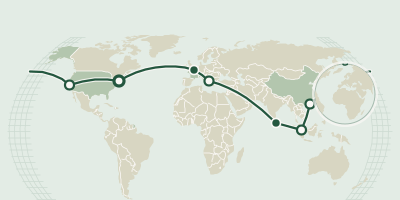
In 1888 Nellie Bly, the star reporter of Joseph Pulitzer's New York World, proposed turning Jules Verne's Around the World in Eighty Days into fact. On 14 November 1889, with two days' notice and as little luggage as she could manage, she sailed from Hoboken to beat Phileas Fogg's fictional record. She came home 72 days, 6 hours and 11 minutes later, a world record — briefly — and a celebrity, while the World's readers guessed her arrival time to the second.
The route follows her book of 1890, stop by stop, with the dates from her own record. She went east by steamer and train, through the Suez Canal and the British ports of Asia.
The Supreme Court had ruled that segregated waiting rooms and lunch counters in terminals serving interstate buses were illegal, but across the Deep South the "whites only" signs stayed up. On 4 May 1961 thirteen volunteers of the Congress of Racial Equality, black and white together, set out from Washington, D.C., on two buses to test the ruling all the way to New Orleans. In Alabama they were met by mobs, a burning bus and police who looked away; hundreds more riders followed them into the jails of Mississippi.
The route follows the rides through the places where it happened, several of them now museums and part of a National Monument.
Three student teachers in Minneapolis wrote The Oregon Trail in two weeks in 1971 for a history class. Its 1985 Apple II version, set in 1848, became a staple of American classrooms — buying oxen, fording rivers, hunting buffalo and, all too often, dying of dysentery — and the series has sold more than 65 million copies. The game was built around real landmarks of the real trail, a 2,170-mile wagon route that some 400,000 emigrants travelled to Oregon and California, mostly between 1846 and 1869, across the homelands of many Native nations.
The route follows the game's stops from Missouri to the Willamette Valley, with what stands at each place today.
In 1990 Christopher McCandless graduated from Emory University, gave his savings to charity and vanished from his family's life. For two years he drifted across America under the name "Alexander Supertramp" — working odd jobs, living in camps, paddling a canoe down the Colorado River into Mexico. In April 1992 he hitchhiked to Alaska and walked into the bush with very little food. He died there that summer, aged 24. Jon Krakauer told his story in the book Into the Wild (1996), filmed by Sean Penn in 2007.
The route follows his documented trail. The Stampede Trail is dangerous, and this route is not an invitation to retrace the last part of it.
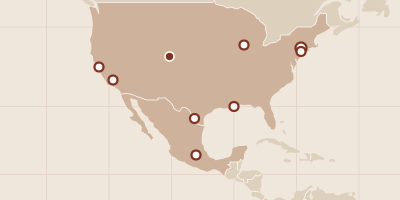
Between 1947 and 1950 Sal Paradise, a young writer from New Jersey, crosses America again and again — hitchhiking, by bus and in borrowed cars — usually in pursuit of his wild, magnetic friend Dean Moriarty. Jack Kerouac typed the story on a continuous scroll of paper in three weeks in April 1951, and it was published in 1957. Sal is Kerouac, Dean is Neal Cassady, and most of the trips really happened.
The route picks out the places the novel names, from a rainy false start on the Hudson to Mexico City and back to a New York street corner. The novel gives towns and streets rather than addresses, so most pins mark areas, not doors.