Mapped Chronicles

Catalog

All routes

More filters
MoviesApproximate

Game of Thrones: Winterfell and the Wall in Northern Ireland

Much of Game of Thrones' North was filmed in Northern Ireland. Winterfell, its godswood, Castle Black, the Kingsroad and a fishing harbour that played Pyke were all real ground dressed as Westeros, and a basalt hillside above a small Antrim village hosts the first execution of the series. The route runs in the order the episodes aired: the deserter's beheading above Cairncastle and the Winterfell of Castle Ward, then the quarry that held Castle Black and the Wall, the godswood, the Kingsroad beech avenue and the harbour where Theon Greyjoy comes home. The last stop is the Moneyglass estate, where a bigger Winterfell was built for the second season and used again for the eighth season's battle. Almost everything here is exterior: Winterfell's great hall was a soundstage set.

7 locations4/7 visitable
BooksSpeculative

Don Quixote: La Mancha's Windmills to Barcelona

A gentleman of La Mancha, a head full of chivalry books, a plain full of mills: this route follows Don Quixote from the village argued to be his to the strand of Barcelona, keeping the order of the book. It begins with the village whose name the narrator refuses to give, the inn where a landlord reading from his account book dubs him a knight, and the ridge of mills that shivered his lance to pieces. In Part II it follows him to Dulcinea's town by night, the cave where he sleeps an hour and believes three days have passed, the lakes of Ruidera, and finally Barcelona, where galley crews salute him three times and a bachelor from his own village unhorses him. Which mills he charged, and where the inn of that first night stood, are guesses: Campo de Criptana and Puerto Lápice are the usual answers.

7 locations5/7 visitable
BooksSpeculative

Ulysses: One Day in Dublin

James Joyce's Ulysses is one ordinary day, 16 June 1904, in Dublin, told in eighteen episodes through Leopold Bloom, a Jewish advertisement canvasser, and Stephen Dedalus, who starts the day in a tower by the sea. This route walks the day in the order the novel runs it: from the Martello tower at Sandycove where it opens to Howth Head, where Molly Bloom's memory ends it with a yes. Almost every stop is a place you can still stand in: the tower where Joyce stayed in 1904, the strand Stephen walks, the street of the chemist's where Bloom buys soap, the cemetery of the funeral, the pub where he eats his sandwich, the library where he passes between Stephen and Mulligan, the quay of the Ormond Hotel and the maternity hospital. The last stop is a recollection rather than a setting: the novel never says where on Howth Head the two of them lay.

9 locations8/9 visitable
HistoryApproximate

D-Day: The Five Normandy Beaches

Just after midnight on 6 June 1944, gliders landed beside a canal bridge at Bénouville, and by mid-morning Allied troops were ashore on five code-named beaches — Utah, Omaha, Gold, Juno and Sword — along the Normandy coast. This route visits the places where that day was won and lost, and what stands there today. It starts with the glider coup de main at Pegasus Bridge, then runs along the coast from west to east: the museum built on the sand at Utah, the Rangers' climb at Pointe du Hoc, the American cemetery above Omaha, the concrete of the Mulberry harbour at Arromanches, the Canadian centre behind Juno and the Grand Bunker above Sword.

7 locations7/7 visitable
HistoryApproximate

Titanic: From Belfast to Halifax

Belfast built her, Southampton sailed her, and two tender ports filled her up before the Atlantic took her. This route follows the whole last leg of Titanic's maiden voyage in order — from the Belfast slipway where 100,000 people watched her leave the ways to the Halifax cemetery where 121 of her dead are buried. Six stops: the shipyard that became a museum, the Southampton quayside and its memorial to the engineers who stayed at their posts, the two Channel ports where tenders ferried passengers out to a ship too big to come alongside, the wreck on the seabed at 12,500 feet, and the graves at Fairview Lawn. Only the wreck is out of reach; every other stop can be walked today.

6 locations5/6 visitable
MoviesFictional

Your Name: Tokyo, Lake Suwa and the Suga Shrine Steps

Taki, a Tokyo schoolboy who waits tables in Shinjuku, keeps waking up in the body of Mitsuha, a shrine maiden in a mountain town who has never left it. They leave notes on each other's skin, fall for each other from a distance — and then the switching stops dead. Taki rides west with two friends to find the town he can only draw from memory, and finds it gone: a fragment of a comet took Itomori and five hundred people three years before his visit. The town was invented, but the film stands on real ground: the Shinjuku where Taki lives and works, the Hida valley that lent Itomori its backdrop, the lake generally credited with the crater pool, and the stone staircase where the story ends. One caveat: Itomori was never filmed, so its crater is the one stop here without a pin.

6 locations5/6 visitable
GamesFictional

Assassin's Creed Unity: Revolutionary Paris

Arno Dorian is a nobleman who walks into a trap: framed for the murder of the man who adopted him, he spends the opening hours of Unity's Paris of 1789 in a prison cell, and walks out of it an Assassin. From there he is off across the capital hunting the true powers behind the Revolution, while Napoleon, Robespierre and an Apple of Eden keep arriving before he can finish the job. Unity rebuilds late 18th-century Paris at roughly 1:1 scale across seven districts, plus Versailles, so almost every stop here is a building you can walk to: the Bastille site, the Assassins' hideout under the Île Saint-Louis, Notre-Dame's towers, the storming of the Tuileries, the execution square that is now the Place de la Concorde, Robespierre at the Hôtel de Ville, and — with the Dead Kings expansion — a Precursor temple under the basilica at Saint-Denis. Two stops are places the game invented rather than built: that hideout and that temple.

9 locations8/9 visitable
MoviesApproximate

Roman Holiday: A Princess in Rome

Crown Princess Ann, on a goodwill tour of Rome, slips out of her embassy for one night of ordinary life. Reporter Joe Bradley finds her asleep in the street, recognises her from a newspaper photograph, and secretly guides her through the city to land an exclusive — a day of ice cream, a Vespa and the Mouth of Truth that turns into something neither of them planned. William Wyler's 1953 comedy was shot almost entirely in Rome. The route follows Ann and Joe through the real locations: the palace that played the embassy, Joe's flat on Via Margutta, the Trevi and the barber by the Spanish Steps, the Colosseum, the Bocca della Verità, the riverside dance beside Castel Sant'Angelo and the closing press conference at Palazzo Colonna.

9 locations8/9 visitable
GamesFictional

GTA V: The Real Los Angeles Behind Los Santos

Los Santos feels like Los Angeles because it is Los Angeles, compressed. Grand Theft Auto V squeezes the city's most famous miles into one playable map, from a hillside sign to a Venice boardwalk. This tour visits seven real stand-ins behind the fiction: the hillside sign, a movie palace, a luxury shopping street, an observatory, a pier, a beach and a towered folk-art park. Every pin marks the real place, and each stop names the game location it doubles for. Expect crowds at the beach and on Hollywood Boulevard, and quiet at the towers.

7 locations7/7 visitable
BooksApproximate

Three Men in a Boat: Kingston to Oxford

Jerome K. Jerome's 1889 comic novel sends three friends, J., George and Harris, and the dog Montmorency up the Thames in a rowing skiff, from Kingston to Oxford, camping out for a fortnight. What follows is one of the funniest books ever written about getting nowhere fast: a hedge maze with a guide who cannot find the exit, a punt run down at sunset, a dog who treats every cat as a personal enemy, and a provision-buying procession that staggers the whole town. The route follows the boat in the book's own order: Kingston's back streets, Hampton Court's maze, the lock opposite Weybridge where George joins them, the island where King John is said to have signed the Charter, tea below Cookham, a night in Marlow, Henley before the regatta, the old walls of Wallingford, and the difficult last mile into Oxford.

9 locations8/9 visitable
MoviesApproximate

The Secret Life of Walter Mitty in Iceland

The Secret Life of Walter Mitty goes from the Time-Life Building in New York to Iceland, where Stykkishólmur doubles for Greenland, Seyðisfjörður hosts the longboard descent and Skógafoss stands in for the Himalayas. Ben Stiller's 2013 film follows a photo editor chasing a missing negative. This route starts at Life's real Manhattan home and then follows Walter through the Icelandic towns, harbour, mountain road, volcano and waterfall that stand in for Greenland and Afghanistan. The places are real; which country they play is not.

6 locations5/6 visitable
MoviesApproximate

Skyfall: From Istanbul to the Highlands

Bond is shot off a train in Turkey and left for dead, while a former agent with a grudge against M attacks MI6 from within. Sam Mendes's 2012 film — the 23rd Bond and the highest-grossing of them all — was shot between November 2011 and May 2012 in London, Turkey and Scotland, with much of "Shanghai" and "Macau" faked in England. The route follows the story from the rooftops of the Grand Bazaar to the railway viaduct where Bond falls, a beach bar in Fethiye, MI6's real headquarters, a Turner in the National Gallery, an abandoned Japanese island, a disused Tube platform and the glen where Bond takes M home. Skyfall Lodge itself was a set in Surrey.

8 locations6/8 visitable
MoviesExact

In Bruges: A Hitman's Tour of Bruges

After a job goes horribly wrong in London, two Irish hitmen are ordered to lie low in Bruges and wait for a phone call. Ken finds the city beautiful; Ray is bored rigid and says so at every turn. Martin McDonagh's 2008 dark comedy was shot entirely on location in the city in February and March 2007. This route follows Ken and Ray through the medieval centre: their hotel, the Belfry, a church with a relic, Bosch's vision of hell in the Groeninge Museum, a park, the Lake of Love and the street where the story ends. One scene was shot in a stand-in church, and the top of the tower was a studio set.

8 locations7/8 visitable
MythologySpeculative

Jason and the Argonauts: To the Golden Fleece

King Pelias sends his nephew Jason to fetch the Golden Fleece from Colchis, at the far end of the Black Sea, hoping he will never come back. Jason builds the Argo, gathers the greatest heroes of his day, Heracles among them, and sails east. Apollonius of Rhodes told the voyage in his Argonautica in the 3rd century BC, and he filled it with real coasts, harbours and local legends. This route follows the outward voyage to Colchis. The way home is left out: ancient writers sent the Argo back by wildly different routes, up rivers into the Adriatic and even across Libya. The heroes and the fleece are myth; the shores, islands and ancient cities are real. Quotations are from R. C. Seaton's 1912 translation.

8 locations8/8 visitable
MythologySpeculative

Aeneas: From Troy to Latium

Troy has fallen. Aeneas, a Trojan prince, carries his old father out of the burning city and sets sail with the survivors to find the new homeland the gods have promised them. Virgil's Aeneid, written for Augustus in the 20s BC, follows years of wrong turns, storms and prophecies until the exiles land in Italy, where their descendants will one day found Rome. This route follows the voyage in the order it happens, which is not the order Virgil tells it: the poem opens in Carthage and lets Aeneas recount the earlier wanderings to Queen Dido. Every stop is a real ancient site, most now open as archaeological parks; Aeneas himself belongs to legend. Quotations are from John Dryden's 1697 translation.

9 locations8/9 visitable
GamesApproximate

Indiana Jones and the Great Circle: Around the World in 1937

In Indiana Jones and the Great Circle (MachineGames, 2024), set in 1937, the trail of a stolen mummified cat runs from the Vatican and Giza to Shanghai and Sukhothai. Indy races the Nazi archaeologist Emmerich Voss around this "Great Circle" of sacred sites — a story Todd Howard conceived for the game. The circle and its secret are pure adventure fiction, but its stops are real: the Vatican, Giza, wartime Shanghai, the ruined Thai capital of Sukhothai and the ziggurat of Ur. The designers rebuilt them from books and photographs as they would have looked in the 1930s. This route follows the main story.

6 locations3/6 visitable
Real JourneysApproximate

Che Guevara and Alberto Granado: The 1952 Journey

The Motorcycle Diaries follows Ernesto Guevara and Alberto Granado's 1952 journey from Buenos Aires across South America — Valparaíso, the Chuquicamata copper mine, Machu Picchu, the San Pablo leper colony on the Amazon — to Caracas. Their overloaded Norton died in Chile; the poverty they saw on the way changed Guevara. Guevara's diary of the trip, published decades later as The Motorcycle Diaries, records how poverty, exploited miners and the lepers they worked with changed him; within a few years he was "Che", a leader of the Cuban Revolution. The route follows the journey from both men's accounts as summarised by historians.

7 locations5/7 visitable
Real JourneysApproximate

Ida Pfeiffer's First Journey Around the World

Ida Pfeiffer's 1846–1848 journey around the world passed through Hamburg, the Brazilian forest, Tahiti and Baghdad, as her own book A Woman's Journey Round the World recounts. A 48-year-old Viennese widow with little money, she travelled mostly alone by cargo ship, horseback and caravan, and came home to a Vienna in revolution. The route follows her first world journey in order, from her own book, A Woman's Journey Round the World: Hamburg, the Brazilian forest, Cape Horn and Valparaíso, Tahiti, Canton, Baghdad, Persia and home. There are no visitor tips for Iraq or Iran.

9 locations7/9 visitable
Real JourneysApproximate

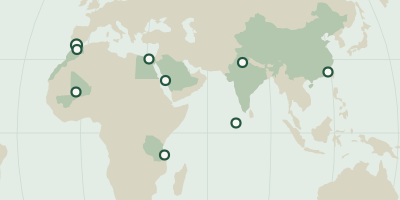
Ibn Battuta: From Tangier to China

In June 1325 a 21-year-old law student left Tangier to make the pilgrimage to Mecca. He did not come home for 24 years. Ibn Battuta crossed the Islamic world and beyond — Arabia, East Africa, Anatolia, Central Asia, India, the Maldives, Sumatra and China — earning his keep as a judge and a guest of sultans, marrying and divorcing along the way. By some estimates he covered about 117,000 kilometres, more than any traveller before the age of steam. Back in Morocco he dictated his memories, the Rihla, to a scholar who polished them and borrowed passages from older books, so not every scene was his own. The route picks out nine stops in the order he reached them; it is not one continuous road. There are no travel tips for Mecca or Mali.

9 locations7/9 visitable
Real JourneysApproximate

Tracks: Robyn Davidson Across Australia

In 1977 Robyn Davidson, then in her twenties, walked about 2,700 kilometres from Alice Springs to the Indian Ocean with four camels and her dog, crossing some of the emptiest desert on earth. She had spent two years in Alice Springs learning to train wild camels. She had no plan to write about it, but a National Geographic article and photographs by Rick Smolan made her famous, and her 1980 book Tracks became a classic, filmed in 2013. The route follows her line west across the Northern Territory and Western Australia in order. Much of it crosses Aboriginal land, where she travelled with a Pitjantjatjara elder, Mr Eddie; pins mark communities and stations, not sacred sites.

7 locations4/7 visitable
Real JourneysApproximate

Bashō's Narrow Road to the Deep North

In spring 1689 the poet Matsuo Bashō gave up his hut in Edo and set off on foot with his friend and disciple Kawai Sora into Oku, the remote north of Japan. For about 156 days and some 2,400 kilometres they walked to the places the old poets had made famous — a barrier gate, a bay of pine islands, a battlefield, a mountain temple — and Bashō answered them with haiku. The travel diary he made of it, Oku no Hosomichi, published in 1702, is one of the classics of Japanese literature, and its stops are still pilgrimage sites. Bashō polished the facts for art; Sora's own diary shows where. Dates follow the old lunar calendar, so they are given here by season.

9 locations9/9 visitable
HistorySpeculative

Mansa Musa's Hajj: Gold Across the Sahara

In 1324 Mansa Musa, ruler of the Mali Empire, set out on the pilgrimage to Mecca with a caravan so rich in gold that Cairo talked about it for years. Arab chroniclers wrote of thousands of servants carrying gold bars and camels loaded with gold dust; historians today treat those numbers as a way of saying "more than anyone could imagine", not as a count. The Catalan Atlas of 1375 still shows him enthroned in the Sahara, holding up a piece of gold. The route keeps to the places the sources actually record: the royal city of Mali, the camp below the pyramids, Cairo, Mecca, and Gao and Timbuktu on the way home. The road across the desert is not documented, so it is not drawn. The route offers no travel advice for Mali.

6 locations1/6 visitable
BooksFictional

The Thirty-Nine Steps: Hannay on the Run

John Buchan's The Thirty-Nine Steps sends Richard Hannay from a flat behind London's Langham Place onto the 7.10 from St Pancras and north to Galloway's Cairnsmore of Fleet and the spa town of Moffat, while a German spy ring hunts him. Hannay has three weeks to survive before he can warn the government. The title comes from a real stair in Broadstairs: 78 steps, not 39. This is John Buchan's 1915 novel, not Hitchcock's very different film. London, St Pancras, Cairnsmore of Fleet and Moffat are named in the book; Hannay's hiding places on the moors and the Kent resort of Bradgate are not real, but the steps that gave the book its title are.

7 locations4/7 visitable
BooksApproximate

Journey to the Centre of the Earth: Hamburg to Stromboli

In May 1863 a Hamburg professor of mineralogy decodes a 300-year-old note in runes: go down the crater of Snæfell in Iceland and you will reach the centre of the Earth. Within days he drags his reluctant nephew Axel north by train, steamer and schooner, hires a silent Icelandic guide named Hans and climbs into the volcano. Verne sets up the impossible with a timetable you could almost follow today — Altona station, Kiel, Copenhagen, Reykjavík, the hamlet of Stapi below the glacier. What happens underground is pure fiction, but the way out is real: three months later the travellers are spat out of Stromboli, an island volcano off Sicily, more than 3,000 km from where they went in.

7 locations6/7 visitable