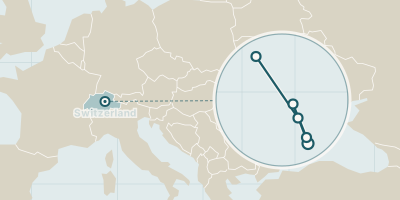
William Tell's legend is set around Lake Lucerne in central Switzerland: his home village Bürglen, the Rütli meadow, the marketplace of Altdorf where he shot the apple, the Tellsplatte where he leaped from the boat, and the Hohle Gasse near Küssnacht where Gessler was killed.
The route follows the story as the chronicler Tschudi and Schiller's play tell it. The legend is not documented history, and every stop is a traditional identification, but each place is real and can be visited.
Two love stories shot in guerrilla style across Hong Kong in 1994: a policeman who buys cans of pineapple while he waits for a month to end, and a girl at a fast-food counter who sneaks into a policeman's flat.
The route follows the plot from a Tsim Sha Tsui nightclub to a block of guesthouses, then across the harbour to Lan Kwai Fong and the Mid-Levels escalator, and ends at Kai Tak, the old airport in Fallen Angels. Chungking Express stops are filming sites; the Midnight Express pin is approximate.
Federico García Lorca was born in a farming village in the Granada vega and wrote his rural plays in the family's summer house on the city's edge. In August 1936, weeks into the Civil War, he was arrested in Granada and killed near Víznar.
The route follows his life from the birthplace to the orchard house, then the last days in 1936 and the memorials in the hills. The exact place of his death and grave is still disputed, and the final stops are marked as approximate or speculative.
J. Robert Oppenheimer studies in Cambridge and Göttingen, builds a physics school at Berkeley, and is handed the one job nobody else wants: build the atomic bomb before the Nazis do. Christopher Nolan's Oppenheimer (2023) follows him from the Cavendish Laboratory to a secret mesa in New Mexico, through the Trinity test and the political fallout that ends his career.
This route follows the film's real places — Cambridge, Göttingen, LeConte Hall, Los Alamos, Trinity, the White House, the Institute for Advanced Study and the room where his security clearance was revoked. The film's own stand-ins, from Ghost Ranch to Kerckhoff Hall, Belen and Alhambra, are noted at each stop.
Ron Howard's 2006 thriller, based on Dan Brown's 2003 novel, sends symbologist Robert Langdon and cryptologist Sophie Neveu from a murdered curator in the Louvre on a quest for the legendary Holy Grail — through a Paris church, a London Templar church and Newton's tomb to a Scottish chapel.
The route follows the film's trail in story order, from the Vitruvian-Man murder and the Saint-Sulpice marker to the Temple Church dead end, the APPLE cryptex at Westminster Abbey and the 'neath-the-rose finale at Rosslyn Chapel. Note the abbey scenes were filmed at Lincoln and Winchester cathedrals.
The Grand Budapest Hotel's imaginary republic of Zubrowka is built from real Saxony: Görlitz's Art Nouveau department store as the lobby, Hainewalde and Waldenburg castles, Osterstein in Zwickau and Dresden's Zwinger. In Wes Anderson's comedy the concierge M. Gustave and his lobby boy Zero are caught up in a murder, a stolen painting and a war.
This route visits the real buildings: an empty Art Nouveau department store that became the hotel lobby, a shuttered concert hall, two castles that make up Madame D.'s estate, a former prison, the most beautiful dairy shop in the world and Dresden's baroque Zwinger. Zubrowka is fictional; these are the filming locations.
The Oregon Trail follows real landmarks of the 2,170-mile trail: Independence, Missouri, Chimney Rock in Nebraska, Independence Rock in Wyoming and Oregon City at the end. Three student teachers in Minneapolis wrote it in 1971; the 1985 Apple II version, set in 1848, made buying oxen, fording rivers and dying of dysentery a classroom staple, and the series has sold more than 65 million copies.
The route follows the game's stops from Missouri to the Willamette Valley, with what stands at each place today.