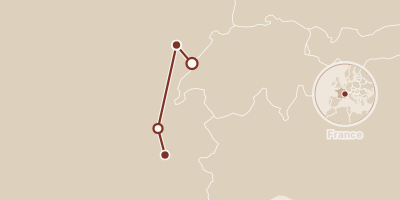
The Red and the Black is set in Franche-Comté: Julien Sorel grows up in the fictional town of Verrières, studies at the seminary in Besançon, and meets his end after a church shooting based on a real 1827 crime near Grenoble.
The route follows Julien from Verrières-de-Joux, the village that may have lent its name, through Besançon's citadel, seminary and cathedral, to Brangues and Place Grenette, where the real Antoine Berthet who inspired the novel was tried and executed.
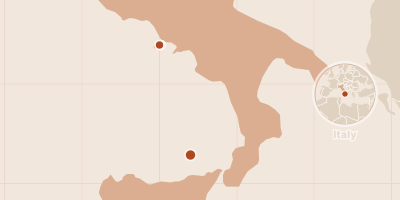
Il Postino (1994) was filmed on two islands: Procida in the Gulf of Naples, where Mario delivers Pablo Neruda's mail around Marina Corricella, Via San Rocco and Piazza dei Martiri, and Salina in the Aeolian Islands, whose Pollara bay hosts Neruda's house and a beach.
The film moves the story to Italy around 1950 and never names the island. This route follows the real places: the waterfront bar where Mario meets Beatrice, the village street, the post office square and the two beaches.
Vauban's fortifications, a UNESCO World Heritage group, include the citadels of Lille and Besançon, the Mont-Louis citadel, the ramparts of Saint-Martin-de-Ré, Mont-Dauphin, Neuf-Brisach and the Asfeld Bridge at Briançon.
Louis XIV's military engineer drew a belt of strongholds around France. Each stop here is a place you can still walk through, and each shows a different way of making a border hard to cross.
Stops follow the date each fortress was begun. Some of them are still working towns, not just monuments.
Hegra (Mada'in Salih) in Saudi Arabia was the Nabataean kingdom's second capital after Petra in Jordan, and the rock-cut tombs of both cities come from the same 1st-century world.
This route follows the Nabataean caravan network from the Hegra tombs through Humeima and Little Petra to the Treasury and Monastery in Petra, and ends at Avdat on the Petra-Gaza road in the Negev.
Final Fantasy XV's Insomnia is based on Shinjuku in Tokyo, Altissia on Venice, while Lestallum is loosely reminiscent of Cuba. This route follows the story from the royal capital through the road trip to the water city.
It visits Shinjuku and the Tokyo Metropolitan Government Building, Old Havana, the Riva degli Schiavoni and St Mark's Basilica. The Havana link is only a loose comparison by the developers.
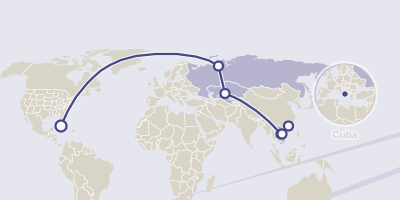
Call of Duty: Black Ops sends CIA operative Alex Mason from the Bay of Pigs in Cuba to the Vorkuta gulag, Baikonur Cosmodrome, Huế in Vietnam and Kowloon Walled City in Hong Kong.
Mason's story is told in flashbacks from an interrogation room, in order, from April 1961 to 1968. This route follows seven real places behind the campaign, and what happened at each one in real history. The game's levels are fiction, so most pins are approximate. Spoiler notice: the last stop reveals the campaign's twist.
A Plague Tale: Innocence is set in Aquitaine in 1348, with landscapes inspired by Saint-Émilion, a town gate modelled on Carcassonne and a final cathedral based on Reims. Its sequel, Requiem, moves to Provence and Marseille in 1349.
The route follows Amicia and Hugo de Rune from their family estate through plague-ridden France to the Order's city of Marseille. Most pins are real stand-ins or regions, and each stop says how close the game comes to the real place.
Lafcadio Hearn's Japan runs from Matsue Castle and Izumo Taisha to Kumamoto, Yaizu and Akama Shrine in Shimonoseki, home of the Kwaidan ghost tale of Hōïchi the Earless.
The route follows his years as a teacher and writer: the samurai house in Matsue, a railway station scene from Kokoro, a fishing town he wrote about, and the shrine that keeps Hōïchi's statue. Hearn does not name the Kumamoto station, so that pin is approximate.
In June 1791 Louis XVI and his family fled the Tuileries Palace in Paris for the fortress of Montmédy, only to be stopped at Varennes-en-Argonne after being recognised at Sainte-Menehould.
This route marks the royal coach's stops from the palace to Varennes, the citadel it never reached, and the way back through Châlons to a silent Paris. Several stops are approximate, because the sources do not name exact buildings.
In 1612 a Nizhny Novgorod merchant, Kuzma Minin, and Dmitry Pozharsky raised the volunteer army that cleared Polish forces from the Moscow Kremlin. The route follows it from the Nizhny Novgorod Kremlin through Yaroslavl and the Trinity Lavra to Red Square.
The five stops trace the militia's march and the monuments to its leaders. The Yaroslavl pin marks the city, as the sources name no building.
The Battle of Kulikovo, fought on 8 September 1380 at Kulikovo Field near the Don, made Grand Prince Dmitry of Moscow famous as Donskoy, "of the Don". The route follows him from Trinity Lavra and Kolomna to the battlefield, Old Simonov and the Moscow Kremlin.
It covers the muster against Mamai's army, the crossing in fog, the ambush regiment, the burial of the fallen and Moscow's burning in 1382. Battlefield pins are approximate because sources give no exact spot.
Conan the Barbarian was filmed across Spain: the Cimmerian village at Valsaín, the Wheel of Pain near Solosancho, the witch's rocks at the Ciudad Encantada, and the deserts, dunes and salt marshes of Almería.
The Hyborian Age is invented; every stop here is a real place. The route follows the film from the raid on Conan's village to the Mountain of Power, and ends at Shepperton Studios in England, where an older King Conan speaks the closing lines.
Fallout 3 is set in the ruins of Washington, D.C., and its Capital Wasteland includes the Washington Monument, the National Mall, the National Archives and the Jefferson Memorial as places the player can explore. Bethesda's 2008 role-playing game takes place in 2277, 200 years after a nuclear war, and sends the Lone Wanderer across the real city and its Metro.
This route follows the main story from the first view of the Washington Monument to the Brotherhood's march on the Jefferson Memorial, taking in the Mall's trenches, the White House crater and the Archives' robot guardian. Raven Rock, the real Cold War bunker in Pennsylvania, is the Enclave's base, and the Broken Steel add-on ends the route at the Citadel inside the Pentagon.
Two Naughty Dog adventures, two treasure hunts: Nathan Drake chases Marco Polo's Cintamani Stone from an Istanbul museum through Borneo and Nepal to the legend of Shambhala, then follows Francis Drake's secret to a lost city in the Arabian sands.
The route follows both games in order. The legendary cities are invented or borrowed, and the game rarely names a real site, so every pin marks the country, city or region behind the chapter.
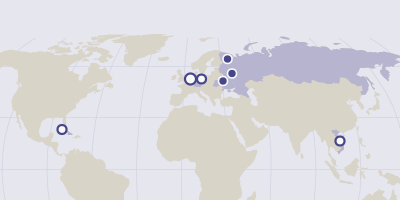
In January 1981 a CIA team led by Russell Adler hunts Perseus, a Soviet spy Adler believed dead. The trail runs from an Amsterdam bar and a Vietnam flashback to East Berlin, the KGB's Lubyanka and a Cuban firefight, before reaching the Solovetsky Islands. The route follows the campaign's real places in mission order and keeps the game's story apart from the real history of each place. A final stop marks the alternate ending at Duga.
The boy born on the Onon River became the ruler of the largest land empire in history. This route follows him from the steppe camps of Khentii, through the war that began at a border town in Kazakhstan, to the siege of Samarkand and a death in the middle of a campaign.
The sources disagree on his birth year, his birthplace and his grave. Where the Secret History of the Mongols gives a legend and other sources give the record, the stops say which is which.
Homer's Trojan War on the map: Mycenae, Aulis, where the fleet waited, the hill of Hisarlik, now identified with Troy, and the Scamander plain, then Pylos and Ithaca from the Odyssey. Each stop is told from Homer, with archaeology kept apart.
The route follows the epic from the fleet at Aulis to the plain of the Scamander, then the Odyssey's road home via Pylos and Ithaca. Many identifications here are traditional or disputed, and the pins show it.
The French Way is the most popular route of the ancient pilgrimage to Santiago de Compostela, It starts at Saint-Jean-Pied-de-Port, crosses the Pyrenees, and from Roncesvalles on the Spanish side still runs about 780 kilometres west to Galicia. It is on the UNESCO World Heritage List.
This route follows it through seven landmarks: a mountain gate, a village of legend, a pilgrims' bridge, a great cathedral, a knights' tournament, a Galician hilltop and the tomb of St James.
In 1466 or 1468 a merchant from Tver set out down the Volga to trade around the Caspian Sea. He was robbed on the way, crossed Persia, sailed from Hormuz to India and wrote down what he saw in A Journey Beyond the Three Seas.
This route follows him from Tver through Derbent, Hormuz and the coast of India to Bidar, and home to Caffa on the Black Sea. Dates are debated, and most stops are marked by area only because his notes name towns rather than buildings.
Ridley Scott's 2005 epic follows Balian, a French blacksmith turned Baron of Ibelin, from his village to Messina, Jerusalem, Kerak, the desert defeat at Hattin and the siege that ends the film. Every stop pairs a scene with the place where it was shot, or with the real place the scene stands for.
The film was made in Spain and Morocco, not the Holy Land, so the route moves between sets and history. Where the film departs from the record, the stop says so: the historical Balian was a prominent lord of the Kingdom of Jerusalem, not a French artisan.
Assassin's Creed (2007) recreates the Holy Land of 1191: Masyaf, Damascus, Acre and Jerusalem, with Solomon's Temple and Richard's camp at Arsuf. Altaïr loses his rank after a botched mission and wins it back one target at a time: nine men in three cities, all secretly Templars.
The route follows the story from the Temple in Jerusalem to the Assassins' fortress of Masyaf, through Damascus, Acre and Jerusalem, to a duel in King Richard's camp. The game's cities are rebuilt for play, so every pin marks the real place the scene is anchored to.
In June 1867 the steamship Quaker City left New York on what Mark Twain called his "Great Pleasure Excursion", a chartered trip to Europe and the Holy Land. A newspaper, the Alta California, paid for his place in exchange for fifty articles, and those letters grew into The Innocents Abroad.
This route follows eight stops: the Wall Street pier, the Azores, Tangier, Milan, Athens, a palace garden near Yalta, Jerusalem and the Sphinx. Each is told through Twain's own scenes, from donkey rides and hotel bills to the places that stopped his jokes. Where he does not name a spot, the pin marks the nearest known place.
The Travels of Marco Polo runs from Venice and Acre to Kublai Khan's Xanadu, then south to Hangzhou and home again. In 1271 a seventeen-year-old Venetian set out with his father and uncle and did not come home for 24 years.
The route follows the book from Venice and Acre to the Persian Gulf, across the Pamir highlands and the desert to Kublai's summer and winter capitals, south to Hangzhou and the port of Zayton, and home again. Some of the roads are reconstructed by scholars, and Polo sometimes exaggerates, so each stop notes where the evidence is thin.
Vlad III ruled Wallachia in three separate reigns and earned his nickname from impalement, his favorite method of execution. His patronymic, Dracula, is thought to have inspired the name of Bram Stoker's vampire, but the man himself spent his life between the Ottoman sultans and the king of Hungary.
Nine places follow his life in order, from the Transylvanian house named as his birthplace to the battlefield near Snagov: hostage years, exile, raids, a war with the sultan and a long imprisonment. Bran Castle is left out on purpose, since it is often, but incorrectly, said to have been his home.