Gran Turismo, Forza and Assetto Corsa race on real circuits: the Nürburgring Nordschleife, Spa-Francorchamps, Monza, Le Mans, Suzuka and Laguna Seca.
This route lists six tracks you can drive in racing games, with what each game does with them and the real circuit behind the screen. Game appearances differ by title and year.
Need for Speed: The Run races across the United States, from the Golden Gate Bridge in San Francisco through Death Valley, Las Vegas, Denver and Chicago to Times Square in New York.
The racing game is an illegal street race from San Francisco to New York City with the Mob and the police in pursuit. Wikipedia records two plots: the Black Box version, starring street racer Jack Rourke, and a Firebrand version, starring a former pro racer called Matt. Most scenes here come from the Firebrand version; each stop says which. The roads are real, but scenes are not tied to exact spots, so most pins mark the city or region.
Spoiler notice: the last stop reveals the ending.
Tokyo Xtreme Racer (Shutokō Battle in Japan) is set on the Shuto Expressway: the C1 loop and the Bayshore Route in Tokyo, then Nagoya, Osaka and the Irohazaka mountain road at Nikko.
The route follows the series from its Tokyo expressway roots through the Tokyo Xtreme Racer 3 city expansion to the Kaido Battle mountain spin-offs. The games recreate long roads, so pins mark one point on each.
The Driver series began in 1999 as a car-chase game and grew into a tour of real cities: Miami, Los Angeles and New York in the first game, Havana, Las Vegas and Rio de Janeiro in Driver 2, Nice and Istanbul in Driver 3, and a fictionalised San Francisco in the 2011 sequel. Tanner's undercover work runs from a Miami parking garage to a presidential car, a Rio climax beneath Christ the Redeemer and the Golden Gate Bridge.
This route follows the series city by city, from Ocean Drive's Art Deco hotels to the Las Vegas Strip and the Bosphorus. Some stops are city-level pins because the games recreate whole urban areas rather than single buildings; only Christ the Redeemer and the Golden Gate Bridge are pinned exactly.
Test Drive Unlimited sent players around Oʻahu's 1,000 miles of roads in 2006; The Crew Motorfest returned to a scaled-down island in 2023, with a car-culture festival at its centre. Both treat the island as a stage, one for a free-roam lifestyle racer and the other for a themed racing playground.
This route follows a road-trip loop from Honolulu Airport through Waikiki, Diamond Head, Hanauma Bay and the North Shore to Haleʻiwa, then back south to Pearl Harbor. Pins mark the real places; the games shrink the island and invent some of the roads in between.
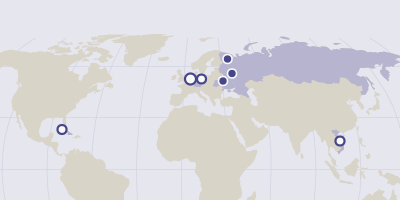
In January 1981 a CIA team led by Russell Adler hunts Perseus, a Soviet spy Adler believed dead. The trail runs from an Amsterdam bar and a Vietnam flashback to East Berlin, the KGB's Lubyanka and a Cuban firefight, before reaching the Solovetsky Islands. The route follows the campaign's real places in mission order and keeps the game's story apart from the real history of each place. A final stop marks the alternate ending at Duga.
Wim Wenders' Perfect Days follows Hirayama, a Tokyo toilet cleaner who keeps his days exactly the same: the same overalls, the same cassette tapes, the same sandwich under the trees. The city changes around him; he notices the light through the leaves.
This route follows the film's real Tokyo, from the old apartment east of the Sumida to four of the Tokyo Toilet project's designer facilities, the shrine bench where he eats lunch, the sento and Asakusa bar that fill his evenings, and the bridge where the story ends.
Forza Horizon 5 drops the Horizon Festival into a fictionalised Mexico, on a map 50% larger than Forza Horizon 4's. Creative director Mike Brown calls Mexico almost the whole world in one country: snowy peaks, tropical jungles, epic canyons, beautiful beaches, ancient architecture and modern cities.
This route visits seven real places the game recreates, from a sea arch at the tip of Baja to a canyon with a train, and says what the game does at each. The map is a condensed Mexico, so the pins mark the real sites, not their positions in the game.
In 1986 the teenage martial artist Ryo Hazuki comes home to the family dojo in Yokosuka and watches his father, Iwao, die at the hands of Lan Di. Swearing revenge, Ryo follows the killer to Hong Kong in 1987 and on to the mountains of Guilin, and the two games turn that trail into one long walk through a living town, a harbor, a crowded Hong Kong district and a walled city.
The route follows Shenmue and Shenmue II in seven stops. Dobuita Street and Kowloon Walled City are real places the game draws on, the dojo and Bailu Village are invented, and every stop says how closely its pin matches the game.
Forza Horizon 4, released on 2 October 2018, turns Great Britain into one giant racetrack: an open world with condensed representations of Edinburgh, the Scottish Highlands, the Lake District and the Cotswolds, where seasons change every week and Derwentwater freezes hard enough to drive across. Microsoft counted 24 million players by November 2020, and Polygon found the game world a theme-park version of England where everything has "the faint whiff of an idealised 1950s about it, a place of ordered pub gardens and rosebushes".
This route drives the real Britain behind the game, north to south: Edinburgh's Old Town, Bamburgh Castle on its coastal crag, three Lake District stops at Derwentwater, Ambleside and Tarn Hows, and the honey-coloured village of Broadway in the Cotswolds. Every stop can be visited today.