The Trail of Tears, the forced removal of the Cherokee from Georgia to Indian Territory (Oklahoma), runs from New Echota, Red Clay and Fort Cass to Blythe Ferry in Tennessee and Fort Gibson.
Each stop ties to a documented moment: a treaty signed by a minority, a council that rejected it, the camps of summer 1838, a river crossing and the arrival in Indian Territory. Some sites are memorials today and others are only markers; the Fort Cass and Fort Gibson pins are approximate.
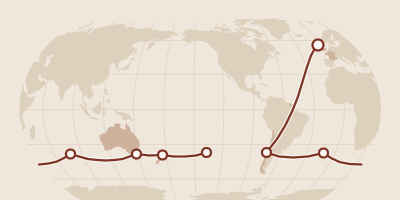
Karl Bushby's Goliath Expedition is a walk from Punta Arenas, Chile, to his home town of Hull, England, via the Darién Gap, the Bering Strait, Siberia, Mongolia, the Caspian Sea and the English Channel. He started on 1 November 1998 and arrived in Hull on 2 November 2026.
The route follows twelve landmarks of the nearly 28-year journey, from the jungle of Panama to a frozen sea crossing in 2006 and two long swims. Positions are approximate except the start and the Dover beach, since the actual paths are not published stop by stop.
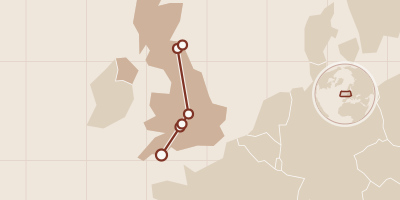
In Rachel Joyce's The Unlikely Pilgrimage of Harold Fry, a retired man walks from Kingsbridge in Devon to Berwick-upon-Tweed, passing Stroud, Cheltenham, Coventry and the Scottish border town of Kelso to reach a dying friend.
The route follows the walk stage by stage, from a post box in Devon to the hospice at the far end of England, and the reasons Harold gives, and withholds, for going. The novel names towns rather than streets, so every pin marks a town.
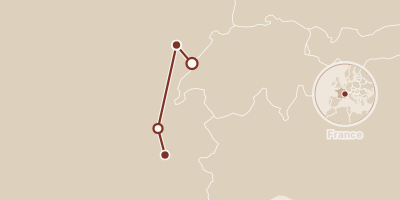
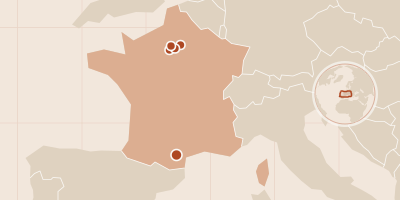
The Red and the Black is set in Franche-Comté: Julien Sorel grows up in the fictional town of Verrières, studies at the seminary in Besançon, and meets his end after a church shooting based on a real 1827 crime near Grenoble.
The route follows Julien from Verrières-de-Joux, the village that may have lent its name, through Besançon's citadel, seminary and cathedral, to Brangues and Place Grenette, where the real Antoine Berthet who inspired the novel was tried and executed.
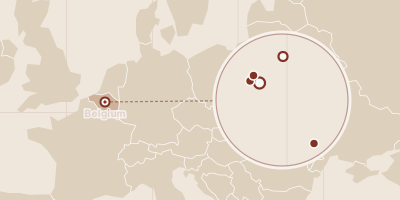
Tintin's Brussels is the Marolles flea market where he buys the Unicorn, the Etterbeek street where Hergé was born, and the museums that keep his work: the Belgian Comic Strip Center, the Hergé Museum in Louvain-la-Neuve and the Moon rocket at Brussels Airport.
Hergé was born in Brussels, and the city shows up in his books and in the places that celebrate them. This route follows five real places from his birth in 1907 to the Tintin sights you can visit today.
The Unicorn flea-market scene is set in the Marolles; other stops are Tintin landmarks rather than story scenes.
Jules Verne's In Search of the Castaways (Captain Grant's Children) follows the 37th parallel south from Dumbarton in Scotland to Talcahuano in Chile, Tristan da Cunha, Amsterdam Island, the Snowy River in Australia and Lake Taupo in New Zealand.
This route follows Lord Glenarvan's yacht Duncan and the search for Captain Grant, ending on Tabor Island. Most pins are approximate, since the book gives a latitude and a landscape rather than street addresses.
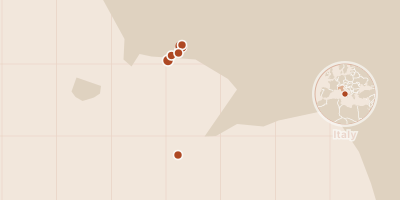
Parthenope (2024), Sorrentino's film, was shot in Naples and on Capri: Villa Lauro in Posillipo, the Galleria Umberto I, Federico II University, the Gardens of Augustus, Spaccanapoli, Naples Cathedral and Via Partenope. It follows a woman named after her city from her birth in 1950 to 2023.
The route runs in story order, from the sea at Posillipo to the seafront where the film ends.
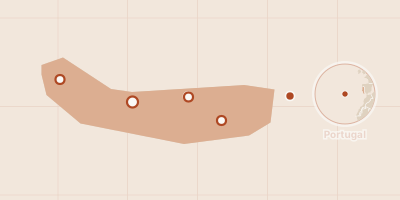
Rabo de Peixe, the Netflix series known as Turn of the Tide, is set in a fishing village on São Miguel in the Azores, but it was shot in several places across the island: Porto Formoso, the Arnel lighthouse, Furnas and the ruined Monte Palace Hotel above Sete Cidades.
The story is loosely based on a real 2001 cocaine landing. The route follows the series from the village to its final scenes, with a note on what you can visit today.
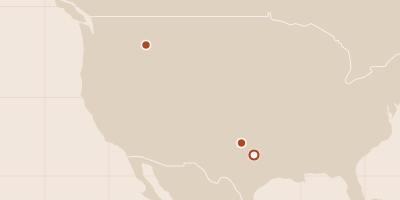
1883 is set on the Dutton family's wagon journey from Fort Worth, Texas, to Montana, and its town scenes were filmed on Exchange Avenue in the Fort Worth Stockyards, with the Dutton ranch at Chief Joseph Ranch in Darby.
The route follows the story from the Pinkerton office and Hotel Calhoun in Fort Worth through Doan's Crossing on the Red River to the Montana valley where the Duttons settle. Filming locations are marked where the sources name them; Doan's Crossing is the story's place, not a set.
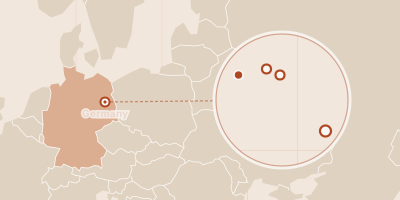
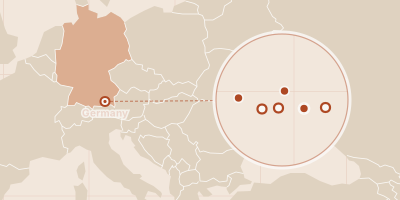
Christiane F. – Wir Kinder vom Bahnhof Zoo is set in West Berlin and filmed around Bahnhof Zoo, Kurfürstenstraße and the Deutschlandhalle, with the heroine's home in Gropiusstadt. It is based on the 1978 book Zoo Station.
Uli Edel's 1981 film follows 13-year-old Christiane Felscherinow from a high-rise in Gropiusstadt through a Bowie concert to the station's underpasses. The route visits the five places the film and the book make famous, in story order, and says plainly where the pins are only the area.
Die Rosenheim-Cops is set in Rosenheim and the Chiemgau, but the town hall, Max-Josefs-Platz, the Chiemsee, Weyarn and Dietramszell are only part of where it was shot.
This route follows seven places where the crime series was set or filmed, from the police headquarters in Rosenheim's town hall to villas near Lake Starnberg. Several stops are marked by area, because the sources name the place but not the exact spot.
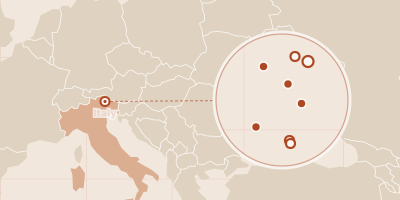
Un passo dal cielo, the Rai 1 series, is set in San Candido in South Tyrol and later in San Vito di Cadore in the Belluno Dolomites, but it was mostly filmed around Lago di Braies, Prato Piazza, Dobbiaco, Lago di Mosigo and Misurina.
This route follows the series from its South Tyrol seasons to its Cadore seasons, with eight places where scenes were set or shot. Where the sources only name a place, the pin marks the area.
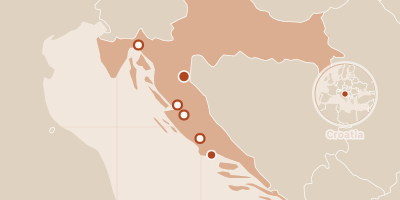
The Winnetou films of the 1960s are set in the Wild West but were shot in Croatia: the Silver Lake is Plitvice, the Apache pueblo stood above the Zrmanja canyon and Santa Fe is the town of Trogir.
This route follows three of the films (Der Schatz im Silbersee, Winnetou 1 and Winnetou 3, 1962 to 1965) from Plitvice and Paklenica to the Krka falls, Trogir and Mali Alan, where Winnetou dies. Most sets were torn down after filming, but the landscapes remain.
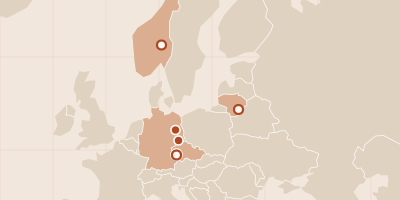
Three Wishes for Cinderella (Drei Haselnüsse für Aschenbrödel, 1973) was shot at Moritzburg Castle near Dresden and Švihov Castle in Bohemia, and the 2021 Norwegian remake at Trakai in Lithuania and Maihaugen in Lillehammer.
The route follows the winter film from the Bohemian forests and the Babelsberg ballroom set to the Moritzburg stairs, then to the remake's locations.
Les Visiteurs (1993) was filmed in Carcassonne, Thoiry, Ermenonville, Argenteuil and Vigny: the Château Comtal in the Cité de Carcassonne is the medieval castle, and the Château d'Ermenonville is Montmirail in the present day.
The route follows a 12th-century knight and his squire from 1123 to 1992, across five film locations, and notes where the film and the places differ.
Marie Curie's life runs from her birthplace on Freta Street in Warsaw to the Latin Quarter, the Radium Institute and the Panthéon in Paris. This route follows the places where Maria Skłodowska became Marie Curie.
It starts with the Flying University and a first laboratory in Warsaw, then the Sorbonne years, her 1895 wedding in Sceaux, the street where Pierre Curie died, the Musée Curie and her tomb in the Panthéon.
Crazy Horse's story runs through six places: Fort Phil Kearny in Wyoming, the Rosebud and Little Bighorn battlefields in Montana, Fort Robinson in Nebraska, and the Crazy Horse Memorial in South Dakota. The Oglala Lakota war leader helped defeat the army from 1866 to 1876, then surrendered and was killed at Fort Robinson in 1877.
The route follows his campaigns in order, then turns to what remains: the burial legend near Wounded Knee Creek and the unfinished mountain carving that many Lakota oppose.
A Munich sightseeing route from Marienplatz and the Frauenkirche to the Residenz and Nymphenburg Palace, tracing six centuries of the city's Wittelsbach rulers, markets and churches.
The walk starts on the old market square, passes the cathedral, the Viktualienmarkt, the royal Residenz and the Theatine Church, then ends at the summer palace where King Ludwig II was born. Many buildings were rebuilt after World War II bombing.
Vauban's fortifications, a UNESCO World Heritage group, include the citadels of Lille and Besançon, the Mont-Louis citadel, the ramparts of Saint-Martin-de-Ré, Mont-Dauphin, Neuf-Brisach and the Asfeld Bridge at Briançon.
Louis XIV's military engineer drew a belt of strongholds around France. Each stop here is a place you can still walk through, and each shows a different way of making a border hard to cross.
Stops follow the date each fortress was begun. Some of them are still working towns, not just monuments.
The Ramayana trail runs from Ayodhya, Rama's traditional birthplace, through Chitrakoot, Panchavati and Hampi to Rameswaram, Dhanushkodi and Sri Lanka's Sita Eliya. Every place here is a traditional identification, not a proven site.
The route follows the epic's order: the exile decreed in Ayodhya, the forests, Sita's abduction, the search in Kishkindha, Hanuman's find in Lanka, and the bridge to Lanka. Most stops are living pilgrimage places you can visit.
The Seven Churches of Revelation lie in western Turkey: Ephesus near Selçuk, Smyrna, Pergamon at Bergama, Thyatira at Akhisar, Sardis, Philadelphia at Alaşehir and Laodicea near Denizli. They are the seven cities addressed in the letters of Revelation 2–3.
This pilgrimage route follows the letters in order, from Ephesus to Laodicea, and sets each message beside what stands on the ground. The sources identify some sites exactly and others only by their modern town.
Saint Paul's missionary journeys run from Paphos in Cyprus through Antioch of Pisidia, Philippi, Athens, Corinth and Ephesus to Malta and Rome, as told in the Acts of the Apostles.
The route follows Paul from his first journey with Barnabas to the shipwreck on Malta and his final years in Rome, with the ruins, hills and basilicas you can still visit.
Several spots, like the Areopagus and Paul's tomb, are traditional identifications, and each stop says how firm the evidence is.
Pablo Picasso was born in Málaga in 1881 and found his path in A Coruña, Barcelona, Madrid and Paris; the route visits his birthplace on Plaza de la Merced, Els Quatre Gats café, the Royal Academy of San Fernando and the Bateau-Lavoir in Montmartre.
It follows the young painter from his birth to the studio where he completed Les Demoiselles d'Avignon in 1907. Four of the five stops can still be seen today.
Vermeer's Delft is a short walk through the Dutch city where Johannes Vermeer was baptized, painted and was buried. The route runs from the Nieuwe Kerk and the Vermeer Centre to the Paardenmarkt, the Vlamingstraat of The Little Street, a view of the skyline from the south, and the Oude Kerk.
The stops follow his life, from baptism in 1632 and the guild in 1653 to the 1654 explosion and his burial in 1675. The exact site of The Little Street is still debated.