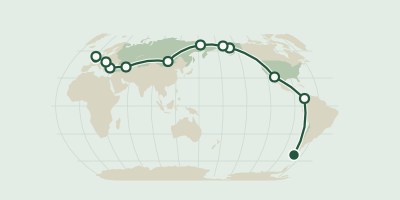
Karl Bushby's Goliath Expedition is a walk from Punta Arenas, Chile, to his home town of Hull, England, via the Darién Gap, the Bering Strait, Siberia, Mongolia, the Caspian Sea and the English Channel. He started on 1 November 1998 and arrived in Hull on 2 November 2026.
The route follows twelve landmarks of the nearly 28-year journey, from the jungle of Panama to a frozen sea crossing in 2006 and two long swims. Positions are approximate except the start and the Dover beach, since the actual paths are not published stop by stop.
The Seven Churches of Revelation lie in western Turkey: Ephesus near Selçuk, Smyrna, Pergamon at Bergama, Thyatira at Akhisar, Sardis, Philadelphia at Alaşehir and Laodicea near Denizli. They are the seven cities addressed in the letters of Revelation 2–3.
This pilgrimage route follows the letters in order, from Ephesus to Laodicea, and sets each message beside what stands on the ground. The sources identify some sites exactly and others only by their modern town.
Saint Paul's missionary journeys run from Paphos in Cyprus through Antioch of Pisidia, Philippi, Athens, Corinth and Ephesus to Malta and Rome, as told in the Acts of the Apostles.
The route follows Paul from his first journey with Barnabas to the shipwreck on Malta and his final years in Rome, with the ruins, hills and basilicas you can still visit.
Several spots, like the Areopagus and Paul's tomb, are traditional identifications, and each stop says how firm the evidence is.
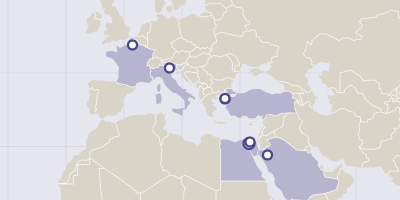
The First Crusade (1096-1099) ran from Clermont in France through Constantinople, Nicaea and Antioch to Jerusalem, and this route follows it stop by stop. It began with Pope Urban II's sermon at Clermont on 27 November 1095.
The six stops cover the sermon, the oaths sworn to the Byzantine emperor in Constantinople, the sieges of Nicaea and Antioch, the battle at Dorylaeum and the fall of Jerusalem in July 1099. Violence is named plainly; the medieval accounts are partly written after the fact.
Suleiman the Magnificent's campaigns run from Belgrade Fortress to Mohács, Vienna and Szigetvár, with the Süleymaniye Mosque in Istanbul as his monument.
The route follows the sultan through the sieges and battles of 1521–1566, from the fall of Belgrade and the battle of Mohács to the failed siege of Vienna in 1529 and his death during the siege of Szigetvár. The Mohács pin marks the town, not the battlefield itself.
Tamerlane (Timur) was born near Shahrisabz and buried in Samarkand, and in between he built palaces, mosques and tombs from Uzbekistan to Kazakhstan, and fought the Ottomans at Ankara.
The route follows his reign from his family's tombs at Shah-i-Zinda in 1372 to his own at Gur-e-Amir, with stops at the Ak-Saray Palace, the Yasawi Mausoleum, the Battle of Ankara and the Bibi-Khanym Mosque.
Saint Nicholas, the early Christian bishop of Myra, was born at Patara, served at Myra (modern Demre) and now rests in Bari, with more relics in Venice. This route follows his legend from Lycia to Nicaea, Gemiler Island and Apulia.
Historians know little of the real man, so the route follows the traditional story and the journey of his bones. It ends in 1087, when sailors carried them across the sea, and in the Venice church that holds more.
Pole to Pole with Michael Palin is a 1992 BBC series that follows the 30-degree east line of longitude from the North Pole to the South Pole, through Spitsbergen, Chernobyl, Istanbul, Wadi Halfa, the Ngorongoro Crater, Lake Tanganyika and Victoria Falls.
The route picks eight stops from the eight episodes, in order, ending at the Amundsen-Scott South Pole Station. Several are named only as towns or regions in the series summary, so those pins are approximate.
The route from the Varangians to the Greeks ran from Staraya Ladoga by the Volkhov and Lake Ilmen, down the Dnieper past Kyiv and Khortytsia, to Berezan and the Golden Horn of Constantinople. It is the river road that linked the Baltic to the Byzantine capital.
The six stops follow Rurik, Oleg and Sviatoslav along it, through the Primary Chronicle's tales of 862, 882, 907 and 972. Several accounts are legend-tinged, and the stops are not in strict date order because they follow the river.
Cleopatra's story runs from the palace of Alexandria to Caesar's Forum in Rome, the gate of Tarsus in Turkey and the sea battle off Actium in Greece, before ending back in Alexandria in 30 BC.
The route follows her meetings with Caesar and Antony and her fall to Octavian. Some places are exact and some only approximate; the palace and tomb in Alexandria have no certain location.
Dan Brown's Inferno sends Langdon from the Palazzo Vecchio and Baptistery in Florence to St Mark's Basilica in Venice and the Hagia Sophia and Basilica Cistern in Istanbul, in a race to find a plague.
The route visits six real places in story order, from the Vasari Corridor to the cistern of 336 columns.
From Russia with Love sends James Bond to Istanbul, onto the Orient Express and out to Venice, and it was filmed in the Grand Bazaar, the Basilica Cistern, Hagia Sophia and Sirkeci Terminal. The villains' island base was Pinewood Studios, and the speedboat chase was shot in Scotland.
The route follows the film from SPECTRE's lair through Istanbul's landmarks to the train, the chase in Scotland and the gondola finale. One caveat: the closing shot under the Bridge of Sighs is clearly rear projection.
Magnificent Century was filmed at Hadımköy's TEM studios, with a replica of Topkapı Palace; its story runs from Topkapı and the Old Palace to Süleymaniye, Hürrem's bathhouse and tomb.
Hürrem rises from harem slave to Suleiman's legal wife, a jump the series turns into a court war. The route follows her from Topkapı and the Old Palace, where the harem lived until 1541, past the mosque Suleiman built for his son, Sinan's Süleymaniye, the bathhouse she endowed near Hagia Sophia, and the tiled tomb where she lies. The palace on screen was a set; the real buildings are still in the city.
Two Naughty Dog adventures, two treasure hunts: Nathan Drake chases Marco Polo's Cintamani Stone from an Istanbul museum through Borneo and Nepal to the legend of Shambhala, then follows Francis Drake's secret to a lost city in the Arabian sands.
The route follows both games in order. The legendary cities are invented or borrowed, and the game rarely names a real site, so every pin marks the country, city or region behind the chapter.
The Driver series began in 1999 as a car-chase game and grew into a tour of real cities: Miami, Los Angeles and New York in the first game, Havana, Las Vegas and Rio de Janeiro in Driver 2, Nice and Istanbul in Driver 3, and a fictionalised San Francisco in the 2011 sequel. Tanner's undercover work runs from a Miami parking garage to a presidential car, a Rio climax beneath Christ the Redeemer and the Golden Gate Bridge.
This route follows the series city by city, from Ocean Drive's Art Deco hotels to the Las Vegas Strip and the Bosphorus. Some stops are city-level pins because the games recreate whole urban areas rather than single buildings; only Christ the Redeemer and the Golden Gate Bridge are pinned exactly.
Homer's Trojan War on the map: Mycenae, Aulis, where the fleet waited, the hill of Hisarlik, now identified with Troy, and the Scamander plain, then Pylos and Ithaca from the Odyssey. Each stop is told from Homer, with archaeology kept apart.
The route follows the epic from the fleet at Aulis to the plain of the Scamander, then the Odyssey's road home via Pylos and Ithaca. Many identifications here are traditional or disputed, and the pins show it.
The fall of Constantinople in 1453, from Rumeli Hisarı on the Bosphorus and the chain across the Golden Horn to Galata hill and Hagia Sophia. Mehmed II's huge cannons and ships hauled over land took the city on 29 May.
This route follows the siege in order: the fortress on the Bosphorus, the chain across the Golden Horn and the ships that bypassed it, the land-wall gates, and Hagia Sophia. Exact positions of some events are not recorded, so several pins are approximate.
In 1973 Paul Theroux set out from London Victoria on a four-month railway loop through Europe, the Middle East, the Indian subcontinent and Southeast Asia, then came back on the Trans-Siberian Railway. His travelogue, published in 1975, became a classic of the genre.
This route follows episodes the book's reviewers single out, from the Direct-Orient Express to Istanbul, Calcutta, Burma, Vietnam and Tokyo. The book's own text could not be checked, so some pins mark a city's station rather than a scene, and some places are not safe to visit now.
In March 1697 a great Russian embassy left Moscow for Europe, and the tsar went with it incognito as "Peter Mikhailov", though at 2.03 metres he was one of the tallest men around. He worked in shipyards, studied gunnery and tried to broaden the Holy League against the Ottoman Empire.
The route follows the journey stop by stop: Riga and Königsberg, the Dutch shipyards, London and Deptford, then Vienna and the meeting with Augustus II at Rava-Ruska. Dates follow each source: the Dutch article uses the Gregorian calendar, the English and Russian sources the Old Style, so the labels say which.
In August 1492 three small ships slipped down the Río Tinto from Palos with a plan to reach the Indies by sailing west. By mid-March 1493 Columbus was back in Palos without his flagship, which had been wrecked off Hispaniola, but with captives, samples of gold and plants unknown in Europe.
The route follows the voyage in order: the friary where the plan found friends, a stopover in the Canaries, the first landfall in the Bahamas, the wrecked flagship and the fort of La Navidad, a storm-driven stop in Lisbon, the return to Palos and the report to the monarchs in Barcelona. The landfall island and the fort site are both debated, and the pins say so.
In December 1933, eighteen-year-old Patrick Leigh Fermor set off from the Hook of Holland to walk to Constantinople, carrying a few clothes, some letters of introduction, an anthology of English verse and a volume of Horace. He slept in barns and shepherds' huts, but gentry and aristocracy kept inviting him into their country houses. He wrote the journey up decades later in A Time of Gifts, Between the Woods and the Water and The Broken Road.
The route follows him through ten places the sources let us pin, from the Hook and a Stuttgart apartment to Melk, Vienna, Prague, the bridge into Hungary, an island on the Danube that now lies under water, Plovdiv and Istanbul. Many pins are approximate: the sources name a town, not the exact spot where he stood.
Battlefield 1 sends its soldiers across the Western Front, the Italian Front, Gallipoli and Arabia. This route follows the War Stories and multiplayer maps that go with them, from the Suez Canal in 1915 to Monte Grappa in October 1918.
Stops run in the order of the real battles, not the game's menu. The maps are the game's own reconstructions, so each pin marks the real ground behind a level, and one stop is a village the game invented.
Vlad III ruled Wallachia in three separate reigns and earned his nickname from impalement, his favorite method of execution. His patronymic, Dracula, is thought to have inspired the name of Bram Stoker's vampire, but the man himself spent his life between the Ottoman sultans and the king of Hungary.
Nine places follow his life in order, from the Transylvanian house named as his birthplace to the battlefield near Snagov: hostage years, exile, raids, a war with the sultan and a long imprisonment. Bran Castle is left out on purpose, since it is often, but incorrectly, said to have been his home.
Murder on the Orient Express runs from Aleppo through Istanbul and Belgrade to a snowdrift near Vinkovci. Poirot's train is stuck there with a murdered man aboard and the killer still on it.
The route follows the story from Aleppo station through Istanbul, where Poirot gets his telegram and his berth, and Belgrade to the snowdrift near Vinkovci. It ends with the 1932 kidnapping that gave Christie her plot. Most pins are indicative: the novel names few exact places.