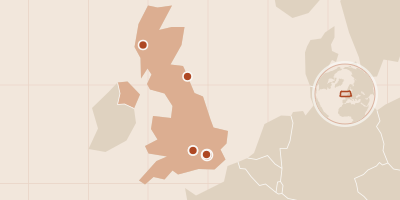
1066 in three battles: Fulford and Stamford Bridge in the north, then Pevensey, Hastings and Battle in the south, with Westminster at both ends. Edward the Confessor died childless that January; by Christmas Day Harold Godwinson had fallen and William of Normandy was crowned.
The route follows the crown from Westminster to the Yorkshire landing of Harald Hardrada, Fulford and Stamford Bridge, then to Pevensey, Hastings and the field at Battle, and back to Westminster on Christmas Day. The exact ground of several battles is debated, so those pins mark the best-known sites.
Netherfield Park is let at last, and Austen's novel follows Elizabeth Bennet from her family's village to a Kent parsonage and on to Derbyshire. The houses of the book are described rather than mapped, so this route follows the real places where the 2005 film and the 1995 BBC series found them.
Nine stops follow the story in order, from Longbourn to the inn at Lambton. Each pin is a real filming site standing in for a place in the book; only Gracechurch Street is the real London street the novel itself names.
Ezio Auditore da Firenze comes to Constantinople in 1511, an old Assassin chasing five keys that unlock a library sealed beneath Masyaf by Altaïr two and a half centuries earlier. The keys lie scattered across an Ottoman capital caught between the succession claims of the princes Ahmet and Selim, with Byzantine Templars working against the city; the search runs from the Galata Tower and Hagia Sophia to the palace at Topkapı, out to the Maiden's Tower in the Bosphorus and, at the end, into a stronghold of the Byzantine Templars under Cappadocia.
This route starts at Masyaf in Syria and follows Ezio through the real Istanbul of the game, the tower, church, palace and islet that can still be visited, before ending underground in Cappadocia.
Kalos is Metropolitan France turned into a star-shaped Pokémon region. Lumiose City is inspired by Paris, its Prism Tower by the Eiffel Tower and its art museum by the Louvre; the Battle Château recalls Chenonceau on the Loire, the palais Chaydeuvre is the château de Versailles, and the stones outside Geosenge Town are the Carnac stones. The games never confirm their models — these are fan and encyclopaedia identifications — so every pin on this route is speculative.
The route follows the story across the real France behind Kalos: the town where the adventure begins, Lumiose's iron tower, two châteaux and a royal palace, a coastal aquarium, the island tower where Mega Evolution is learned, the cathedral clock behind Anistar's sundial, the Breton megalith field where Team Flare hides its ultimate weapon, and an abandoned mine where the legendary Zygarde sleeps.
December 1499: Cesare Borgia's army has struck the Auditore villa at Monteriggioni, killing Mario and seizing the Apple of Eden. Assassin's Creed Brotherhood sends Ezio to Rome, the center of Templar power, to take the fight to the Borgia-led Templars, and the hunt for the Apple runs from St Peter's Basilica to a temple hidden underneath the Colosseum.
This route follows Ezio from the villa at Monteriggioni through Borgia Rome — the Castel Sant'Angelo fortress, the Pantheon, St Peter's and the Colosseum — to Viana in Navarre, Spain, where his fight with Cesare ends on the battlements. Every stop is a real place you can visit.
In 1868, at the onset of the Second Industrial Revolution, twin Assassins Jacob and Evie Frye come to a London controlled by the Templars under Crawford Starrick, and set out to take the city back: building their street gang, the Rooks, across an open world of seven Victorian boroughs. Jacob works through Starrick's lieutenants while Evie hunts a Piece of Eden, the Shroud, from St Paul's to the Tower to a vault under Buckingham Palace.
This route follows both threads across the capital, then jumps forward: to Whitechapel in 1888, where Evie hunts Jack the Ripper in the expansion, and to Tower Bridge in 1916, where Jacob's granddaughter Lydia clears a German spy nest at Churchill's request. Every stop is a real building or district you can walk to.
Assassin's Creed Valhalla brings the Viking Eivor and their clan to Anglo-Saxon England, where Hytham asks for help ridding the land of the Order of the Ancients. Following tip-offs from an informant who signs himself the "Poor Fellow-Soldier of Christ", Eivor hunts Order members from Grantebridge to Jorvik and Wincestre.
The route visits the real places behind the game's: Cambridge, where the jarlskona Soma takes back her town; York, the capital of Viking Britain; the docks of Repton, where the Great Heathen Army wintered; Alfred's Winchester; the battle at Chippenham in 878; and Athelney, where the informant's identity is finally revealed. All six can be visited today.
The Godfather was filmed on Staten Island, on Mott Street and in Sicily, where Savoca and Forza d'Agrò play Corleone. Michael is pulled into the family war, flees to Sicily, loses Apollonia to a car bomb and settles every score during his nephew's baptism.
Coppola shot the film on real locations around New York City and Sicily: the Staten Island house that played the compound, the Mott Street block of the Genco Olive Oil front, the villages of Savoca and Forza d'Agrò that play Corleone, the bar and church of Michael's courtship, the villa of the bombing, and the Little Italy cathedral of the baptism climax.
Before Hogwarts there is London: a market alley off Gracechurch Street, a barrier between platforms, a staircase in Oxford, a castle in Northumberland and a steam train crossing a Highland viaduct. This route visits six real places that built the Harry Potter films, shot from September 2000 to March 2001 and returned to in the sequels.
You start where Harry buys his school supplies, run through the wall at King's Cross, climb the stairs down which McGonagall comes to meet him, wake in the hospital wing, take your first flying lesson at Alnwick and ride out over Glenfinnan — six real places, each tied to the scene it created.
Ron Howard's 2006 thriller, based on Dan Brown's 2003 novel, sends symbologist Robert Langdon and cryptologist Sophie Neveu from a murdered curator in the Louvre on a quest for the legendary Holy Grail — through a Paris church, a London Templar church and Newton's tomb to a Scottish chapel.
The route follows the film's trail in story order, from the Vitruvian-Man murder and the Saint-Sulpice marker to the Temple Church dead end, the APPLE cryptex at Westminster Abbey and the 'neath-the-rose finale at Rosslyn Chapel. Note the abbey scenes were filmed at Lincoln and Winchester cathedrals.
After a job goes horribly wrong in London, two Irish hitmen are ordered to lie low in Bruges and wait for a phone call. Ken finds the city beautiful; Ray is bored rigid and says so at every turn. Martin McDonagh's 2008 dark comedy was shot entirely on location in the city in February and March 2007.
This route follows Ken and Ray through the medieval centre: their hotel, the Belfry, a church with a relic, Bosch's vision of hell in the Groeninge Museum, a park, the Lake of Love and the street where the story ends. One scene was shot in a stand-in church, and the top of the tower was a studio set.
In November 1095 Pope Urban II, answering a Byzantine emperor's plea for help against the Seljuk Turks, called western Christians to an armed pilgrimage to Jerusalem. Tens of thousands answered — knights, foot soldiers and poor pilgrims. Their armies took separate roads to Constantinople, then marched together across Anatolia and Syria. Almost four years after the call, they stormed Jerusalem and massacred much of its population.
The route follows the main armies in order, from Clermont to Jerusalem, using the participants' own chronicles as summarised by modern historians. Violence against Jews in the Rhineland and against the people of the cities on the way is part of the story and is named plainly. There are no travel tips for Syria or the Lebanese border area.