Terminator 2: Judgment Day was shot across Los Angeles and beyond in 1990 and 1991: the Sixth Street Bridge, the Santa Monica Place mall, the Bull Creek spillway and the Kaiser Steel mill in Fontana all appear in the film.
This route follows nine of those real places in story order, from the biker bar where the T-800 picks up its clothes to the steel mill where it dies. Some have vanished — the Sixth Street Viaduct was demolished and the Corral Bar is now a library — and one is in Fremont, not Los Angeles at all.
Jaws was filmed on Martha's Vineyard, which stood in for Amity Island: Edgartown, State Beach and the Jaws Bridge.
Steven Spielberg began shooting there on 2 May 1974, using the island's whaling town, its barrier beaches and the little Chappaquiddick ferry as the summer resort the shark terrorises. This route follows the film from the opening bonfire at South Beach to the last shot off Cape Poge Light. In between are Brody's beach-closing signs at Water and Main, the Kintner attack at Joseph Sylvia State Beach, the shark's run under the American Legion Memorial Bridge into Sengekontacket Pond, Quint's vanished workshop at Menemsha and the open water between Oak Bluffs and East Chop where the Orca hunts.
On 28 July 2010 Okabe Rintaro and Mayuri Shiina walk into the Radio Kaikan for a conference, and Okabe finds Kurisu Makise lying in a pool of blood. A text message sent moments later reaches his friend Daru a week early, and the PhoneWave in their Akihabara lab turns out to send mail into the past.
The route follows the real streets behind the visual novel and anime: the station exit, the Radio Kaikan hall where the story starts, the lab above a television repair shop, Mayuri's maid café, Ruka's shrine and the gyudon shop where the lab members eat. The old Radio Kaikan was demolished in 2011, so the present building is a 2014 replacement.
Two Naughty Dog adventures, two treasure hunts: Nathan Drake chases Marco Polo's Cintamani Stone from an Istanbul museum through Borneo and Nepal to the legend of Shambhala, then follows Francis Drake's secret to a lost city in the Arabian sands.
The route follows both games in order. The legendary cities are invented or borrowed, and the game rarely names a real site, so every pin marks the country, city or region behind the chapter.
In September 1978, an 18-year-old photographer named Reza Shirazi comes home to Tehran and is pulled into the last days before Black Friday. The developers built the game from interviews with forty Iranians who lived through the revolution and from photographs by Michel Setboun; the streets, the cinema hideout and the prison are real places, filled with a fictional cast.
This route follows the game's 1978 story in order, from a Hasanabad rooftop to the shooting at Jaleh Square, then ends in the Evin Prison interrogation that frames the whole game. It is a route through the city the game recreates, not a walking itinerary.
Age of Empires II follows Joan of Arc from a French army camp at Vaucouleurs to the stake at Rouen. The designers said they deferred to history wherever it did not interfere with gameplay, and the campaign's spine — Orléans, Patay, Reims, Paris — is close to the record. But the game also bends the story, placing Joan at a battle she missed and turning a failed assault on Paris into a betrayal. This route follows the campaign's stops in order and sets each one beside what the sources say happened there.
Lost Heaven, Illinois, never existed. The game's studio built it as a 1930s Chicago: an American city split by rivers, its downtown a wall of new skyscrapers, its West Side holding Italian and Chinese neighborhoods, its fortunes made on Prohibition bootlegging. The studio called Chicago of the 1920s and 1930s its real-world inspiration.
This route follows six real Chicago places that stand behind Lost Heaven's geography and mood: the river at Wolf Point, the elevated Loop, the Board of Trade, Taylor Street, Chinatown and a jazz club with Prohibition history. The pins mark real Chicago sites, not in-game locations; Lost Heaven is fictional and the game maps no district one-to-one onto the city.
The Driver series began in 1999 as a car-chase game and grew into a tour of real cities: Miami, Los Angeles and New York in the first game, Havana, Las Vegas and Rio de Janeiro in Driver 2, Nice and Istanbul in Driver 3, and a fictionalised San Francisco in the 2011 sequel. Tanner's undercover work runs from a Miami parking garage to a presidential car, a Rio climax beneath Christ the Redeemer and the Golden Gate Bridge.
This route follows the series city by city, from Ocean Drive's Art Deco hotels to the Las Vegas Strip and the Bosphorus. Some stops are city-level pins because the games recreate whole urban areas rather than single buildings; only Christ the Redeemer and the Golden Gate Bridge are pinned exactly.
Test Drive Unlimited sent players around Oʻahu's 1,000 miles of roads in 2006; The Crew Motorfest returned to a scaled-down island in 2023, with a car-culture festival at its centre. Both treat the island as a stage, one for a free-roam lifestyle racer and the other for a themed racing playground.
This route follows a road-trip loop from Honolulu Airport through Waikiki, Diamond Head, Hanauma Bay and the North Shore to Haleʻiwa, then back south to Pearl Harbor. Pins mark the real places; the games shrink the island and invent some of the roads in between.
Akito wakes after a traffic crash in a Shibuya emptied by a masked occultist's fog, sharing his body with the spirit KK and able to see the Marebito that now fill the streets. Tango Gameworks built the district as a condensed, walkable stage rather than a straight copy, keeping landmarks, borrowing back streets and folding in a few districts from elsewhere in Tokyo.
The route follows the game from the scramble crossing and the station through Center Gai, Dōgenzaka and the 109 stand-in, then north to a borrowed Yanaka Ginza and across town to the Tokyo Tower finale. Pins mark the real places; the game's map moves some of them closer together.
In the spring of 1989, Henry leaves Boulder for a summer job as a fire lookout in Wyoming's Shoshone National Forest. His only company is Delilah, the voice on the other end of a walkie-talkie, until fireworks at a lake, a ransacked tower and a fenced research camp turn the job into a mystery.
The route follows the game's places and the real Wyoming behind them: the bar where Henry meets Julia, the Cody rodeo the characters talk about, the Shoshone forest still marked by the 1988 Yellowstone fires, and stand-ins for the fictional Two Forks tower, Jonesy Lake, Wapiti Station, Cave 452 and Thorofare Lookout.
inFAMOUS 2 builds New Marais from real New Orleans: the French Quarter, Bayou St. John, Oak Alley, Fort Jackson and the Lower Ninth Ward. Cole MacGrath flees ruined Empire City to a Louisiana city ruled by the demagogue Joseph Bertrand and needs a scientist, a device and power cores to beat the Beast.
New Marais is Sucker Punch's New Orleans: a fictional city assembled from the French Quarter, above-ground cemeteries, plantation houses, a Civil War fort, the bayous and the flooded districts left by a hurricane. This route follows Cole's story through seven of those stand-ins, from the swamp where he lands to the cathedral tower where the game ends.
In January 1981 a CIA team led by Russell Adler hunts Perseus, a Soviet spy Adler believed dead. The trail runs from an Amsterdam bar and a Vietnam flashback to East Berlin, the KGB's Lubyanka and a Cuban firefight, before reaching the Solovetsky Islands. The route follows the campaign's real places in mission order and keeps the game's story apart from the real history of each place. A final stop marks the alternate ending at Duga.
In August 2010 a Bohemia Interactive team went to Lemnos to gather references, and came back with the material for Altis, the island where Arma 3 is set. Two years later two of the studio's developers were arrested on the same island and held for 129 days on suspicion of spying. After the arrest the game's main island, until then called Limnos, was renamed Altis; Stratis kept its name.
The route follows the real island from Myrina and its castle, past a church with no roof and a miniature desert, to the airport and the old Allied base at Moudros, then across the water to Agios Efstratios. Arma 3's war is set in 2034–2035; the harbours, theatre and dunes are not.
Percy Jackson is a twelve-year-old boy in New York City who has just learned that the Greek gods are real — and that Zeus's master bolt is missing. With Annabeth and Grover, he has ten days to cross the country, find the bolt and reach the Underworld beneath Los Angeles before a war breaks out on Olympus.
Rick Riordan's 2005 novel turns real American landmarks into monster stops: the Metropolitan Museum of Art, a Montauk beach, the Gateway Arch, a Denver water park, a Las Vegas casino that eats time, the Santa Monica Pier and the Empire State Building. A Disney+ series adapted the story from December 2023 to January 2024.
Wim Wenders' Perfect Days follows Hirayama, a Tokyo toilet cleaner who keeps his days exactly the same: the same overalls, the same cassette tapes, the same sandwich under the trees. The city changes around him; he notices the light through the leaves.
This route follows the film's real Tokyo, from the old apartment east of the Sumida to four of the Tokyo Toilet project's designer facilities, the shrine bench where he eats lunch, the sento and Asakusa bar that fill his evenings, and the bridge where the story ends.
In 1600 an English pilot came ashore in Japan. FX's Shōgun renames the players — John Blackthorne is William Adams, Lord Toranaga is Tokugawa Ieyasu, Lady Mariko is Hosokawa Gracia — and moves the shipwreck from Usuki to the Izu village of Ajiro. This route follows the documented places behind the drama, from the real landing at Usuki and the regents' court at Osaka Castle to the mansion where Gracia died, Adams's shipyard at Itō, his house in Nihonbashi and his grave at Hirado. The 2024 series was filmed in British Columbia.
Where The Last Kingdom is set: Bamburgh Castle in Northumberland, Viking York, the Somerset marshes at Athelney and the battlefield at Edington, the real ground of Uhtred's wars. A Saxon boy raised by Danes, he fights for Alfred and against him, and each stop is set against what history records.
The television series adapts Bernard Cornwell's Saxon Stories; where a stop follows a particular novel or series, the point says so. The show was filmed mainly in Hungary, so the places below are the real settings of the events, not the filming locations.
Goblin was filmed in Seoul, on the Jumunjin breakwater on Korea's east coast and in Quebec City, where the red door in Petit-Champlain, the Château Frontenac and the Tourny fountain appear. A Goryeo general killed by his king returns as an immortal goblin and spends 939 years looking for the bride who can pull the sword from his chest.
The route follows the story from the palace set where his Goryeo past was filmed to his house in Seoul, the Gangneung breakwater where they first meet, and the old streets of Quebec City beyond a red door. It ends at the park that stands in for the Yoo family cemetery.
Russia's best-loved bogatyr was a peasant's son who could not walk until he was 33. Then he set out for Kiev, defended a city, killed a whistling monster in the forest and became the chief hero of Prince Vladimir's court.
The route follows the epic songs known as byliny, from his village near Murom to the Kiev Pechersk Lavra, where the relics of a real monk, Ilya Pechersky, are said by some to be the hero's. Legend and history are marked apart: the pins show where tradition puts the story, not proof that it happened.
Sleeping Dogs sends an undercover cop into the Sun On Yee triad across a compact Hong Kong built from four real Island districts. The designers photographed the city for a week and then bent it to fit the story.
This route visits the four districts in turn, starting with Aberdeen, where the story opens. Pins mark whole districts, not mission sites: no source ties a specific mission to a street.
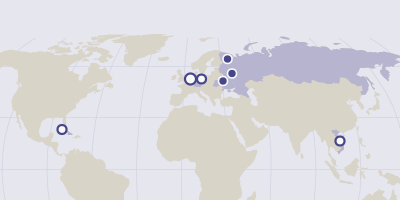
Mafia II is set in Empire Bay, a city that never existed but borrows from six real American ones. This route follows Vito's story from Sicily in 1943 to the 1951 war between mob families and the Triads.
Only Sicily and a New York City stand-in are pinned; the sources tie no mission to a real place, so the remaining story stops stay unpinned.
Port Royal and Tortuga were built on a quiet St Vincent bay, Cannibal Island is Dominican rainforest, and a private Bahamian cay sits behind a famous duel.
This route follows the shoots from St Vincent in 2002 through Dominica in 2005 to Grand Bahama, where the ships were filmed in a hurricane season. Most pins mark areas, not exact sets; the sets themselves were built and taken down.
Gilgamesh, king of Uruk, goes looking for the secret of immortality. This route follows the epic from its city to the Cedar Forest and the flood hero's home, then to the Nineveh library where the tablets were found.
The poem's places are legend and the tablets' places are archaeology; each stop says which, and which pins are only candidates. The Iraqi sites are not visitor destinations.