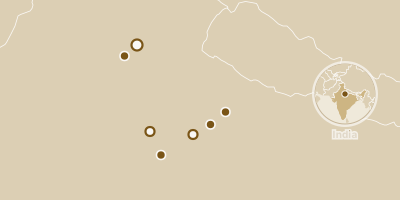
Tradition links the Mahabharata to northern India: the Kuru court at Hastinapur near Meerut, Kampil for Draupadi's contest, Delhi's Purana Qila as Indraprastha, and Jyotisar, where Krishna speaks the Bhagavad Gita. The five Pandava brothers survive a murder plot, lose everything in a rigged dice game and meet their hundred cousins in an eighteen-day war at Kurukshetra.
Northern India is dotted with places that tradition links to the story, several of them with real Iron Age remains. This route follows the Pandavas through those traditional sites. They are identifications of faith and local memory; archaeology has found ancient towns, but not the epic's events.
On the eve of his coronation, Prince Rama of Ayodhya is sent into the forest for fourteen years, so that his stepmother's son can rule. His wife Sita and brother Lakshmana go with him. In the forest Sita is carried off by Ravana, the demon king of Lanka, and Rama, helped by Hanuman and an army of vanaras, monkey-like forest people, crosses the sea to win her back. The Sanskrit epic attributed to Valmiki runs to some 24,000 verses and is still retold, staged and worshipped across South and Southeast Asia.
For centuries pilgrims have tied its episodes to real places, from Ayodhya to the hills of Sri Lanka. This route follows those traditional identifications, which are matters of faith and local memory rather than archaeology. Most of the stops are living temples.
King Pelias sends his nephew Jason to fetch the Golden Fleece from Colchis, at the far end of the Black Sea, hoping he will never come back. Jason builds the Argo, gathers the greatest heroes of his day, Heracles among them, and sails east. Apollonius of Rhodes told the voyage in his Argonautica in the 3rd century BC, and he filled it with real coasts, harbours and local legends.
This route follows the outward voyage to Colchis. The way home is left out: ancient writers sent the Argo back by wildly different routes, up rivers into the Adriatic and even across Libya. The heroes and the fleece are myth; the shores, islands and ancient cities are real. Quotations are from R. C. Seaton's 1912 translation.
Troy has fallen. Aeneas, a Trojan prince, carries his old father out of the burning city and sets sail with the survivors to find the new homeland the gods have promised them. Virgil's Aeneid, written for Augustus in the 20s BC, follows years of wrong turns, storms and prophecies until the exiles land in Italy, where their descendants will one day found Rome.
This route follows the voyage in the order it happens, which is not the order Virgil tells it: the poem opens in Carthage and lets Aeneas recount the earlier wanderings to Queen Dido. Every stop is a real ancient site, most now open as archaeological parks; Aeneas himself belongs to legend. Quotations are from John Dryden's 1697 translation.
In Indiana Jones and the Great Circle (MachineGames, 2024), set in 1937, the trail of a stolen mummified cat runs from the Vatican and Giza to Shanghai and Sukhothai. Indy races the Nazi archaeologist Emmerich Voss around this "Great Circle" of sacred sites — a story Todd Howard conceived for the game.
The circle and its secret are pure adventure fiction, but its stops are real: the Vatican, Giza, wartime Shanghai, the ruined Thai capital of Sukhothai and the ziggurat of Ur. The designers rebuilt them from books and photographs as they would have looked in the 1930s. This route follows the main story.
Egypt, 49 BC. Bayek, the last Medjay protector of the Siwa Oasis, loses his son to a band of masked men, and his hunt for them leads him into the war between Cleopatra and her brother Ptolemy XIII, and to the arrival of Julius Caesar. Ubisoft's 2017 game ends with Bayek and his wife Aya founding the secret brotherhood that the whole series grows from.
The studio worked with Egyptologists and historians, enlarged cities for a sense of "pharaonic scale", and later added a combat-free Discovery Tour. This route follows the main story through the real places it uses, from the oracle at Siwa to the spot in Rome where Caesar died. Bayek and the secret orders are fiction; the queen, the generals and the murders mostly are not.
Fallout: New Vegas rebuilds the real Mojave: Goodsprings, Primm, Nipton, Searchlight, Boulder City and Hoover Dam are all on its map. In 2281 a courier carrying a platinum poker chip is shot and left in a shallow grave, survives and hunts the man who did it, into a war for the desert between the New California Republic, Caesar's Legion and Mr. House.
The designers built the map from US Geological Survey data and photographs of the real desert, so the game's road south from Goodsprings and back up to Las Vegas runs through real towns. The route follows that road. The towns' massacres, radiation and battles are fiction; their saloons, roller coasters and dam are not.
Ida Pfeiffer's 1846–1848 journey around the world passed through Hamburg, the Brazilian forest, Tahiti and Baghdad, as her own book A Woman's Journey Round the World recounts. A 48-year-old Viennese widow with little money, she travelled mostly alone by cargo ship, horseback and caravan, and came home to a Vienna in revolution.
The route follows her first world journey in order, from her own book, A Woman's Journey Round the World: Hamburg, the Brazilian forest, Cape Horn and Valparaíso, Tahiti, Canton, Baghdad, Persia and home. There are no visitor tips for Iraq or Iran.
Xuanzang's search for the original Buddhist scriptures runs from Chang'an across the Taklamakan's edge, the Tian Shan and the Hindu Kush to the Buddhas of Bamiyan, then on to Taxila, Kashmir and Nalanda. The monk left in 629 despite a Tang ban on foreign travel, and his record inspired Journey to the West.
His travel record, the Great Tang Records on the Western Regions, is still a key source for the history of Central Asia and India, and his journey inspired the classic novel Journey to the West. The route follows him there and back. There are no travel tips for Afghanistan.
In December 1831 a 22-year-old Cambridge graduate with a passion for beetles and rocks sailed from Plymouth as an unpaid naturalist on HMS Beagle, a ten-gun survey brig. The voyage was meant to take two years and took five. Charles Darwin came home with crates of fossils, skins and notebooks — and with questions about the islands that would lead him, two decades later, to On the Origin of Species.
The route follows the ship around the world in order, using Darwin's own Journal of Researches for dates and details: the volcanic Cape Verde islands, the Brazilian forest, the fossil beds of Argentina, Tierra del Fuego, a great Chilean earthquake, the Galápagos, Cape Town and home to Falmouth.
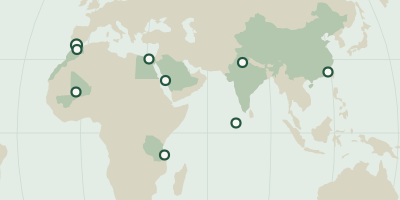
In June 1325 a 21-year-old law student left Tangier to make the pilgrimage to Mecca. He did not come home for 24 years. Ibn Battuta crossed the Islamic world and beyond — Arabia, East Africa, Anatolia, Central Asia, India, the Maldives, Sumatra and China — earning his keep as a judge and a guest of sultans, marrying and divorcing along the way. By some estimates he covered about 117,000 kilometres, more than any traveller before the age of steam.
Back in Morocco he dictated his memories, the Rihla, to a scholar who polished them and borrowed passages from older books, so not every scene was his own. The route picks out nine stops in the order he reached them; it is not one continuous road. There are no travel tips for Mecca or Mali.
In November 1095 Pope Urban II, answering a Byzantine emperor's plea for help against the Seljuk Turks, called western Christians to an armed pilgrimage to Jerusalem. Tens of thousands answered — knights, foot soldiers and poor pilgrims. Their armies took separate roads to Constantinople, then marched together across Anatolia and Syria. Almost four years after the call, they stormed Jerusalem and massacred much of its population.
The route follows the main armies in order, from Clermont to Jerusalem, using the participants' own chronicles as summarised by modern historians. Violence against Jews in the Rhineland and against the people of the cities on the way is part of the story and is named plainly. There are no travel tips for Syria or the Lebanese border area.
On a Sunday evening in May 1857 Indian soldiers of the East India Company's army mutinied at Meerut and rode for Delhi. Within weeks much of northern India was in revolt — soldiers, princes dispossessed by the Company, and villagers with their own grievances. It took the British more than a year to crush it, and afterwards the Company itself was abolished and India placed under the Crown.
The rebellion goes by many names, from the Sepoy Mutiny to the First War of Independence. It was not one army on one road but a chain of uprisings, and the route visits its main centres in order: Meerut, Delhi, Kanpur, Lucknow, Jhansi, Kalpi and Gwalior. Both sides committed atrocities against civilians, and the texts name them plainly.
In 1324 Mansa Musa, ruler of the Mali Empire, set out on the pilgrimage to Mecca with a caravan so rich in gold that Cairo talked about it for years. Arab chroniclers wrote of thousands of servants carrying gold bars and camels loaded with gold dust; historians today treat those numbers as a way of saying "more than anyone could imagine", not as a count. The Catalan Atlas of 1375 still shows him enthroned in the Sahara, holding up a piece of gold.
The route keeps to the places the sources actually record: the royal city of Mali, the camp below the pyramids, Cairo, Mecca, and Gao and Timbuktu on the way home. The road across the desert is not documented, so it is not drawn. The route offers no travel advice for Mali.
The Boshin War ran from Kyoto to Hakodate in eighteen months: the battlefield at Toba, Edo Castle, the hill of Ueno, Aizu's castle and Goryōkaku. In January 1868 the young emperor was declared ruler in fact as well as name, ending more than 250 years of Tokugawa rule, and the last shogun's supporters fought on until a breakaway republic made its last stand.
The route follows that war in six places, all of them visitable: the battlefield at Toba, Edo Castle, the hill of Ueno, Aizu's castle and the hill where its teenage soldiers died, and Goryōkaku. Dates are given in the Western calendar, converted from the Japanese lunar dates used at the time.
In 1791 Saint-Domingue was France's richest colony, a sugar and coffee economy worked by hundreds of thousands of enslaved Africans under brutal conditions. Thirteen years later it was Haiti, the first nation born from a successful slave revolt and the first independent Black-led state in the Americas. The cost was enormous: some 200,000 Black Haitians died, and tens of thousands of French and British soldiers, most of them from yellow fever.
The route follows the turning points, from the ceremony that tradition places at Bois Caïman to the declaration at Gonaïves, with a detour to the French mountain fortress where Toussaint Louverture died. Fighting was savage on all sides, and the texts say so plainly. The route offers no travel advice for Haiti.
On 12 March 1930 Mahatma Gandhi, aged 60, walked out of his ashram in Ahmedabad with 78 followers, heading for the sea. His target was the British monopoly on salt, a tax that touched every Indian household. Twenty-four days and about 385 kilometres later, on a beach at Dandi, he picked up a lump of salty mud and broke the law — and millions followed.
The route follows the march south through Gujarat in its real order, with the dates from the day-by-day itinerary: the ashram, the first night's halt, the Kheda country, Borsad, Surat and Dandi, where a memorial now stands. The final stop covers what came next: Gandhi's arrest and the beatings at the Dharasana salt works that shocked the world.
In 1989 communist rule in Central and Eastern Europe came apart in a few months — through round-table talks in Poland, a picnic on the Hungarian border, candlelit marches in Leipzig, a muddled press conference in Berlin, students in Prague and a bloody uprising in Romania. Each country had its own causes, but every crack made the next one easier.
The route visits the exact places where it happened, most of them marked today by a memorial, a museum or a plaque: the shipyard gate where Solidarity was born, the palace of the Round Table, the old border road near Sopron, the church in Leipzig, the bridge at Bornholmer Straße, a street corner in Prague, a pastor's flat in Timișoara and the balcony in Bucharest.
Exit West sends Saeed and Nadia through magic doors from a city at war to a tent camp on Mykonos, an empty mansion in Kensington, London, and Marin County, north of San Francisco. Mohsin Hamid's 2017 novel skips the refugees' dangerous journeys and keeps only the arrivals.
The doors are magic, but Hamid calls the book "geographically autobiographical": every stop is a place he has lived in or loved. The home city is never named, though he says it was based in many ways on Lahore, so that pin is speculative.
Barcelona, 1945. A bookseller leads his ten-year-old son Daniel through a dark alley off the Ramblas to the Cemetery of Forgotten Books, a secret library where every child may adopt one book. Daniel chooses a novel by Julián Carax — and discovers that someone has spent years hunting down and burning every other copy.
Carlos Ruiz Zafón's 2001 bestseller is a love letter to the old city, and its mystery runs through real streets: the Ramblas, the Gothic Quarter, the Ribera, Tibidabo and Montjuïc. The library, the bookshop, the hospice and the Aldaya mansion are invented, so those pins mark the streets where Zafón put them; the café, squares and castle are real and open to visitors.
Ifemelu and Obinze fall in love at secondary school in Lagos, in a Nigeria under military rule where everyone seems to be planning to leave. She gets a scholarship to Philadelphia; he, refused an American visa after 9/11, ends up working illegally in London. Over thirteen years in the United States Ifemelu discovers that she has become "black" — and writes a hit blog about it — before deciding to go home.
Chimamanda Ngozi Adichie's 2013 novel moves between real cities on three continents, and the route follows it in story order rather than in the book's flashback structure. Homes, salons and the university in Philadelphia are not identified, so most pins mark the city or campus.
In 1970s Kabul, Amir, the son of a rich merchant, and Hassan, the son of his father's Hazara servant, grow up as near-brothers and fly fighting kites together. In the winter of 1975 Amir wins the city's kite tournament — and fails Hassan at the moment Hassan needs him most. War sends Amir into exile in California; a phone call from Peshawar a quarter of a century later sends him back into Taliban Kabul to make amends.
Khaled Hosseini's 2003 debut follows real places in Afghanistan, Pakistan and California. Homes and alleys in the story are not identified, so those pins mark neighbourhoods; the route offers no travel advice for Afghanistan or Peshawar.
On 16 June 1994 an American, Jesse, and a French student, Céline, meet on a train from Budapest. He talks her into getting off with him in Vienna, and with no money for a hotel they walk the city all night, talking about love, death and everything else until his flight leaves in the morning. Richard Linklater's 1995 film was shot entirely in Vienna and began a trilogy that continued in Before Sunset and Before Midnight.
The film strings its locations together as if they were a single walk; in reality they are scattered across the city, from the outer districts to the Danube. This route visits them in the order of the night.
Breaking Bad was both set and filmed in Albuquerque, New Mexico, and its car wash, motels, diners and Los Pollos Hermanos became as recognisable as the cast. Walter White, a high school chemistry teacher with stage-three lung cancer, starts cooking methamphetamine with a former student, Jesse Pinkman; Vince Gilligan's series ran on AMC from 2008 to 2013, 62 episodes in all.
This route visits seven places from the series and its film sequel, El Camino. Almost all of them are working businesses. The White and Pinkman houses are people's real homes and are deliberately left off the map.