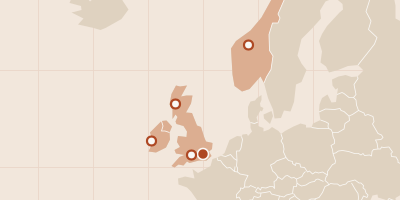
Harry Potter and the Half-Blood Prince was filmed at London's Millennium Bridge, Lacock Abbey in Wiltshire, Fort William in Scotland, Norway's Rauma Line and the Cliffs of Moher in Ireland.
The route follows the 2009 film's scenes in order, from the bridge collapse that opens it to the sea cave where Harry and Dumbledore hunt a Horcrux. Hogwarts Express shots even left the UK for snow in Norway.
Most spots are real places you can visit; the cave interior itself was computer-generated.
Jack the Ripper's Whitechapel murders of 1888 happened along a few Whitechapel and Spitalfields streets: Durward Street (then Buck's Row), Hanbury Street, Berner Street, Mitre Square and Miller's Court in Spitalfields. Five killings are generally attributed to the unidentified murderer.
This route follows the canonical victims in date order, with the Goulston Street graffito and the Ten Bells pub. Some sites are gone or renamed, and Miller's Court has no pin.
Zodiac (2007) is set around the San Francisco Bay Area, from Vallejo and Lake Berryessa to Presidio Heights and the San Francisco Chronicle. The film follows the real Zodiac Killer case.
This route walks five places from the film in story order, from the July 1969 attack at Blue Rock Springs Park to the police hunt. Several scenes were shot in Los Angeles, which is noted where it matters.
Little Women is set in a Massachusetts town loosely based on Concord, and Louisa May Alcott wrote it at Orchard House, the Alcott family home that is now a museum. Follow the March sisters from Concord to Washington, Nice and Lake Geneva.
The route visits Orchard House and The Wayside, where the Alcott family lived and acted out scenes later used in the book, then follows the story abroad: a Washington hospital, the Promenade des Anglais in Nice and Chillon on Lake Geneva. The Concord stops are the real houses behind the March family's home.
The Last Samurai (2003) is set in Japan in 1876 but was filmed mostly in Taranaki, New Zealand, where Mount Taranaki stands in for Mount Fuji, plus Engyō-ji near Himeji, Chion-in in Kyoto and Castle Green in Pasadena.
This route follows Nathan Algren's story from the opening restaurant scene to the parade ground, the fog battle, Katsumoto's village, his temple and the emperor's palace, and shows where each one really is. Several stops are sets or stand-ins.
The Satsuma Rebellion of 1877 began in Kagoshima, besieged Kumamoto Castle, was fought out at Tabaruzaka and ended on Shiroyama, where Saigō Takamori died. This route follows the samurai army from its first march to its last stand.
Six stops run from Kagoshima Castle through Kumamoto, Hitoyoshi and Mount Enodake and back to Kagoshima. Three are exact landmarks you can visit; the battlefield and retreat stops are approximate.
Saint Nicholas, the early Christian bishop of Myra, was born at Patara, served at Myra (modern Demre) and now rests in Bari, with more relics in Venice. This route follows his legend from Lycia to Nicaea, Gemiler Island and Apulia.
Historians know little of the real man, so the route follows the traditional story and the journey of his bones. It ends in 1087, when sailors carried them across the sea, and in the Venice church that holds more.
John Muir's 1867 walk from Kentucky to the Gulf of Mexico passed Mammoth Cave, the Cumberland Mountains, Savannah's Bonaventure Cemetery and Cedar Key. He told it in A Thousand-Mile Walk to the Gulf.
The route follows the book from Louisville to Florida, then on to Yosemite Valley in 1868. Some stops are general areas rather than exact spots, as marked on each point.
York has been defended by walls since Roman times, and this walk strings together six places around them: the Multangular Tower, York Minster, Clifford's Tower, Micklegate Bar, the Shambles and Walmgate Bar.
Each stop is a moment in the city's story, from a Roman fort built around 71 AD to a siege in 1644.
St Petersburg's history can be walked in an afternoon: from the Peter and Paul Fortress, where the city was founded in 1703, past Kazan Cathedral on Nevsky Prospect to Senate Square, Palace Square and the cruiser Aurora on the Neva.
Seven stops follow the city from its foundation through the Decembrist revolt of 1825, the assassination of Alexander II, Bloody Sunday in 1905 and the events of October 1917. The stops zigzag across the centre, so the pins are markers rather than a single line.
The Berlin Wall ran past the Brandenburg Gate, Checkpoint Charlie and Bernauer Straße, and much of that story can be walked today. It went up overnight on 13 August 1961 and stood until the border opened in November 1989.
This route follows the Wall from its first day to its afterlife: the gate it closed, the checkpoint where tanks faced each other, the station border hall, an escape tunnel, the memorial and the painted East Side Gallery.
Bonnie and Clyde's two-year run took them from Eastham prison farm in Texas through a Joplin shootout, the Red Crown Tourist Court in Missouri and Dexfield Park in Iowa, to a roadside ambush near Gibsland, Louisiana.
This route follows the real trail in order, from Clyde Barrow's prison years to the morning of 23 May 1934 and his burial in Dallas. Some spots are only approximately known, and each says so.
Wyatt Earp's story runs from the Long Branch Saloon in Dodge City, Kansas, to the Oriental Saloon, the lot beside Fly's and Boothill Graveyard in Tombstone, Arizona, and on to the railroad tracks of Tucson.
It follows the lawman from his 1878 job as a Dodge City assistant marshal through the Gunfight at the O.K. Corral on 26 October 1881 to the killings that followed in 1882. Exact buildings are uncertain for several stops, and those pins are marked approximate.
Gone with the Wind is set in Georgia: Tara lies about five miles outside Jonesboro, and Scarlett O'Hara's Atlanta runs along Peachtree Street. The depot, Five Points and Oakland Cemetery are real Atlanta places the story names.
The route follows the novel from the eve of the Civil War through the depot and Five Points in the fall of Atlanta in 1864, and ends at the Margaret Mitchell House, where the book was written.
Selma Lagerlöf's Nils Holgersson flies over Sweden on a goose's back, from the castles of Skåne at Vittskövle and Glimmingehus to the cliffs of Kullaberg, Karlskrona, Öland and Stockholm's Skansen.
The novel takes a tiny boy across all the historical provinces of Sweden. This route follows six real places from its southern chapters to the capital, with the scene the book sets at each. Ottenby is approximate.
Captain Alatriste is set in Madrid, from the Plaza Mayor and the House of the Seven Chimneys to the Prado, where Velázquez's The Surrender of Breda hangs, and from the siege of Breda to Seville. Arturo Pérez-Reverte's novels follow a Spanish sword for hire and his young squire Íñigo Balboa.
The route walks the Madrid of the first two books, follows the army to Breda in the third, and ends in Seville with The King's Gold. Breda and Seville are approximate pins; the Madrid stops can be visited.
Hašek's The Good Soldier Švejk is set in Prague, in the pub U Kalicha on Na Bojišti, and in Tábor, Putim, České Budějovice and Bruck an der Leitha, on Švejk's way to the front.
The route follows Švejk from his Prague local, by train and on foot through South Bohemia, to the town on the Austria–Hungary border where the regiment is stationed.
Jules Verne's novel sends Dr. Samuel Ferguson across Africa in a balloon filled with hydrogen, from Zanzibar past Lake Victoria, Lake Chad and Timbuktu to the Senegal River and Saint-Louis.
The route follows seven places from the book in order, from the departure port to the Nile source, the desert crossing and the falls of Gouina where the Victoria is lost. Verne's Africa is a nineteenth-century view, and the novel's pins are broad: most marks are areas, not exact spots.
XO, Kitty, the spin-off of the To All the Boys films, is set at a fictional Seoul school but filmed at real places: Incheon International Airport, Kaywon University of Art and Design, the Dongdaemun Design Plaza and Hwaseong Fortress's Seojangdae.
The route follows Kitty's first season from landing at the airport to the end-of-term talent show, taking in a hotel exterior at State Tower Namsan, Nodeul Island on the Han River and the Independence Hall of Korea in Cheonan. The school itself is fictional, and its interiors were shot at other sites around Seoul.
Zhang Yimou's Hero (2002) was shot at Hengdian World Studios in Zhejiang, near old Dunhuang in the desert, at Arrow Bamboo Lake and Nuorilang Falls in Jiuzhaigou, and in an autumn oak grove in Inner Mongolia.
The route follows the film from the Qin king's palace to the calligraphy school, the golden-leaf duel, the lake fight and the waterfall. Two stops are unpinned: the sources name the desert location and the oak grove only by area.
Dilwale Dulhania Le Jayenge is set between London, the Swiss Alps and Punjab, and was filmed in Gstaad, Saanen, Zweisimmen and near Gurgaon. Raj and Simran meet on a backpacking trip across Europe and fall in love before her arranged marriage.
The route follows the story from Trafalgar Square and King's Cross to the Swiss stations and the Gstaad promenade, then to the mustard fields outside Gurgaon and the final platform at Apta. The Punjab scenes were filmed elsewhere in India, which the stops say plainly.
Fellini's film La Dolce Vita follows the journalist Marcello from Saint Peter's Square to the Baths of Caracalla, the Trevi Fountain and the Via Veneto, ending on a beach at Passo Oscuro.
The route follows Marcello's episodes in film order, from the helicopter prologue to the dawn on the beach. Much of the film was shot in studio sets, so the route notes where a real place stood in for a set, or the reverse.
Bridget Jones's Diary is set and filmed around Borough Market in south London, with Shad Thames, the Royal Courts of Justice and Cornhill on the way. The film moves Bridget from Holland Park to a flat above the Globe pub, where the story begins.
This route follows the film's story through eight London and country locations: the book launch at the ICA, the first date at Shad Thames, the mini-break at Stoke Park, the anniversary party at Syon House and the snowy finale. The film was shot over six weeks in and around London in 2000.
Crocodile Dundee follows a Northern Territory bushman from the billabongs of Kakadu to the Plaza Hotel and the subways of Manhattan. Its Walkabout Creek is really the pub at McKinlay, Queensland; its outback is Anbangbang Billabong and Gunlom Falls; its New York runs from Newark airport to Columbus Circle.
The route follows reporter Sue Charlton and Mick Dundee from the outback to New York, one filming location per scene. A few places stand in for others, and the captions say where.