At 21, Jack London sailed north in July 1897 to join the Klondike gold rush. He came home without gold but with scurvy and the stories that made his name: The Call of the Wild, "To Build a Fire" and more.
This route follows him from the beach at Dyea over the Chilkoot Pass, down the lakes and rapids of the Yukon, through a winter at the Stewart River to Dawson City, where his cabin still stands.
Sadko is a poor gusli player from Novgorod whose music wins the favour of the Sea Tsar, a golden fish and a fortune, until the sea demands payment. The story is best known abroad through Rimsky-Korsakov's opera.
The route follows the tale through the real geography it grew from: the merchants' market, Lake Ilmen, the Volkhov trade route, the river's source, and the Novgorod church of the man Sadko may be based on. None of the places is named exactly in the tale, so all pins are approximate.
Assassin's Creed Mirage is set in 9th-century Baghdad, with the Round City and the House of Wisdom, and stops at Anbar, Alamut and al-Ula. Street thief Basim Ibn Ishaq becomes a Hidden One hunting the Order of the Ancients amid the Anarchy at Samarra.
The route follows him from the ruined town of Anbar to the mountain fortress of Alamut, through the districts of Baghdad and on to the oasis of al-Ula. Little of the Round City survives and the House of Wisdom is gone, so those pins are approximate; the Iraqi stops are for reading, not visiting.
Disguised as a beggar, a Belgian-French explorer walked into the forbidden city of Lhasa among pilgrims. Alexandra David-Néel and her adopted son Yongden stayed two months in 1924, then slipped away before the governor could act.
The route follows her from Kumbum, where she studied for years, across the Kyi to the Potala and the Monlam crowds, then on to Samye, Tsetang and Gyantse. Pins are area-level, and critics have disputed her account since 1972.
El Dorado is Lake Guatavita, 57 km northeast of Bogotá, where legend sets the gilded zipa's raft, with stops at Funza, Sogamoso and the Gold Museum. The ritual was written down generations after the conquest; the gold and the draining are history.
The route follows both threads, and each stop says which is which: Quesada's march in 1537, the lake itself, the drainage, a rival lake, the cave where a raft turned up in 1969 and the Bogotá museum that keeps it.
Fionn mac Cumhaill is the hero of Irish legend who gained all knowledge by burning his thumb on a salmon, saved Tara from a fire-breather and, in folk tales, built the Giant's Causeway to reach a Scottish rival. His stories are tied to real hills, rivers and rocks, many of them still named for him.
The route follows his legend from the Boyne of his boyhood through Tara, the Hill of Allen, Slieve Gullion and Benbulben, then to the tall tales of Lough Neagh, the Causeway and Fingal's Cave. Nothing here is history: pins mark where tradition places each tale.
Heracles' first six labours are set across the Peloponnese: Tiryns, Nemea and its lion, Lerna and its Hydra, Ceryneia, Erymanthos and Elis. He must kill a lion no arrow pierces and a many-headed Hydra, and clean a stable of thirty years' dung.
This route follows the first six labours in their traditional order, from the fortress of Tiryns through Nemea, Lerna, Ceryneia, Erymanthos and Elis to Lake Stymphalia. The myth rarely names an exact spot, so most pins mark the place the tale is tied to, not a cave or a lair.
A baker's oven in Pudding Lane, a gale from the east and a city of timber and pitch: in four days in September 1666 the fire destroyed medieval London, including Old St Paul's. Samuel Pepys watched it from the Tower, from the river and from a church tower, and wrote it all down.
The route follows the fire from its first spark on Sunday morning to its end on Wednesday, then to the Monument and the Golden Boy that remember it. Where the sources give only an area, such as the refugee camps at Moorfields, the pin marks it loosely.
A retired detective with a fear of heights is hired to follow a friend's wife around San Francisco, because her husband fears she is possessed by Carlotta Valdes, a woman who died in 1857. Hitchcock's 1958 thriller was shot on location in San Francisco, at Mission San Juan Bautista, in Big Basin Redwoods State Park, at Cypress Point on 17-Mile Drive and at Paramount Studios in Hollywood.
This route follows the story in film order through nine places: a vanished restaurant, a Nob Hill apartment block, a mission cemetery and an art museum, a fort under the Golden Gate Bridge, a coastal kiss, a mission bell tower and a hotel with a green neon sign.
Gil Pender is a screenwriter with a nostalgia problem, in Paris with a fiancée and her wealthy parents. Every night at midnight a 1920s car pulls up and carries him back to the 1920s, among the Fitzgeralds, Hemingway and the surrealists. By day he is stuck in 2010.
This route follows the film from Monet's garden at Giverny to Pont Alexandre III, with the stops placed from a film-locations guide: where the 1920s scenes are shot you can still sit, eat and shop today. The party and flea-market scenes are approximate.
King Arthur's legend has no single home: he is conceived at Tintagel and holds court at Caerleon, Cadbury Castle is claimed as Camelot and Glastonbury is linked to Avalon. The route follows Geoffrey of Monmouth, Malory and others from Merlin's dragons to the sword returned to the water.
Every pin marks a real place that tradition has attached to an episode, not a site proven by history, and each stop says where the link is doubted.
Murder on the Orient Express runs from Aleppo through Istanbul and Belgrade to a snowdrift near Vinkovci. Poirot's train is stuck there with a murdered man aboard and the killer still on it.
The route follows the story from Aleppo station through Istanbul, where Poirot gets his telegram and his berth, and Belgrade to the snowdrift near Vinkovci. It ends with the 1932 kidnapping that gave Christie her plot. Most pins are indicative: the novel names few exact places.
Agatha Christie's 1937 mystery puts Hercule Poirot on holiday in Aswan, waiting to board the Nile steamer Karnak. Among his fellow passengers are a jilted woman stalking her ex-fiancé's honeymoon, her former friend the heiress, and a boulder that comes uncomfortably close to the bride.
The route follows the steamer from Aswan to Wadi Halfa and ends at Karnak, where the 1978 film moves the falling stone. The novel itself puts that scene at Abu Simbel.
In April 1625 an eighteen-year-old Gascon rides into the market town of Meung on a yellow pony, bound for Paris and the King's Musketeers. Dumas's novel follows D'Artagnan from that first quarrel through duels, a secret night in the Louvre, a bet made during a siege and a midnight ending on a river bank.
The route runs from the Loire to Paris, on to La Rochelle and Portsmouth, and back to the banks of the Lys. The streets, squares and palaces are real; most inns, houses and bastions are Dumas's, so several pins mark a town or a street rather than a building.
Watch Dogs 2 recreates the Bay Area: San Francisco, Oakland, Marin County and Silicon Valley, from Coit Tower and the Golden Gate Bridge to Alcatraz and a parody of the Googleplex, where the hacker Marcus Holloway and his crew DedSec set out to bring down the Blume corporation's surveillance network.
This route follows the places where the story's operations happen, from Coit Tower and Embarcadero Center to Sutro Tower, the Googleplex, Ubisoft's own studio, the Golden Gate Bridge and Alcatraz.
Hill Valley is fictional, but almost all of it is Los Angeles. The 1985 film sends Marty McFly thirty years back to a small California town, and the filmmakers built its square on a studio backlot and dressed real malls, schools, churches and houses around the city as Hill Valley. This route follows the story from the Twin Pines Mall car park in City of Industry through 1955 and back to the McFly home in Arleta.
Each stop is a real place that played a piece of Hill Valley; the private homes are seen from the street only.
Assassin's Creed IV Black Flag sets its pirate Caribbean in Havana, Nassau, Kingston and Port Royal. Edward Kenway steals a dead Assassin's name, takes the Jackdaw, builds a brotherhood in Nassau, loses his friends and chases the Observatory, a device that can watch anyone on earth.
Black Flag sets all of it in real ports — Havana, Nassau, Kingston, Port Royal — and then leaves the Caribbean for the Maya ruins of Tulum, an island in the Gulf of Guinea and a final scene in London. The route follows Edward from the harbour where Torres's plot starts, through the pirate republic and the governor who ends it, to the Kingston house where Mary Read drops the disguise, the jail at Port Royal, Príncipe, where the Sage is waiting, and Covent Garden. Most stops mark a real landmark in the town the game rebuilds.
Tradition links the Mahabharata to northern India: the Kuru court at Hastinapur near Meerut, Kampil for Draupadi's contest, Delhi's Purana Qila as Indraprastha, and Jyotisar, where Krishna speaks the Bhagavad Gita. The five Pandava brothers survive a murder plot, lose everything in a rigged dice game and meet their hundred cousins in an eighteen-day war at Kurukshetra.
Northern India is dotted with places that tradition links to the story, several of them with real Iron Age remains. This route follows the Pandavas through those traditional sites. They are identifications of faith and local memory; archaeology has found ancient towns, but not the epic's events.
On the eve of his coronation, Prince Rama of Ayodhya is sent into the forest for fourteen years, so that his stepmother's son can rule. His wife Sita and brother Lakshmana go with him. In the forest Sita is carried off by Ravana, the demon king of Lanka, and Rama, helped by Hanuman and an army of vanaras, monkey-like forest people, crosses the sea to win her back. The Sanskrit epic attributed to Valmiki runs to some 24,000 verses and is still retold, staged and worshipped across South and Southeast Asia.
For centuries pilgrims have tied its episodes to real places, from Ayodhya to the hills of Sri Lanka. This route follows those traditional identifications, which are matters of faith and local memory rather than archaeology. Most of the stops are living temples.
King Pelias sends his nephew Jason to fetch the Golden Fleece from Colchis, at the far end of the Black Sea, hoping he will never come back. Jason builds the Argo, gathers the greatest heroes of his day, Heracles among them, and sails east. Apollonius of Rhodes told the voyage in his Argonautica in the 3rd century BC, and he filled it with real coasts, harbours and local legends.
This route follows the outward voyage to Colchis. The way home is left out: ancient writers sent the Argo back by wildly different routes, up rivers into the Adriatic and even across Libya. The heroes and the fleece are myth; the shores, islands and ancient cities are real. Quotations are from R. C. Seaton's 1912 translation.
Xuanzang's search for the original Buddhist scriptures runs from Chang'an across the Taklamakan's edge, the Tian Shan and the Hindu Kush to the Buddhas of Bamiyan, then on to Taxila, Kashmir and Nalanda. The monk left in 629 despite a Tang ban on foreign travel, and his record inspired Journey to the West.
His travel record, the Great Tang Records on the Western Regions, is still a key source for the history of Central Asia and India, and his journey inspired the classic novel Journey to the West. The route follows him there and back. There are no travel tips for Afghanistan.
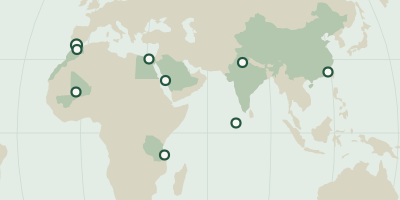
In June 1325 a 21-year-old law student left Tangier to make the pilgrimage to Mecca. He did not come home for 24 years. Ibn Battuta crossed the Islamic world and beyond — Arabia, East Africa, Anatolia, Central Asia, India, the Maldives, Sumatra and China — earning his keep as a judge and a guest of sultans, marrying and divorcing along the way. By some estimates he covered about 117,000 kilometres, more than any traveller before the age of steam.
Back in Morocco he dictated his memories, the Rihla, to a scholar who polished them and borrowed passages from older books, so not every scene was his own. The route picks out nine stops in the order he reached them; it is not one continuous road. There are no travel tips for Mecca or Mali.
In spring 1689 the poet Matsuo Bashō gave up his hut in Edo and set off on foot with his friend and disciple Kawai Sora into Oku, the remote north of Japan. For about 156 days and some 2,400 kilometres they walked to the places the old poets had made famous — a barrier gate, a bay of pine islands, a battlefield, a mountain temple — and Bashō answered them with haiku.
The travel diary he made of it, Oku no Hosomichi, published in 1702, is one of the classics of Japanese literature, and its stops are still pilgrimage sites. Bashō polished the facts for art; Sora's own diary shows where. Dates follow the old lunar calendar, so they are given here by season.
Dracula crosses Transylvania's Borgo Pass and Whitby's harbour, steps and churchyard, then Purfleet on the Thames and London Zoo. A young English solicitor becomes the Count's prisoner; Dracula ships himself to England in fifty boxes of earth and is hunted back to his mountains by Van Helsing's band.
Stoker never visited Transylvania; he built its geography from books and maps, and the English half from places he knew. The route follows the novel's diaries and letters stop by stop: the inn at Bistritz, the Borgo Pass, the Black Sea port of Varna, the harbour, steps and churchyard of Whitby, Purfleet on the Thames, London Zoo and the final race up the Danube at Galatz.