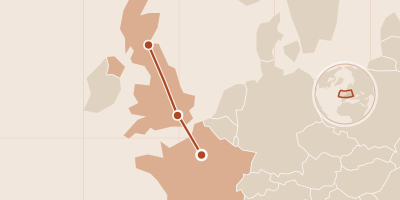
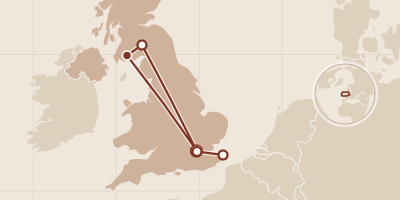
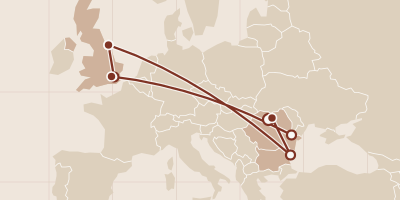
Belfast built her, Southampton sailed her, and two tender ports filled her up before the Atlantic took her. This route follows the whole last leg of Titanic's maiden voyage in order — from the Belfast slipway where 100,000 people watched her leave the ways to the Halifax cemetery where 121 of her dead are buried.
Six stops: the shipyard that became a museum, the Southampton quayside and its memorial to the engineers who stayed at their posts, the two Channel ports where tenders ferried passengers out to a ship too big to come alongside, the wreck on the seabed at 12,500 feet, and the graves at Fairview Lawn. Only the wreck is out of reach; every other stop can be walked today.
Ron Howard's 2006 thriller, based on Dan Brown's 2003 novel, sends symbologist Robert Langdon and cryptologist Sophie Neveu from a murdered curator in the Louvre on a quest for the legendary Holy Grail — through a Paris church, a London Templar church and Newton's tomb to a Scottish chapel.
The route follows the film's trail in story order, from the Vitruvian-Man murder and the Saint-Sulpice marker to the Temple Church dead end, the APPLE cryptex at Westminster Abbey and the 'neath-the-rose finale at Rosslyn Chapel. Note the abbey scenes were filmed at Lincoln and Winchester cathedrals.
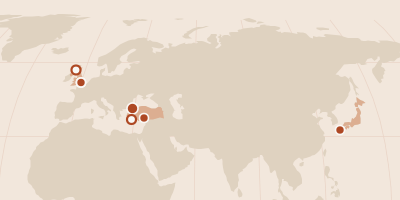
Bond is shot off a train in Turkey and left for dead, while a former agent with a grudge against M attacks MI6 from within. Sam Mendes's 2012 film — the 23rd Bond and the highest-grossing of them all — was shot between November 2011 and May 2012 in London, Turkey and Scotland, with much of "Shanghai" and "Macau" faked in England.
The route follows the story from the rooftops of the Grand Bazaar to the railway viaduct where Bond falls, a beach bar in Fethiye, MI6's real headquarters, a Turner in the National Gallery, an abandoned Japanese island, a disused Tube platform and the glen where Bond takes M home. Skyfall Lodge itself was a set in Surrey.
One night at Cruachan, Queen Medb of Connacht and her husband Ailill compare their riches and find them equal in all but one thing: Ailill owns a magnificent white-horned bull. Medb sets out to take an even finer one, the Brown Bull of Cooley, from Ulster, whose warriors are all laid low by an ancient curse. Only the seventeen-year-old Cú Chulainn stands in her way, holding off her army ford by ford, one champion a day.
The Táin Bó Cúailnge, "the Cattle Raid of Cooley", is the centrepiece of Ireland's Ulster Cycle, preserved in manuscripts from the 12th century on. Its storytellers loved explaining place-names, and many of its places are real and visitable. This route follows the raid from Connacht to Cooley and the bull's last journey home. Quotations are from Joseph Dunn's 1914 translation.
Two branches of one royal family, the five Pandava brothers and their hundred Kaurava cousins, quarrel over the throne of the Kuru kingdom. The Pandavas survive a murder plot, win the princess Draupadi, build a splendid capital, lose everything in a rigged game of dice and spend thirteen years in exile before the families meet in an eighteen-day war at Kurukshetra. The Sanskrit epic, one of the longest poems ever composed, also holds the Bhagavad Gita.
Northern India is dotted with places that tradition links to the story, several of them with real Iron Age remains. This route follows the Pandavas through those traditional sites. They are identifications of faith and local memory; archaeology has found ancient towns, but not the epic's events.
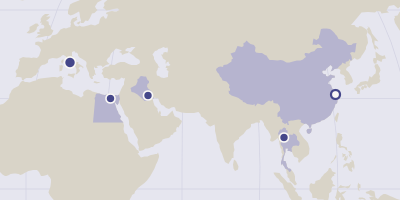
1937, between Raiders of the Lost Ark and The Last Crusade. A giant breaks into Marshall College, steals a mummified cat and knocks out Indiana Jones. The trail leads Indy to a "Great Circle" of sacred sites spaced evenly around the globe, and into a race against the Nazi archaeologist Emmerich Voss to unlock its power. Todd Howard conceived the story of MachineGames' 2024 game, and its director pictured it as a "lost Indiana Jones adventure from the 1980s".
The circle and its secret are pure adventure fiction, but its stops are real: the Vatican, Giza, wartime Shanghai, the ruined Thai capital of Sukhothai and the ziggurat of Ur. The designers rebuilt them from books and photographs as they would have looked in the 1930s. This route follows the main story.
Bohemia, 1403. King Wenceslaus IV has been kidnapped by his half-brother Sigismund, whose mercenaries burn the silver-mining village of Skalitz. Henry, the blacksmith's son, survives, and the rest of the 2018 role-playing game by Prague's Warhorse Studios follows his hunt for justice and his father's sword across a small stretch of the Sázava valley in Central Bohemia.
Almost every place in the game is real and still on the map: Stříbrná Skalice, the ruins of Talmberk, the town of Rataje with its castle Pirkštejn, the monastery at Sázava. Many of the lords Henry serves were real people too. The route follows the main story; the sequel's opening at Trosky closes it.
In 629 a young Chinese Buddhist monk, troubled by contradictions between the Chinese translations of the scriptures, slipped out of the Tang capital in defiance of a ban on foreign travel and set off for India to find the original texts. Xuanzang crossed the Taklamakan's edge, the Tian Shan and the Hindu Kush, studied for years in India's great monastery at Nalanda, and came home sixteen years later with 657 Sanskrit texts carried by a train of horses.
His travel record, the Great Tang Records on the Western Regions, is still a key source for the history of Central Asia and India, and his journey inspired the classic novel Journey to the West. The route follows him there and back. There are no travel tips for Afghanistan.
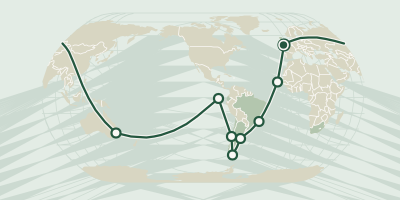
In December 1831 a 22-year-old Cambridge graduate with a passion for beetles and rocks sailed from Plymouth as an unpaid naturalist on HMS Beagle, a ten-gun survey brig. The voyage was meant to take two years and took five. Charles Darwin came home with crates of fossils, skins and notebooks — and with questions about the islands that would lead him, two decades later, to On the Origin of Species.
The route follows the ship around the world in order, using Darwin's own Journal of Researches for dates and details: the volcanic Cape Verde islands, the Brazilian forest, the fossil beds of Argentina, Tierra del Fuego, a great Chilean earthquake, the Galápagos, Cape Town and home to Falmouth.
May 1914. Richard Hannay, bored in London after years in southern Africa, lets a frightened American into his flat — and a few days later finds him dead on the floor with a knife through his heart. Wanted for murder and hunted by a German spy ring, Hannay has three weeks to survive until he can warn the government. He runs for the moors of Galloway, then back south to a meeting of ministers and a Kent clifftop.
This is John Buchan's 1915 novel, not Hitchcock's very different film. London, St Pancras, Cairnsmore of Fleet and Moffat are named in the book; Hannay's hiding places on the moors and the Kent resort of Bradgate are not real, but the steps that gave the book its title are.
A young English solicitor travels to the Carpathians to sell a London house to a nobleman — and becomes his prisoner. The Count then ships himself to England in fifty boxes of earth, comes ashore in a Yorkshire storm and starts hunting in London, until a small band led by Professor Van Helsing chases him all the way back to his mountains.
Stoker never visited Transylvania; he built its geography from books and maps, and the English half from places he knew. The route follows the novel's diaries and letters stop by stop: the inn at Bistritz, the Borgo Pass, the Black Sea port of Varna, the harbour, steps and churchyard of Whitby, Purfleet on the Thames, London Zoo and the final race up the Danube at Galatz.