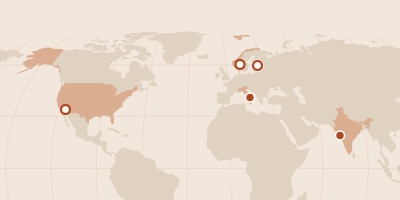
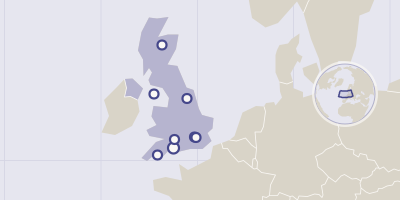
A CIA officer called the Protagonist joins Tenet, a secret organisation fighting a war across time. Inverted bullets and a Russian oligarch named Sator pull him from a Kyiv opera house to Mumbai, Oslo, the Amalfi Coast and Tallinn, chasing a device sent back from the future.
This route follows the film's real locations: Tallinn's Linnahall standing in for the Kyiv opera house, Colaba in Mumbai, the Oslo freeport sequence, the gardens of Villa Cimbrone above Amalfi, the Tallinn streets of the car chase and the California ghost town used for Stalsk-12. The Oslo Freeport and Stalsk-12 are fictional, so their pins mark the real places the film points to.
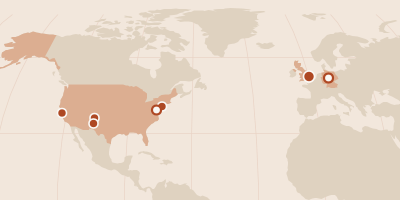
J. Robert Oppenheimer studies in Cambridge and Göttingen, builds a physics school at Berkeley, and is handed the one job nobody else wants: build the atomic bomb before the Nazis do. Christopher Nolan's Oppenheimer (2023) follows him from the Cavendish Laboratory to a secret mesa in New Mexico, through the Trinity test and the political fallout that ends his career.
This route follows the film's real places — Cambridge, Göttingen, LeConte Hall, Los Alamos, Trinity, the White House, the Institute for Advanced Study and the room where his security clearance was revoked. The film's own stand-ins, from Ghost Ranch to Kerckhoff Hall, Belen and Alhambra, are noted at each stop.
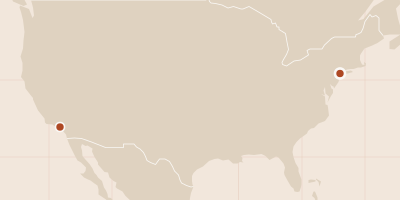
In 1984 Ghostbusters sent three Columbia parapsychologists into the ghost-removal business, armed with proton packs and a converted firehouse. The film turned a handful of real New York addresses into a haunted city, from the marble reading room of the New York Public Library to the apartment block that becomes Spook Central.
Most of the exterior landmarks survive and can be visited, though the Sedgewick Hotel's interiors were filmed on the other side of the country, at a grand downtown Los Angeles hotel. This route follows the film's story from the first library ghost to the rooftop battle with Gozer.
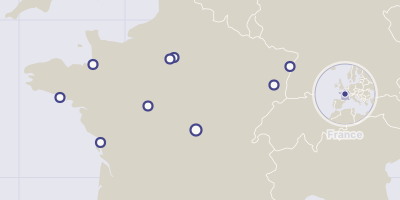
Kalos is Metropolitan France turned into a star-shaped Pokémon region. Lumiose City is inspired by Paris, its Prism Tower by the Eiffel Tower and its art museum by the Louvre; the Battle Château recalls Chenonceau on the Loire, the palais Chaydeuvre is the château de Versailles, and the stones outside Geosenge Town are the Carnac stones. The games never confirm their models — these are fan and encyclopaedia identifications — so every pin on this route is speculative.
The route follows the story across the real France behind Kalos: the town where the adventure begins, Lumiose's iron tower, two châteaux and a royal palace, a coastal aquarium, the island tower where Mega Evolution is learned, the cathedral clock behind Anistar's sundial, the Breton megalith field where Team Flare hides its ultimate weapon, and an abandoned mine where the legendary Zygarde sleeps.
The Galar region is Britain played back as a game: a fictional land inspired by the United Kingdom, dotted with landmarks that recall Bath and York, crowned by a London of clock towers and football-stadium gyms. Eight gym cities, eight badges, and then the Champion's Cup in Wyndon, where Leon waits and the Darkest Day breaks.
This route walks the real Britain behind that map, south to north and then beyond: a chalk giant, a lighthouse, Roman baths, a minster, a national stadium and a clock tower, plus the two downloadable lands, the Isle of Man and the snows of Scotland. Every identification is a fan or developer reading, never confirmed in the games, so every pin here is speculative.
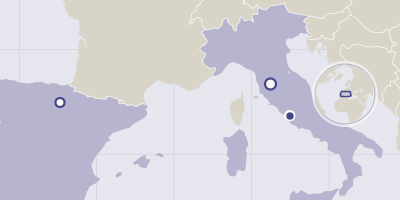
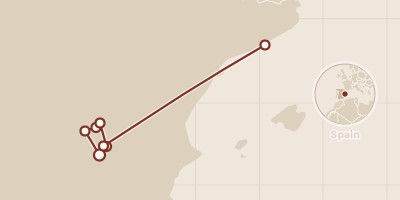
December 1499: Cesare Borgia's army has struck the Auditore villa at Monteriggioni, killing Mario and seizing the Apple of Eden. Assassin's Creed Brotherhood sends Ezio to Rome, the center of Templar power, to take the fight to the Borgia-led Templars, and the hunt for the Apple runs from St Peter's Basilica to a temple hidden underneath the Colosseum.
This route follows Ezio from the villa at Monteriggioni through Borgia Rome — the Castel Sant'Angelo fortress, the Pantheon, St Peter's and the Colosseum — to Viana in Navarre, Spain, where his fight with Cesare ends on the battlements. Every stop is a real place you can visit.
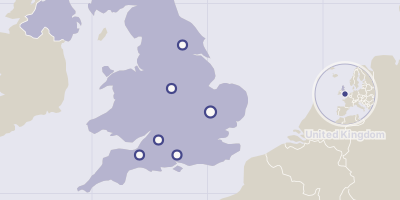
Assassin's Creed Valhalla brings the Viking Eivor and their clan to Anglo-Saxon England, where Hytham asks for help ridding the land of the Order of the Ancients. Following tip-offs from an informant who signs himself the "Poor Fellow-Soldier of Christ", Eivor hunts Order members from Grantebridge to Jorvik and Wincestre.
The route visits the real places behind the game's: Cambridge, where the jarlskona Soma takes back her town; York, the capital of Viking Britain; the docks of Repton, where the Great Heathen Army wintered; Alfred's Winchester; the battle at Chippenham in 878; and Athelney, where the informant's identity is finally revealed. All six can be visited today.
The pope is dead, four cardinals have been kidnapped, and a missing vial of antimatter will destroy the Vatican at midnight. The American symbologist Robert Langdon is called in and reads the threat as a path: four altars of the "Path of Illumination", tied to the classical elements, where a cardinal will die each hour from 8 p.m. With Vittoria Vetra, a CERN scientist, he races the clock across Rome — from a Pantheon they wrongly believe holds the first answer to a fountain where a cardinal is being drowned.
This route follows Ron Howard's 2009 film rather than Dan Brown's novel: the Pantheon and Raphael's tomb, the Chigi Chapel in Santa Maria del Popolo, the obelisk in St Peter's Square, Bernini's Ecstasy of Saint Teresa, the Fountain of the Four Rivers, the assassin's lair at Castel Sant'Angelo, and the midnight finale beneath St Peter's. All of it still stands; the caveat is that Rome's diocese refused the crew access to the churches, so several interiors in the film are studio sets.
A gentleman of La Mancha, a head full of chivalry books, a plain full of mills: this route follows Don Quixote from the village argued to be his to the strand of Barcelona, keeping the order of the book.
It begins with the village whose name the narrator refuses to give, the inn where a landlord reading from his account book dubs him a knight, and the ridge of mills that shivered his lance to pieces. In Part II it follows him to Dulcinea's town by night, the cave where he sleeps an hour and believes three days have passed, the lakes of Ruidera, and finally Barcelona, where galley crews salute him three times and a bachelor from his own village unhorses him.
Which mills he charged, and where the inn of that first night stood, are guesses: Campo de Criptana and Puerto Lápice are the usual answers.
James Joyce's Ulysses is one ordinary day, 16 June 1904, in Dublin, told in eighteen episodes through Leopold Bloom, a Jewish advertisement canvasser, and Stephen Dedalus, who starts the day in a tower by the sea. This route walks the day in the order the novel runs it: from the Martello tower at Sandycove where it opens to Howth Head, where Molly Bloom's memory ends it with a yes.
Almost every stop is a place you can still stand in: the tower where Joyce stayed in 1904, the strand Stephen walks, the street of the chemist's where Bloom buys soap, the cemetery of the funeral, the pub where he eats his sandwich, the library where he passes between Stephen and Mulligan, the quay of the Ormond Hotel and the maternity hospital. The last stop is a recollection rather than a setting: the novel never says where on Howth Head the two of them lay.
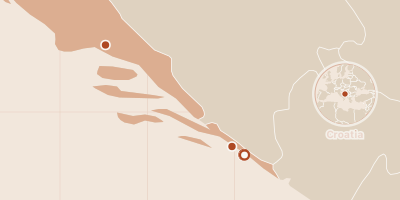
After a first season in Malta, the show crossed the Adriatic to a walled city. Dubrovnik's two-kilometre ramparts, the fortress above its western gate and its late-medieval streets played King's Landing for everything the effects departments could not invent: the name-day combats, the riot at the gate, Cersei's walk of atonement.
Eight stops run in the order the episodes aired — Lovrijenac and the Pile Gate in the second season, the Rector's Palace when Dubrovnik doubled as Qarth, the Red Keep's gardens at Trsteno and the Meereen stand-in at Klis in the third and fourth, and the Jesuit stairs where the fifth-season finale was shot in October 2014. Only the exteriors live here: the Red Keep and the Sept of Baelor were computer-generated.
A student framed for an assault is put on probation, moves into a Tokyo neighbourhood that does not exist, and ends the school year as one of the Phantom Thieves. Persona 5 is set in modern-day Tokyo and uses real districts — Sangenjaya, Shibuya, Shinjuku and Akihabara — as its map, alongside the Metaverse where the Thieves enter Palaces.
This route picks five stops out of that year: Sojiro's Café Leblanc above Sangen-jaya Station, the Shibuya counter where the Thieves buy their equipment, Shinjuku's bar street and a fortune-teller's stand, the Akihabara arcade where a schoolboy holds a high score, and Odaiba, where the palace of Persona 5 Royal rises. Leblanc, the Crossroads Bar and the Gigolo Arcade are invented; the neighbourhoods around them are not.
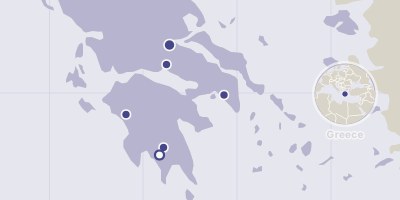
Greece, 431 BC: Athens and Sparta are tearing the Greek world apart, and you are a Spartan mercenary caught between them. Assassin's Creed Odyssey sends you across the Aegean with a broken spear and an eagle at your side, hunting your lost family and the masked Cult of Kosmos that destroyed it.
This route follows the Eagle Bearer's trail from the hot gates of Thermopylae to the oracle at Delphi, the Acropolis of Athens, the sanctuary at Olympia, warrior Sparta and finally Mount Taygetos. Every stop is a real place you can visit, recreated in the game's vast open world.
After a job goes horribly wrong in London, two Irish hitmen are ordered to lie low in Bruges and wait for a phone call. Ken finds the city beautiful; Ray is bored rigid and says so at every turn. Martin McDonagh's 2008 dark comedy was shot entirely on location in the city in February and March 2007.
This route follows Ken and Ray through the medieval centre: their hotel, the Belfry, a church with a relic, Bosch's vision of hell in the Groeninge Museum, a park, the Lake of Love and the street where the story ends. One scene was shot in a stand-in church, and the top of the tower was a studio set.
King Pelias sends his nephew Jason to fetch the Golden Fleece from Colchis, at the far end of the Black Sea, hoping he will never come back. Jason builds the Argo, gathers the greatest heroes of his day, Heracles among them, and sails east. Apollonius of Rhodes told the voyage in his Argonautica in the 3rd century BC, and he filled it with real coasts, harbours and local legends.
This route follows the outward voyage to Colchis. The way home is left out: ancient writers sent the Argo back by wildly different routes, up rivers into the Adriatic and even across Libya. The heroes and the fleece are myth; the shores, islands and ancient cities are real. Quotations are from R. C. Seaton's 1912 translation.
In August 1914 France expels its German residents, and Karl is torn from his French wife Marie and their baby on a farm near Saint-Mihiel and drafted into the German army. Marie's father Emile is called up on the other side. Ubisoft Montpellier's hand-drawn 2014 game, made for the war's centenary, follows them, an American volunteer called Freddie, a Belgian nurse, Anna, and Walt the medic dog across four years of the Western Front.
The heroes are invented, but the battles are not, and every chapter is full of real objects and short historical notes. This route visits the places the story passes through, from the Marne in 1914 to the Chemin des Dames in 1917. Most are now memorials, museums or preserved battlefields.
In November 1274 a Mongol and Korean fleet landed on Tsushima, a mountainous Japanese island halfway to Korea, and overwhelmed its few defenders. Sucker Punch's 2020 game drops a fictional samurai, Jin Sakai, into that invasion: he survives the massacre on the beach and turns into "the Ghost", a guerrilla who breaks the samurai code to drive the invaders out.
The designers visited Tsushima twice but did not copy it one to one. This route visits the real places behind the game's opening battle, its castle and its shrines, most of them featured in the island's own guide for players. Jin, his clan and his battles are fiction; the landing, the fortress and the mountains are not.
In 629 a young Chinese Buddhist monk, troubled by contradictions between the Chinese translations of the scriptures, slipped out of the Tang capital in defiance of a ban on foreign travel and set off for India to find the original texts. Xuanzang crossed the Taklamakan's edge, the Tian Shan and the Hindu Kush, studied for years in India's great monastery at Nalanda, and came home sixteen years later with 657 Sanskrit texts carried by a train of horses.
His travel record, the Great Tang Records on the Western Regions, is still a key source for the history of Central Asia and India, and his journey inspired the classic novel Journey to the West. The route follows him there and back. There are no travel tips for Afghanistan.
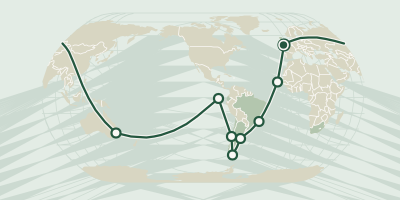
In December 1831 a 22-year-old Cambridge graduate with a passion for beetles and rocks sailed from Plymouth as an unpaid naturalist on HMS Beagle, a ten-gun survey brig. The voyage was meant to take two years and took five. Charles Darwin came home with crates of fossils, skins and notebooks — and with questions about the islands that would lead him, two decades later, to On the Origin of Species.
The route follows the ship around the world in order, using Darwin's own Journal of Researches for dates and details: the volcanic Cape Verde islands, the Brazilian forest, the fossil beds of Argentina, Tierra del Fuego, a great Chilean earthquake, the Galápagos, Cape Town and home to Falmouth.
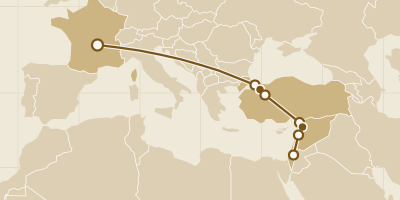
In November 1095 Pope Urban II, answering a Byzantine emperor's plea for help against the Seljuk Turks, called western Christians to an armed pilgrimage to Jerusalem. Tens of thousands answered — knights, foot soldiers and poor pilgrims. Their armies took separate roads to Constantinople, then marched together across Anatolia and Syria. Almost four years after the call, they stormed Jerusalem and massacred much of its population.
The route follows the main armies in order, from Clermont to Jerusalem, using the participants' own chronicles as summarised by modern historians. Violence against Jews in the Rhineland and against the people of the cities on the way is part of the story and is named plainly. There are no travel tips for Syria or the Lebanese border area.
In January 1868 Japan's young emperor was declared ruler in fact as well as name, ending more than 250 years of Tokugawa shogunate. The last shogun's supporters did not give up quietly. For eighteen months a civil war rolled north from the edge of Kyoto to Edo, into the mountains of Aizu and finally to a star-shaped fortress on Hokkaido, where a short-lived breakaway republic made its last stand.
The route follows that war in six places, all of them visitable: the battlefield at Toba, Edo Castle, the hill of Ueno, Aizu's castle and the hill where its teenage soldiers died, and Goryōkaku. Dates are given in the Western calendar, converted from the Japanese lunar dates used at the time.
In 1791 Saint-Domingue was France's richest colony, a sugar and coffee economy worked by hundreds of thousands of enslaved Africans under brutal conditions. Thirteen years later it was Haiti, the first nation born from a successful slave revolt and the first independent Black-led state in the Americas. The cost was enormous: some 200,000 Black Haitians died, and tens of thousands of French and British soldiers, most of them from yellow fever.
The route follows the turning points, from the ceremony that tradition places at Bois Caïman to the declaration at Gonaïves, with a detour to the French mountain fortress where Toussaint Louverture died. Fighting was savage on all sides, and the texts say so plainly. The route offers no travel advice for Haiti.
On 12 March 1930 Mahatma Gandhi, aged 60, walked out of his ashram in Ahmedabad with 78 followers, heading for the sea. His target was the British monopoly on salt, a tax that touched every Indian household. Twenty-four days and about 385 kilometres later, on a beach at Dandi, he picked up a lump of salty mud and broke the law — and millions followed.
The route follows the march south through Gujarat in its real order, with the dates from the day-by-day itinerary: the ashram, the first night's halt, the Kheda country, Borsad, Surat and Dandi, where a memorial now stands. The final stop covers what came next: Gandhi's arrest and the beatings at the Dharasana salt works that shocked the world.
In Wes Anderson's 2014 comedy, the concierge M. Gustave and his lobby boy Zero are caught up in a murder, a stolen painting and a war in the imaginary alpine republic of Zubrowka. The pink hotel on its crag is a model; almost everything else was shot in winter 2013 in eastern Germany, in and around the border town of Görlitz and across Saxony.
This route visits the real buildings: an empty Art Nouveau department store that became the hotel lobby, a shuttered concert hall, two castles that make up Madame D.'s estate, a former prison, the most beautiful dairy shop in the world and Dresden's baroque Zwinger. Zubrowka is fictional; these are the filming locations.