Jesse and Céline are now a couple with twin daughters, on a summer holiday in southern Greece. Before Midnight, the third and final film of Richard Linklater's Before trilogy, was shot in 15 days on the Peloponnese coast and turns one last night into a long, honest argument about love.
The route follows the film from an airport farewell to a writer's house, a castle, a harbour town and a resort hotel. The filmmakers have named few exact addresses, so the Pylos and hotel stops are approximate.
In 1986 the teenage martial artist Ryo Hazuki comes home to the family dojo in Yokosuka and watches his father, Iwao, die at the hands of Lan Di. Swearing revenge, Ryo follows the killer to Hong Kong in 1987 and on to the mountains of Guilin, and the two games turn that trail into one long walk through a living town, a harbor, a crowded Hong Kong district and a walled city.
The route follows Shenmue and Shenmue II in seven stops. Dobuita Street and Kowloon Walled City are real places the game draws on, the dojo and Bailu Village are invented, and every stop says how closely its pin matches the game.
On 20 September 1519 five ships and about 270 men sailed from Spain to find a western sea road to the Spice Islands. Magellan died in the Philippines, but Juan Sebastián Elcano brought the Victoria home three years later with eighteen survivors and 26 tons of spices, having sailed all the way around the world.
The route follows the voyage from the mouth of the Guadalquivir past Port St. Julian, through the strait and across the Pacific to the Moluccas, then home past the Cape of Good Hope. Anchorages are often unrecorded, so most pins mark the nearest known place; the dates come from Pigafetta's journal and modern accounts.
1066 in three battles: Fulford and Stamford Bridge in the north, then Pevensey, Hastings and Battle in the south, with Westminster at both ends. Edward the Confessor died childless that January; by Christmas Day Harold Godwinson had fallen and William of Normandy was crowned.
The route follows the crown from Westminster to the Yorkshire landing of Harald Hardrada, Fulford and Stamford Bridge, then to Pevensey, Hastings and the field at Battle, and back to Westminster on Christmas Day. The exact ground of several battles is debated, so those pins mark the best-known sites.
The Hound of the Baskervilles takes Sherlock Holmes across Dartmoor: Cabell's tomb at Buckfastleigh, the ten-thirty train from Paddington, Princetown's prison and Hound Tor. A spectral hound stalks the moor.
The route runs from the grave that may have inspired the legend and the ten-thirty train from Paddington to the convict prison at Princetown, the mire, the tors and the Stapletons' house. Baskerville Hall and Merripit House exist only in the book, so their pins mark a stand-in or nothing at all.
A CIA officer called the Protagonist joins Tenet, a secret organisation fighting a war across time. Inverted bullets and a Russian oligarch named Sator pull him from a Kyiv opera house to Mumbai, Oslo, the Amalfi Coast and Tallinn, chasing a device sent back from the future.
This route follows the film's real locations: Tallinn's Linnahall standing in for the Kyiv opera house, Colaba in Mumbai, the Oslo freeport sequence, the gardens of Villa Cimbrone above Amalfi, the Tallinn streets of the car chase and the California ghost town used for Stalsk-12. The Oslo Freeport and Stalsk-12 are fictional, so their pins mark the real places the film points to.
A feather drifts down onto a bench in Savannah, and a man starts to talk. His life unrolls across half a century of American history, from an Alabama childhood to the jungles of Vietnam, the Lincoln Memorial, the Watergate and a bayou shrimp boat.
This route follows the film in order, from the bench on Chippewa Square to the lighthouse in Maine and the desert where the running finally stops. It marks the real locations and the real stand-ins, since the fictional town of Greenbow and the Vietnam jungle were both played by South Carolina.
Kalos is Metropolitan France turned into a star-shaped Pokémon region. Lumiose City is inspired by Paris, its Prism Tower by the Eiffel Tower and its art museum by the Louvre; the Battle Château recalls Chenonceau on the Loire, the palais Chaydeuvre is the château de Versailles, and the stones outside Geosenge Town are the Carnac stones. The games never confirm their models — these are fan and encyclopaedia identifications — so every pin on this route is speculative.
The route follows the story across the real France behind Kalos: the town where the adventure begins, Lumiose's iron tower, two châteaux and a royal palace, a coastal aquarium, the island tower where Mega Evolution is learned, the cathedral clock behind Anistar's sundial, the Breton megalith field where Team Flare hides its ultimate weapon, and an abandoned mine where the legendary Zygarde sleeps.
The second season of The White Lotus moves to a luxury resort in Sicily, following the staff and wealthy guests through a week of sightseeing days, villa parties and opera nights. Guests explore Taormina's Greek theatre, Daphne drags Harper down to Baroque Noto, and Tanya falls in with a wealthy Brit whose Palermo villa hides an ugly twist.
This route visits the real filming locations in episode order, from the San Domenico Palace hotel to the island beach of the finale. The show swaps two villas across the island: its Noto palace is really Villa Tasca outside Palermo, and Quentin's Palermo villa is Villa Elena near Noto.
Dune turns real places into its planets: Norway's Stadlandet is Caladan, Jordan's Wadi Rum and Abu Dhabi's Liwa Oasis share Arrakis, Budapest's Origo Studios build Arrakeen and Italy's Brion tomb becomes the emperor's court. Paul Atreides leaves Caladan for the desert planet, the sole source of spice, then forces Emperor Shaddam to come to Arrakis with Irulan and his Sardaukar soldiers.
This route links the five key locations: Stadlandet standing in for Caladan, Wadi Rum and the Liwa Oasis sharing Arrakis, Origo Studios staging Arrakeen and the ornithopters, and the Brion tomb doubling as the imperial court. Part One shot from March to July 2019 in Hungary, Jordan, Norway and the Emirates; Part Two followed from July to December 2022, adding Italy and Namibia to the itinerary.
Jurassic Park (1993) invents a dinosaur theme park on an island that does not exist, then shoots almost all of it on one small Hawaiian island, Kauaʻi. On 11 September 1992, the last scheduled day of the Kauaʻi shoot, Hurricane Iniki passed directly over the island and pushed one famous sequence to a ranch on Oʻahu.
Nine stops follow the film in story order: the garden of the opening attack, the stream that played a Dominican amber mine, the Kapaʻa waterfront that played a Costa Rica café, the falls every visitor flies past, the estate where the visitor centre façade stood, the gates below Mount Waiʻaleʻale, the canyon of the dead fence, the Gallimimus stampede at Kualoa Ranch and the garden where Grant finds the nest. Filming on Kauaʻi began on 24 August 1992.
Daniel Craig's first Bond bleeds, loses at cards and gets his boss a dressing-down, and the film's geography plays tricks of its own: Montenegro is a Czech spa town, Madagascar is an abandoned building site in Nassau, and the House of Commons is a monastery library in Prague.
The route follows the film from the black-and-white opening in a Prague office block to the digger chase on a Bahamian building site, a Paradise Island resort, the casino and hotel of Karlovy Vary, the Lake Como villa where Bond recovers from poison, the Venetian palazzo that sinks with Vesper inside, and the Lake Como house where Bond finally gives his name. Two stops are hotels and one is a monastery library you can walk into; the digger site is now inside a military base.
Indiana Jones and the Last Crusade (1989) sends Indy from a Boy Scout outing in the Utah desert to the rock-cut façade of Petra, chasing the Holy Grail and his missing father. Three trials guard the cup at the end. The film borrows its scenery from half of Europe, the Middle East and the American West.
Nine stops, most of them still standing: the Arches canyons of the opening, the church façade in Venice's Campo San Barnaba that plays the library, an Eifel castle dressed as Brunwald, a San Francisco building that played Berlin's Tempelhof airport, the Almería beach where Henry brings down a fighter with an umbrella, a Granada station playing Alexandretta, the Tabernas tank chase, the Treasury that fronts the Grail's temple, and the Texas sunset the film ends on. Dates are story time; filming ran from May 1988 to early 1989.
Tatooine is the Star Wars desert everyone knows, but the films kept finding other corners of the Earth for their galaxy: redwoods in northern California, a villa on Lake Como, a plaza in Seville, the desert around an oasis in Abu Dhabi, a monastery island off County Kerry and the largest salt flat in the world, in Bolivia.
This route follows the shooting in the order the films were made, from the Endor forest of Return of the Jedi to the Crait battle of The Last Jedi. Two stops mark an area rather than a spot: the Endor scenes were partly shot on private land, and no source names the stretch of desert that stood in for Jakku.
Just after midnight on 6 June 1944, gliders landed beside a canal bridge at Bénouville, and by mid-morning Allied troops were ashore on five code-named beaches — Utah, Omaha, Gold, Juno and Sword — along the Normandy coast. This route visits the places where that day was won and lost, and what stands there today.
It starts with the glider coup de main at Pegasus Bridge, then runs along the coast from west to east: the museum built on the sand at Utah, the Rangers' climb at Pointe du Hoc, the American cemetery above Omaha, the concrete of the Mulberry harbour at Arromanches, the Canadian centre behind Juno and the Grand Bunker above Sword.
After a first season in Malta, the show crossed the Adriatic to a walled city. Dubrovnik's two-kilometre ramparts, the fortress above its western gate and its late-medieval streets played King's Landing for everything the effects departments could not invent: the name-day combats, the riot at the gate, Cersei's walk of atonement.
Eight stops run in the order the episodes aired — Lovrijenac and the Pile Gate in the second season, the Rector's Palace when Dubrovnik doubled as Qarth, the Red Keep's gardens at Trsteno and the Meereen stand-in at Klis in the third and fourth, and the Jesuit stairs where the fifth-season finale was shot in October 2014. Only the exteriors live here: the Red Keep and the Sept of Baelor were computer-generated.
The Secret Life of Walter Mitty goes from the Time-Life Building in New York to Iceland, where Stykkishólmur doubles for Greenland, Seyðisfjörður hosts the longboard descent and Skógafoss stands in for the Himalayas. Ben Stiller's 2013 film follows a photo editor chasing a missing negative.
This route starts at Life's real Manhattan home and then follows Walter through the Icelandic towns, harbour, mountain road, volcano and waterfall that stand in for Greenland and Afghanistan. The places are real; which country they play is not.
King Pelias sends his nephew Jason to fetch the Golden Fleece from Colchis, at the far end of the Black Sea, hoping he will never come back. Jason builds the Argo, gathers the greatest heroes of his day, Heracles among them, and sails east. Apollonius of Rhodes told the voyage in his Argonautica in the 3rd century BC, and he filled it with real coasts, harbours and local legends.
This route follows the outward voyage to Colchis. The way home is left out: ancient writers sent the Argo back by wildly different routes, up rivers into the Adriatic and even across Libya. The heroes and the fleece are myth; the shores, islands and ancient cities are real. Quotations are from R. C. Seaton's 1912 translation.
Troy has fallen. Aeneas, a Trojan prince, carries his old father out of the burning city and sets sail with the survivors to find the new homeland the gods have promised them. Virgil's Aeneid, written for Augustus in the 20s BC, follows years of wrong turns, storms and prophecies until the exiles land in Italy, where their descendants will one day found Rome.
This route follows the voyage in the order it happens, which is not the order Virgil tells it: the poem opens in Carthage and lets Aeneas recount the earlier wanderings to Queen Dido. Every stop is a real ancient site, most now open as archaeological parks; Aeneas himself belongs to legend. Quotations are from John Dryden's 1697 translation.
In December 1831 a 22-year-old Cambridge graduate with a passion for beetles and rocks sailed from Plymouth as an unpaid naturalist on HMS Beagle, a ten-gun survey brig. The voyage was meant to take two years and took five. Charles Darwin came home with crates of fossils, skins and notebooks — and with questions about the islands that would lead him, two decades later, to On the Origin of Species.
The route follows the ship around the world in order, using Darwin's own Journal of Researches for dates and details: the volcanic Cape Verde islands, the Brazilian forest, the fossil beds of Argentina, Tierra del Fuego, a great Chilean earthquake, the Galápagos, Cape Town and home to Falmouth.
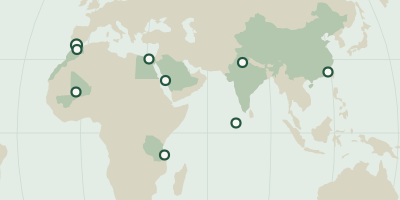
In June 1325 a 21-year-old law student left Tangier to make the pilgrimage to Mecca. He did not come home for 24 years. Ibn Battuta crossed the Islamic world and beyond — Arabia, East Africa, Anatolia, Central Asia, India, the Maldives, Sumatra and China — earning his keep as a judge and a guest of sultans, marrying and divorcing along the way. By some estimates he covered about 117,000 kilometres, more than any traveller before the age of steam.
Back in Morocco he dictated his memories, the Rihla, to a scholar who polished them and borrowed passages from older books, so not every scene was his own. The route picks out nine stops in the order he reached them; it is not one continuous road. There are no travel tips for Mecca or Mali.
In spring 1689 the poet Matsuo Bashō gave up his hut in Edo and set off on foot with his friend and disciple Kawai Sora into Oku, the remote north of Japan. For about 156 days and some 2,400 kilometres they walked to the places the old poets had made famous — a barrier gate, a bay of pine islands, a battlefield, a mountain temple — and Bashō answered them with haiku.
The travel diary he made of it, Oku no Hosomichi, published in 1702, is one of the classics of Japanese literature, and its stops are still pilgrimage sites. Bashō polished the facts for art; Sora's own diary shows where. Dates follow the old lunar calendar, so they are given here by season.
In November 1095 Pope Urban II, answering a Byzantine emperor's plea for help against the Seljuk Turks, called western Christians to an armed pilgrimage to Jerusalem. Tens of thousands answered — knights, foot soldiers and poor pilgrims. Their armies took separate roads to Constantinople, then marched together across Anatolia and Syria. Almost four years after the call, they stormed Jerusalem and massacred much of its population.
The route follows the main armies in order, from Clermont to Jerusalem, using the participants' own chronicles as summarised by modern historians. Violence against Jews in the Rhineland and against the people of the cities on the way is part of the story and is named plainly. There are no travel tips for Syria or the Lebanese border area.
Ernest Shackleton set out in 1914 to cross Antarctica on foot. He never even landed. His ship, Endurance, was trapped in the pack ice of the Weddell Sea, drifted for ten months and was crushed and sunk, leaving 28 men on the ice with three lifeboats. What followed — months on drifting floes, a landing on Elephant Island, an 800-mile voyage in an open boat and a march across the mountains of South Georgia — ended with every one of them coming home alive.
The route follows that escape from South Georgia to the wreck and back, with dates from Shackleton's own account, South. Most of these places can only be reached by expedition ship.