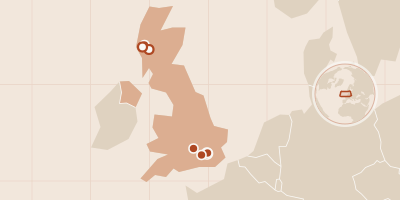
Harry Potter and the Prisoner of Azkaban was filmed on Lambeth Bridge and Stoney Street in London, the Glenfinnan Viaduct and Glen Coe in Scotland, Virginia Water in Surrey and the Divinity School in Oxford.
The third film was the first to use real locations extensively, so this route follows the story in film order, from the Knight Bus in London to the Dementors on the Highland train and the hospital wing in Oxford. Several lakes stood in for the Black Lake, so some pins are approximate.
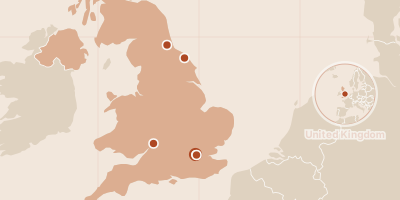
Harry Potter and the Philosopher's Stone (2001) was filmed at London Zoo, Australia House in London, Goathland station in North Yorkshire, and Gloucester and Durham cathedrals.
This route follows the film's scenes in order, from the snake at the zoo to Harry's first months at Hogwarts, and goes beyond the best-known sites in the overview route.
Need for Speed: The Run races across the United States, from the Golden Gate Bridge in San Francisco through Death Valley, Las Vegas, Denver and Chicago to Times Square in New York.
The racing game is an illegal street race from San Francisco to New York City with the Mob and the police in pursuit. Wikipedia records two plots: the Black Box version, starring street racer Jack Rourke, and a Firebrand version, starring a former pro racer called Matt. Most scenes here come from the Firebrand version; each stop says which. The roads are real, but scenes are not tied to exact spots, so most pins mark the city or region.
Spoiler notice: the last stop reveals the ending.
Walden is set at Walden Pond in Concord, Massachusetts, where Henry David Thoreau lived from July 1845 to September 1847. This route follows the book from his cabin site to the railroad, Concord's jail, Flint's Pond, Baker Farm and Brister's Hill.
Thoreau compressed his two years into a single calendar year in the book. The stops follow the order of its chapters, and most of the paths and ponds can still be walked around Walden Pond State Reservation. Several spots in the woods are only approximately placed on the map.
The moai of Easter Island (Rapa Nui) were carved at Rano Raraku quarry and raised on platforms such as Ahu Tongariki and Ahu Akivi, and the island's legends explain them: a founder who landed at Anakena, seven scouts turned to stone, statues that walked, and a birdman race at Orongo.
The route follows those stories from the landing beach to the quarry, the restored platforms and the cliff village above the sea. Oral traditions are told as traditions, not as proven history.
Atlantis comes from two dialogues by Plato, Timaeus and Critias, and searchers have placed it at Santorini, the Strait of Gibraltar, Spartel Bank, Doñana in Spain and the Richat Structure in Mauritania.
This route starts with Plato's own frame in Sais, Egypt, then visits five of the proposed locations. Every pin after the first is a theory, not a find.
Overwatch (called Overwatch 2 until February 2026) sets maps in real places across Africa and Asia: the Temple of Anubis is on the Giza Plateau near Cairo, Petra is in Jordan, Busan is in South Korea, and Neon Junction is inspired by Tokyo.
This route follows ten maps west to east, from Morocco to Tokyo, with the mode, the date each arrived and the real place behind it. Other routes cover Overwatch maps in Europe and in the Americas. Aatlis has no pin because Blizzard names no city in Morocco; Oasis and Suravasa pin only their country.
Overwatch (called Overwatch 2 until February 2026) sets its American maps in real places: Midtown ends at Grand Central in New York, New Queen Street is Toronto, Havana is in Cuba, Paraíso is Rio de Janeiro and Hollywood is a Los Angeles movie lot.
This route follows seven maps west to east from Hollywood to Rio, including Dorado, a Mexican town whose look came from a photo of Italy. Other routes cover Overwatch maps in Europe and in Africa and Asia. Pins mark a real model place, not a copied district; Dorado and Runasapi have no pin because they are invented towns with no named real place.
War Thunder's tank maps are based on real places: Stalingrad Tractor Plant, Bastogne, Hürtgen Forest, Cologne Cathedral, Berlin's Reichstag, Novorossiysk, Volokolamsk, Breslau (Wrocław), Darwin Hill in the Falklands and the Fulda Gap.
The developers say how close each map is to its original, from rebuilt photographs of the Stalingrad factory to a layout only inspired by the real ground. This route follows ten of them in the order of their history, with a short note on what happened at each real place.
Maps are classed here as exact only where the developers copy a real district; the rest are marked approximate.
Look Back is set around the hometown of manga artist Tatsuki Fujimoto, Nikaho in Akita Prefecture, and the live-action film of 2026 was shot mainly there, from the cherry-tree lane at Kunpuen to Nikaho Station. The story follows Fujino and Kyomoto, two girls who draw manga together. It became an anime film in June 2024.
The route follows the story from Fujino's childhood walks in Nikaho and the bookshop in Hirasawa, to the rebuilt bedroom sets at the station and the Smile centre, and on to the art university in Yamagata where the story turns.
Seven Samurai was filmed at Toho Studios in Tokyo and in Shizuoka and Hakone, because no single location could cover the whole area.
Kurosawa's 1954 film has one mountain village, but it was stitched together from different places: studio rice fields in Setagaya, a valley above the Tanna Tunnel, a mill site in Izu, a waterfall in Shizuoka and a mountain pass in Hakone.
The stops are approximate because the screen village never existed as one place.
Where was Yamatai, the kingdom of Queen Himiko? The two leading answers are Yoshinogari in Saga, northern Kyushu, and Makimuku beside the Hashihaka Kofun in Sakurai, Nara.
The route follows the Wei Zhi account of Himiko from Iki Island and the Shikanoshima gold seal to the two rival sites, and ends at the burial mound often linked with her grave. The location of Yamatai is still unsettled.
Hiroo Onoda, the Japanese soldier who kept fighting on Lubang Island in the Philippines until 1974, is traced here from the Nakano School in Tokyo to Lubang's mountains and Manila's Malacañang Palace.
Sent to Lubang on 26 December 1944 with orders never to surrender, Onoda stayed in hiding for 28 years, 6 months and 8 days after Japan's surrender. The route follows his training, his years in the hills, his surrender in March 1974 and a disputed return visit in 1996. Several locations are approximate, and accounts of the violence on the island are contested.
Amachan, the 2013 NHK morning drama, is set in Kitasanriku, a fictional town modelled on Kuji, Iwate; this route visits Kuji Station, Kosode Coast and railway stations along the Sanriku Coast.
Aki, a shy Tokyo girl, becomes a sea-urchin diver and a local idol in a small seaside town. This route follows the hometown chapter through five real places: Kuji Station, Kosode Coast, Horinai Station, Tanohata Station and Taneichi High School. Several stand in for places the drama names differently.
Hashima, nicknamed Gunkanjima or Battleship Island, lies about 15 km off Nagasaki, and its coal mine grew from the same story as Glover Garden, the Kosuge Slip Dock and the Takashima mine.
The route follows Nagasaki's industrial rise from 1859: the Scottish merchant Thomas Blake Glover, Japan's first western-style dock, a pioneering coal shaft, the Mitsubishi shipyard and finally Hashima, packed with 5,259 people in 1959 and empty after 1974. It also records the wartime forced labour of Korean civilians and Chinese prisoners of war on Hashima.
The Last Samurai (2003) is set in Japan in 1876 but was filmed mostly in Taranaki, New Zealand, where Mount Taranaki stands in for Mount Fuji, plus Engyō-ji near Himeji, Chion-in in Kyoto and Castle Green in Pasadena.
This route follows Nathan Algren's story from the opening restaurant scene to the parade ground, the fog battle, Katsumoto's village, his temple and the emperor's palace, and shows where each one really is. Several stops are sets or stand-ins.
Emperor Go-Daigo overthrew the Kamakura shogunate in 1333 after holding out at Kasagi Temple, being exiled to the Oki Islands and escaping to Mount Funanoue, and he ended his life at Yoshino. This route follows him from Kasagi to Kyoto and the Southern Court.
The six stops trace 1331 to 1339: the failed stand at Kasagi, exile on Oki, the escape to Mount Funanoue, the short Kenmu Restoration in Kyoto, the temporary palace at Yoshimizu Shrine and the emperor's tomb at Nyoirin-ji. Several pins are approximate because the sources describe regions or traditions, not exact spots.
Kusunoki Masashige, Japan's famous loyal samurai, fought from Akasaka and Chihaya Castle in Osaka Prefecture and died at Minatogawa in Kobe in 1336. Five stops follow his life from a temple school to his statue in Tokyo.
The route runs from Kanshin-ji in Kawachinagano, where he studied, through the two mountain fortresses that made his name, to the shrine at Minatogawa and the bronze monument beside the Imperial Palace. Where the exact spot is not known, the pin marks the area.
Departures (Okuribito), the 2008 film, was shot around Sakata, Kaminoyama and Tsuruoka in Yamagata, Japan. The story follows a cellist who becomes an encoffinment mortician in his hometown.
The route visits the Concerto café in Kaminoyama, the NK Agent office and Minato-za cinema in Sakata, the Tsuru-no-yu bathhouse in Tsuruoka and Amarume Station. Several buildings have moved or closed since filming.
Shakushain's War (1669) was the Ainu uprising against the Matsumae clan of Japan, fought between Shinhidaka, Matsumae Castle and Kunnui in Hokkaido.
The route follows the revolt from the feud on the Shibechari River to the mediation at Matsumae, the fighting at Kunnui and the leader's death at Piypok. It ends with the Shakushain statue in Shinhidaka. Several sites are approximate and are marked as such.
Tokyo Story (1953) follows an elderly couple from Onomichi to Tokyo and the hot spring town of Atami, with filming at Jōdo-ji temple, Ueno Park, Tokyo Station and Osaka Castle.
The route follows the film in order: the Onomichi temple of its famous dawn scene, the Adachi suburbs, the Atami seawall, Ueno Park, Tokyo Station and Osaka Castle. Several original film spots, such as the Atami seawall, are gone.
The Ryukyu Kingdom ruled Okinawa from Shuri Castle in Naha, and its story can still be walked at Nakijin, Zakimi and Katsuren castles and the Tamaudun royal tombs.
The route follows the kingdom from the three-principality era and Shō Hashi's unification in 1429, through a rival lord's fall in 1458, to the royal tombs of 1501. Most of these castle sites are ruins or reconstructions.
The true story behind Hachi: A Dog's Tale and Hachikō Monogatari runs from Ōdate, Akita, where the dog was born, to the Hachikō statue at Shibuya Station in Tokyo, Aoyama Cemetery, and a Rhode Island depot that played "Bedridge" in the 2009 film.
The route follows Hachikō, the Akita who kept waiting for his owner Hidesaburō Ueno, a Tokyo Imperial University professor, long after Ueno failed to return on 21 May 1925. It covers the birthplace, the station, the final morning, the grave and the 2009 film's location. Film details differ from the real history in places.
The Russo-Japanese War of 1904–05 was fought at Port Arthur, on the Yalu River, at Mukden and in the Tsushima Strait, and ended at Portsmouth, Maine.
This route follows the war from the first night attack on Port Arthur in February 1904 to the peace treaty signed in September 1905. Battlefields are pinned approximately; only the Mikasa and the Portsmouth shipyard are exact.