In the 1920s the Osage Nation drew oil wealth from beneath its Oklahoma land, and newspapers called the Osage the richest nation or social group on earth, man for man. Then they began to die — shot, poisoned, killed by a bomb in Fairfax — while local courts and guardians controlled the money.
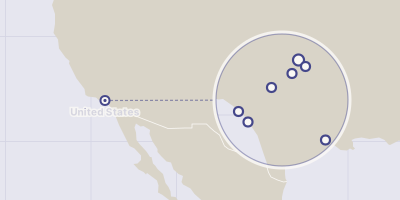
This route follows the documented places of the Osage murders, from Mollie Kyle's Gray Horse and Pawhuska's Million Dollar Elm to the Fairfax bombing, a lawyer's body beside the railroad, and the trials at Guthrie and Oklahoma City. It ends at the Osage Nation Museum, which keeps the record in the tribe's own voice. Scorsese's 2023 film was shot in many of the same towns.
In April 1923, with the Irish Civil War burning across the water, Colm Doherty stops speaking to his oldest friend, Pádraic Súilleabháin. The island of Inisherin is fictional, but the film was shot on two real ones: Inishmore, where Pádraic's cottage and the cliffs stand in for it, and Achill, where the pub, the shop, the lake and Colm's house were found.
This route follows the film's story from Pádraic's cottage to Colm's beach. Because Inisherin does not exist, every pin marks a real filming location; the sets at Cloughmore and Purteen are gone, and Colm's cottage is a private home to be seen from outside.
A Russian student expelled from university in 1864 ends up living among people in north-eastern New Guinea who had never seen a European. Nikolai Miklouho-Maclay was a zoologist and anthropologist, an early follower of Darwin who refuted the view that human races were different species.
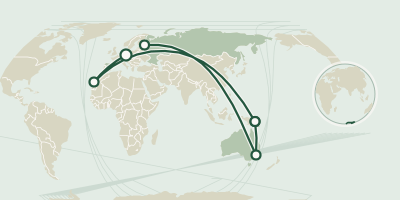
The route follows him from Haeckel's Jena and the Canary Islands to Astrolabe Bay, the Sydney research station he founded, and his grave in St Petersburg. Most pins are approximate: the sources name regions, not camps.
At 82, Leo Tolstoy slipped out of his house in the night, boarded a train with no destination in mind and was dead within ten days. The route follows that flight of November 1910, from his estate through two monasteries to a small railway station that suddenly drew the attention of the world.
It covers six stops in the Tula, Kaluga and Lipetsk regions. Three stops are approximate: two railway stations pinned by map search, and Astapovo, pinned on its village.
A Cornish knight fetches an Irish princess for his uncle the king, and a love potion on the ship ruins everything. Tristan and Iseult is a medieval legend told in many versions since the 12th century, and every retelling sets it on a slightly different map.
This route follows the lovers from Tristan's drowned homeland to Dublin, Cornwall and Brittany, ending on the island that carries his name. Almost every site is a tradition rather than a fact, so each pin says how sure it is.
Hemingway wrote A Moveable Feast about his poor, happy early years in 1920s Paris, working from notebooks he had left in trunks at the Ritz in 1928. It was published in 1964, after his death.
This route walks the memoir's Paris: the flat on the rue du Cardinal-Lemoine, Gertrude Stein's salon, Sylvia Beach's bookshop, the cafés of Montparnasse and Saint-Germain, and the Ritz where the notebooks resurfaced. Hemingway himself said the book may be read as imagination, so treat its scenes as a memory, not a record.
A schoolgirl in Kyushu follows a stranger into an abandoned resort, opens a door that was meant to stay shut, and ends up chasing a cat across Japan, closing doors as she goes. Her last door stands in the hometown she lost to the 2011 tsunami.
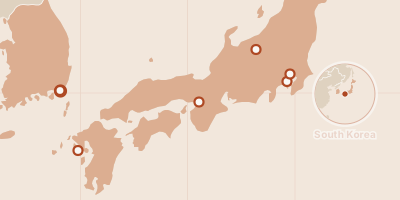
The route follows her path in story order: Nichinan harbour, the Bungo-Mori roundhouse, Yawatahama port, a Kobe mountain, Ochanomizu and Hijiri Bridge in Tokyo, then Miyako and Orikasa Station in Iwate. The film is animated, so most pins mark places that Wikipedia says its scenes were modelled on, and the Kobe amusement park is disputed.
In Mission: Impossible – Dead Reckoning Part One, Ethan Hunt races a rogue artificial intelligence called the Entity for a two-piece key that can control it. The chase crosses the Empty Quarter, Abu Dhabi, Rome and Venice before a night train runs into the Alps and a bridge is blown.
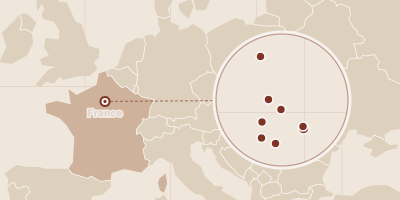
Almost every stop is a real place: the desert and airport in the Emirates, a car chase through Rome, a party at the Doge's Palace, a cliff jump at Hellesylt in Norway, and the Alpine train sequence doubled on a Yorkshire heritage railway and in a Peak District quarry.
Los Santos feels like Los Angeles because it is Los Angeles, compressed. Grand Theft Auto V squeezes the city's most famous miles into one playable map, from a hillside sign to a Venice boardwalk.
This tour visits seven real stand-ins behind the fiction: the hillside sign, a movie palace, a luxury shopping street, an observatory, a pier, a beach and a towered folk-art park. Every pin marks the real place, and each stop names the game location it doubles for. Expect crowds at the beach and on Hollywood Boulevard, and quiet at the towers.
Sunja grows up in her mother's boarding house on Yeongdo, an island in the harbour of Busan, under Japanese rule. Pregnant by a married man, she marries a gentle minister instead and leaves with him for Osaka, where Koreans live poor and despised in a neighbourhood called Ikaino. The Apple TV+ series (2022–2024), based on Min Jin Lee's 2017 novel, follows four generations of her family from 1915 to 1989.
The route follows the family through real places in Korea and Japan, in story order. Homes, shops and offices in the series are fictional, so the pins mark the neighbourhoods and cities where the story is set, not filming locations.
In 1970s Kabul, Amir, the son of a rich merchant, and Hassan, the son of his father's Hazara servant, grow up as near-brothers and fly fighting kites together. In the winter of 1975 Amir wins the city's kite tournament — and fails Hassan at the moment Hassan needs him most. War sends Amir into exile in California; a phone call from Peshawar a quarter of a century later sends him back into Taliban Kabul to make amends.
Khaled Hosseini's 2003 debut follows real places in Afghanistan, Pakistan and California. Homes and alleys in the story are not identified, so those pins mark neighbourhoods; the route offers no travel advice for Afghanistan or Peshawar.