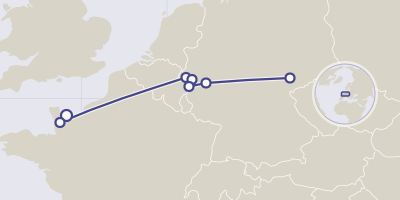
War Thunder's tank maps are based on real places: Stalingrad Tractor Plant, Bastogne, Hürtgen Forest, Cologne Cathedral, Berlin's Reichstag, Novorossiysk, Volokolamsk, Breslau (Wrocław), Darwin Hill in the Falklands and the Fulda Gap.
The developers say how close each map is to its original, from rebuilt photographs of the Stalingrad factory to a layout only inspired by the real ground. This route follows ten of them in the order of their history, with a short note on what happened at each real place.
Maps are classed here as exact only where the developers copy a real district; the rest are marked approximate.
Emperor Go-Daigo overthrew the Kamakura shogunate in 1333 after holding out at Kasagi Temple, being exiled to the Oki Islands and escaping to Mount Funanoue, and he ended his life at Yoshino. This route follows him from Kasagi to Kyoto and the Southern Court.
The six stops trace 1331 to 1339: the failed stand at Kasagi, exile on Oki, the escape to Mount Funanoue, the short Kenmu Restoration in Kyoto, the temporary palace at Yoshimizu Shrine and the emperor's tomb at Nyoirin-ji. Several pins are approximate because the sources describe regions or traditions, not exact spots.
Shakushain's War (1669) was the Ainu uprising against the Matsumae clan of Japan, fought between Shinhidaka, Matsumae Castle and Kunnui in Hokkaido.
The route follows the revolt from the feud on the Shibechari River to the mediation at Matsumae, the fighting at Kunnui and the leader's death at Piypok. It ends with the Shakushain statue in Shinhidaka. Several sites are approximate and are marked as such.
The Ryukyu Kingdom ruled Okinawa from Shuri Castle in Naha, and its story can still be walked at Nakijin, Zakimi and Katsuren castles and the Tamaudun royal tombs.
The route follows the kingdom from the three-principality era and Shō Hashi's unification in 1429, through a rival lord's fall in 1458, to the royal tombs of 1501. Most of these castle sites are ruins or reconstructions.
The Battle of Iwo Jima was fought in February and March 1945 on a small volcanic island in Japan's Ogasawara group, from the black-sand landing beaches to the summit of Mount Suribachi. Its famous flag-raising photograph became the Marine Corps War Memorial in Arlington, Virginia.
This route follows the battle from the landing on 19 February, through the Suribachi flag-raising and the fight for the northern gorge, to the memorial in Arlington and the 1985 Reunion of Honor, where veterans of both sides met on the same beach. Iwo Jima itself is not open to ordinary visitors.
The Shinsengumi, the squad of Kondō Isami and Hijikata Toshizō, began in Hino in the Tama region and ended in Hakodate. Their story runs through Mibu-dera and the Ikedaya Inn in Kyoto, the battle of Fushimi, and Kondō's execution in Itabashi.
The route follows Kondō Isami and Hijikata Toshizō from a dojo in Hino to the Boshin War. Several stops can still be visited, though some pins mark an area rather than the exact spot.
Tokugawa Ieyasu, founder of the Tokugawa shogunate, was born at Okazaki Castle and buried at Nikkō Tōshō-gū. His route also crosses the Sekigahara battlefield, Edo Castle in Tokyo and Sunpu Castle in Shizuoka.
Follow five places from his birth in 1543 through the 1600 battle, his rise to shogun in 1603, his retirement and his death in 1616. Sekigahara is pinned approximately to the town.
Miyamoto Musashi, Japan's most famous swordsman, moves through this route from the Sekigahara campaign of 1600 to the duel on Ganryū Island, Osaka Castle, Kumamoto Castle and the cave of Reigandō, where he wrote The Book of Five Rings.
The route follows the biography stop by stop, from a village birthplace that sources place in two provinces to the cave where he spent his last years. Several details, including his role at Sekigahara and Osaka, are debated or rest on later accounts.
Nicosia's walled old city is a five-kilometre ring of Venetian fortifications with three surviving gates — Famagusta, Kyrenia and Paphos. Inside are the Selimiye Mosque, the Bedesten, the caravanserai of Büyük Han and Ledra Street, the shopping street that became a symbol of the island's division. The walk crosses the Green Line on foot.
The route begins at Eleftheria Square, enters by Famagusta Gate and loops through the old city: the Selimiye and the Bedesten, Büyük Han, Kyrenia Gate, the Ledra Street crossing, the Ömeriye Mosque and Paphos Gate. The Selimiye, Bedesten, Büyük Han and Kyrenia Gate stand north of the Green Line; the rest are in the south.
The 1999 Kargil War was fought on the ridges above the Srinagar–Leh highway, around Kargil, Dras, Tololing and Tiger Hill in Ladakh, after Pakistani forces occupied heights on the Indian side of the Line of Control. India calls its campaign Operation Vijay.
The route goes from the highway at Kargil to the battles for Tololing, Tiger Hill and Point 4875, and ends at the Dras war memorial. Both Indian and Pakistani accounts are noted, and many of the heights remain military ground.
In August 2010 a Bohemia Interactive team went to Lemnos to gather references, and came back with the material for Altis, the island where Arma 3 is set. Two years later two of the studio's developers were arrested on the same island and held for 129 days on suspicion of spying. After the arrest the game's main island, until then called Limnos, was renamed Altis; Stratis kept its name.
The route follows the real island from Myrina and its castle, past a church with no roof and a miniature desert, to the airport and the old Allied base at Moudros, then across the water to Agios Efstratios. Arma 3's war is set in 2034–2035; the harbours, theatre and dunes are not.
The Romanovs' last journey runs from the Alexander Palace at Tsarskoye Selo to the governor's mansion in Tobolsk and the Ipatiev House in Yekaterinburg, then to Ganina Yama and Porosyonkov Log. Sixteen months after Nicholas II's abdication, none of the family was alive.
The route follows that road from the Alexander Palace through the governor's house in Tobolsk to Yekaterinburg and the forest sites nearby, where the story ended and where it was later argued over. It is told plainly, and the final stops are places of mourning for many visitors.
In the autumn of 1600 two armies met at Sekigahara to decide who would hold power after Toyotomi Hideyoshi. One day in the fog gave Tokugawa Ieyasu a decisive victory and put him on the road to the shogunate.
The route follows the campaign from the siege of Fushimi to the castles of Mino, the field of Sekigahara, the fall of Mitsunari's Sawayama and his burial in Kyoto, and ends at Edo Castle in 1603. Dates inside Japan's old calendar are labelled as such.
In September 1799 the Russian field marshal Suvorov led his army into Switzerland to join the Allied forces, only to find his allies failing him. He fought through the Alps, crossed high passes and ended in Chur.
The route follows the march from Taverne to Chur. Dates are Gregorian (New Style), and pins mark villages or passes rather than battlefields.
Nioh plays out its dark-fantasy 1600 on real ground: the Tower of London, Kyoto, Sekigahara and Osaka Castle. William Adams, a blond outsider, escapes England and becomes Ieyasu's ally against demons and the alchemist Edward Kelley in Japan's civil wars.
The route follows the main campaign and its last two expansions: the Tower of London, Kyoto, Sekigahara, then the Sanada-maru, Tennōji and Osaka Castle. The game is fantasy, so the map shows where its history happened, not where it was filmed or modelled.
Private First Class Ronald "Red" Daniels lands on Omaha Beach on D-Day with the 1st Infantry Division and fights his way into Germany with one squad, until a friend is captured and the search for him ends at a concentration camp. Call of Duty: WWII is a 2017 game by Sledgehammer Games, and its campaign is set among real battles.
The route follows the missions in order: Omaha Beach, Marigny, Aachen, the Hürtgen Forest, the Ardennes, the bridge at Remagen and Berga, with the real battle each one echoes. Pins mark battle areas, not a mission's exact street.
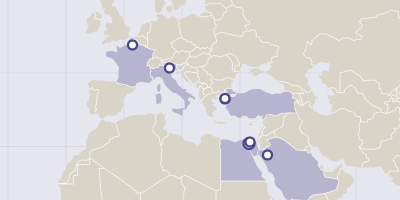
Battlefield 1 sends its soldiers across the Western Front, the Italian Front, Gallipoli and Arabia. This route follows the War Stories and multiplayer maps that go with them, from the Suez Canal in 1915 to Monte Grappa in October 1918.
Stops run in the order of the real battles, not the game's menu. The maps are the game's own reconstructions, so each pin marks the real ground behind a level, and one stop is a village the game invented.
1066 in three battles: Fulford and Stamford Bridge in the north, then Pevensey, Hastings and Battle in the south, with Westminster at both ends. Edward the Confessor died childless that January; by Christmas Day Harold Godwinson had fallen and William of Normandy was crowned.
The route follows the crown from Westminster to the Yorkshire landing of Harald Hardrada, Fulford and Stamford Bridge, then to Pevensey, Hastings and the field at Battle, and back to Westminster on Christmas Day. The exact ground of several battles is debated, so those pins mark the best-known sites.
Fitzgerald set The Great Gatsby on two invented peninsulas, West Egg and East Egg, but he built them from the Long Island he knew in Great Neck, where he lived from October 1922. Behind the glamour sit a dump, a station and a hotel suite that were all real.
This route follows Nick from the Eggs through the valley of ashes, Penn Station, the Queensboro Bridge and the Plaza Hotel. The Eggs, the valley and Gatsby's house are invented, so their pins mark the real places the novel is read against.
Assassin's Creed III crosses the American Revolution from London's Covent Garden opera house to Boston's Old State House, Bunker Hill and the Battery in Manhattan. In 1754 the Templar Haytham Kenway carries a stolen key to the colonies; his son Connor becomes the Assassin who hunts him through the war.
Assassin's Creed III builds its America from real maps, and almost every stop can still be walked: the opera house in Covent Garden, the Old State House and Boston Harbor, the green at Lexington and the bridge at Concord, the Bunker Hill battlefield, the Valley Forge encampment, the Monmouth battlefield, and the Battery at the foot of Manhattan, where the war ends.
Dune turns real places into its planets: Norway's Stadlandet is Caladan, Jordan's Wadi Rum and Abu Dhabi's Liwa Oasis share Arrakis, Budapest's Origo Studios build Arrakeen and Italy's Brion tomb becomes the emperor's court. Paul Atreides leaves Caladan for the desert planet, the sole source of spice, then forces Emperor Shaddam to come to Arrakis with Irulan and his Sardaukar soldiers.
This route links the five key locations: Stadlandet standing in for Caladan, Wadi Rum and the Liwa Oasis sharing Arrakis, Origo Studios staging Arrakeen and the ornithopters, and the Brion tomb doubling as the imperial court. Part One shot from March to July 2019 in Hungary, Jordan, Norway and the Emirates; Part Two followed from July to December 2022, adding Italy and Namibia to the itinerary.
Assassin's Creed Valhalla brings the Viking Eivor and their clan to Anglo-Saxon England, where Hytham asks for help ridding the land of the Order of the Ancients. Following tip-offs from an informant who signs himself the "Poor Fellow-Soldier of Christ", Eivor hunts Order members from Grantebridge to Jorvik and Wincestre.
The route visits the real places behind the game's: Cambridge, where the jarlskona Soma takes back her town; York, the capital of Viking Britain; the docks of Repton, where the Great Heathen Army wintered; Alfred's Winchester; the battle at Chippenham in 878; and Athelney, where the informant's identity is finally revealed. All six can be visited today.
Ifemelu and Obinze fall in love at secondary school in Lagos, in a Nigeria under military rule where everyone seems to be planning to leave. She gets a scholarship to Philadelphia; he, refused an American visa after 9/11, ends up working illegally in London. Over thirteen years in the United States Ifemelu discovers that she has become "black" — and writes a hit blog about it — before deciding to go home.
Chimamanda Ngozi Adichie's 2013 novel moves between real cities on three continents, and the route follows it in story order rather than in the book's flashback structure. Homes, salons and the university in Philadelphia are not identified, so most pins mark the city or campus.
In 218 BC the Carthaginian general Hannibal set out from Spain to attack Rome by the one route the Romans never expected: overland, across the Pyrenees, the Rhône and the Alps, with tens of thousands of soldiers, horses and 37 war elephants. Five months later he came down into the plain of the Po with a battered but unbeaten army, and within weeks had won his first two victories in Italy.
The route follows the march as told by the Greek historian Polybius, who wrote about seventy years later and walked the Alpine route himself. Nobody knows for certain where Hannibal crossed the Rhône or which pass he used, so several pins are marked speculative.