Cole MacGrath loses his first fight with the Beast, flees the ruins of Empire City and sails south to New Marais, a Louisiana city under the thumb of a demagogue named Joseph Bertrand. To beat the Beast he needs a scientist, a device and a handful of power cores — and then he has to decide what he is willing to sacrifice.
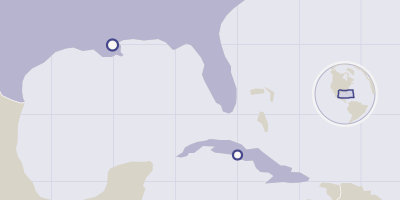
New Marais is Sucker Punch's New Orleans: a fictional city assembled from the French Quarter, above-ground cemeteries, plantation houses, a Civil War fort, the bayous and the flooded districts left by a hurricane. This route follows Cole's story through seven of those stand-ins, from the swamp where he lands to the cathedral tower where the game ends.
Age of Empires II follows Joan of Arc from a French army camp at Vaucouleurs to the stake at Rouen. The designers said they deferred to history wherever it did not interfere with gameplay, and the campaign's spine — Orléans, Patay, Reims, Paris — is close to the record. But the game also bends the story, placing Joan at a battle she missed and turning a failed assault on Paris into a betrayal. This route follows the campaign's stops in order and sets each one beside what the sources say happened there.
Red Dead Redemption 2 follows the Van der Linde gang through 1899 across five invented U.S. states. Most of the map has no named real model, but Saint Denis was built on New Orleans.
This route follows the main story from Blackwater to Saint Denis and an island beyond. Pins mark only places the sources name; the rest stay unpinned and keep their place in the sequence.
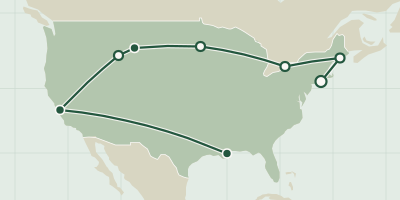
In 1960 the novelist John Steinbeck fitted a pickup truck with a camper shell, named it Rocinante and set out from Long Island with his poodle, Charley. He wanted to see his country because he made his living writing about it, and his main question was what Americans are like today.
This route follows eight stops of the outer loop, from Sag Harbor through Maine, Niagara Falls and Minnesota to Montana, Yellowstone and Steinbeck's native Salinas Valley, then down to New Orleans. The book is a novelist's account: it has been challenged as partly fictionalised, so read the encounters as stories and the places as real.
The Supreme Court had ruled that segregated waiting rooms and lunch counters in terminals serving interstate buses were illegal, but across the Deep South the "whites only" signs stayed up. On 4 May 1961 thirteen volunteers of the Congress of Racial Equality, black and white together, set out from Washington, D.C., on two buses to test the ruling all the way to New Orleans. In Alabama they were met by mobs, a burning bus and police who looked away; hundreds more riders followed them into the jails of Mississippi.
The route follows the rides through the places where it happened, several of them now museums and part of a National Monument.
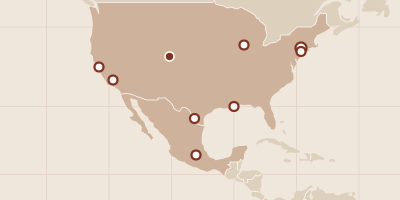
Between 1947 and 1950 Sal Paradise, a young writer from New Jersey, crosses America again and again — hitchhiking, by bus and in borrowed cars — usually in pursuit of his wild, magnetic friend Dean Moriarty. Jack Kerouac typed the story on a continuous scroll of paper in three weeks in April 1951, and it was published in 1957. Sal is Kerouac, Dean is Neal Cassady, and most of the trips really happened.
The route picks out the places the novel names, from a rainy false start on the Hudson to Mexico City and back to a New York street corner. The novel gives towns and streets rather than addresses, so most pins mark areas, not doors.