Sally Rooney's Normal People is set in County Sligo and at Trinity College Dublin, but the television series was shot in a school in Clonsilla, the pubs of Tubbercurry, Trinity itself, a villa in Lazio and a frozen coast at Luleå.
The route follows Marianne and Connell from their last school days to university and abroad. Several stops are stand-ins for places the story names, and each says so.
Verano Azul was filmed in Nerja on Spain's Costa del Sol: Burriana beach, the Balcón de Europa, Cala Chica (La Caleta de Maro) and the Cueva de Nerja.
The route follows the gang's summer from the first day of shooting on Burriana, past the Parque Verano Azul and its replica of La Dorada, to the fake cemetery at Almuñécar where Chanquete is buried. The town is never named on screen, but the locations run from Nerja and Maro to Vélez-Málaga and Motril.
Home Alone's Kevin McCallister lives at a real three-storey house at 671 Lincoln Avenue in Winnetka, Illinois; his family's Christmas dash was filmed at Chicago's O'Hare, and Home Alone 2 sends him to the Plaza Hotel, Central Park and the Rockefeller Center tree.
The route follows both films in order, from the Winnetka house and the two churches where Kevin meets Old Man Marley to the Chicago buildings that stood in for Duncan's Toy Chest and the New York landmarks of the sequel. Every stop is a documented filming location; the house is a private home, so visitors should not disturb the residents.
Two years after a pandemic turns millions of people into feral Freakers, outlaw biker Deacon St. John rides central Oregon as a drifter and bounty hunter. He believes his wife Sarah died when a NERO helicopter lifted her out of the outbreak — until he learns she was moved to a military outpost at Crater Lake.
Days Gone's Oregon is a compressed, renamed version of the real high desert: Bend becomes Farewell, Black Butte Ranch becomes Iron Butte Ranch, and the militia holds Crater Lake. The route follows Deacon's ride from the opening evacuation to the volcanic lake where the story ends, through the hot springs, small towns and logging country that Bend Studio used as its model.
Two girls grow up in a poor Naples neighbourhood in the 1950s, one pushed on by school, the other by sheer brilliance. Elena Ferrante's four Neapolitan Novels follow their friendship from a doll thrown down a cellar chute to a package in the mail in 2010.
The route runs from the district of the first book through Ischia, Pisa, San Giovanni a Teduccio and Florence to Turin. The books never name the streets, so most pins mark areas, not buildings.
Liberty City is New York with the labels peeled off. Grand Theft Auto IV rebuilds four of the boroughs, borrows New Jersey for the state across the river, and copies in the Statue of Liberty, the Coney Island Cyclone, the Manhattan Bridge, Times Square and the Empire State Building — then renames nearly all of them, so the game's Liberty statue holds a takeaway coffee instead of a torch. The story is set in 2008, the year the game arrived.
This route pins nine real places behind those names: the triumphal arch at Brooklyn's Grand Army Plaza, the wooden Cyclone at Coney Island, the Manhattan Bridge as the Algonquin Bridge, Brighton Beach as Hove Beach, the surviving 1964 World's Fair site in Queens, and three Manhattan landmarks — Middle Park, Star Junction and the Rotterdam Tower. Each stop names the in-game location it stands in for. One caveat: Rockstar deliberately avoided a precise recreation of New York, so expect the landmarks, not the street plan.
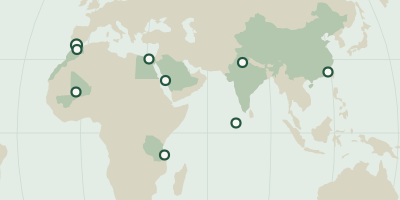
In June 1325 a 21-year-old law student left Tangier to make the pilgrimage to Mecca. He did not come home for 24 years. Ibn Battuta crossed the Islamic world and beyond — Arabia, East Africa, Anatolia, Central Asia, India, the Maldives, Sumatra and China — earning his keep as a judge and a guest of sultans, marrying and divorcing along the way. By some estimates he covered about 117,000 kilometres, more than any traveller before the age of steam.
Back in Morocco he dictated his memories, the Rihla, to a scholar who polished them and borrowed passages from older books, so not every scene was his own. The route picks out nine stops in the order he reached them; it is not one continuous road. There are no travel tips for Mecca or Mali.
In 1324 Mansa Musa, ruler of the Mali Empire, set out on the pilgrimage to Mecca with a caravan so rich in gold that Cairo talked about it for years. Arab chroniclers wrote of thousands of servants carrying gold bars and camels loaded with gold dust; historians today treat those numbers as a way of saying "more than anyone could imagine", not as a count. The Catalan Atlas of 1375 still shows him enthroned in the Sahara, holding up a piece of gold.
The route keeps to the places the sources actually record: the royal city of Mali, the camp below the pyramids, Cairo, Mecca, and Gao and Timbuktu on the way home. The road across the desert is not documented, so it is not drawn. The route offers no travel advice for Mali.