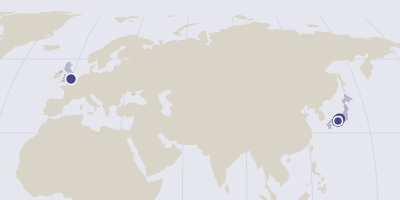
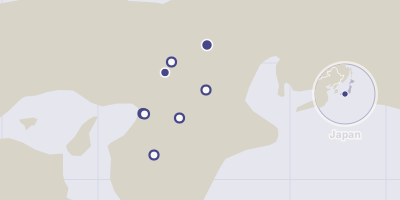
In 1600 an English pilot came ashore in Japan. FX's Shōgun renames the players — John Blackthorne is William Adams, Lord Toranaga is Tokugawa Ieyasu, Lady Mariko is Hosokawa Gracia — and moves the shipwreck from Usuki to the Izu village of Ajiro. This route follows the documented places behind the drama, from the real landing at Usuki and the regents' court at Osaka Castle to the mansion where Gracia died, Adams's shipyard at Itō, his house in Nihonbashi and his grave at Hirado. The 2024 series was filmed in British Columbia.
Team Ninja's open-world samurai game drops a masterless Blade Twin into the last years of the shogunate. Between 1858 and 1868 the story runs from Yokohama's foreign quarter through the killing of a Chief Minister to Kyoto's Shinsengumi and a plot to burn Edo.
This route follows the game's main story through seven places, from the port to the capital, pairing each scene with the real site that history ties to it. Where the game names only a district, the pin marks the nearest well-known landmark.
A retired sake brewer set out on foot to measure Japan. Over ten surveys starting in 1800 Inō Tadataka and his team paced the coasts and paths of the country, and maps based on his work were still in use in 1924.
The route follows his life in places: the brewer's house at Sawara, the shrine where he prayed before the first survey, Mount Hakodate and the far end of that journey in Hokkaido, Nihonbashi, his grave and the shrine that honours him. The surveys were separate expeditions, so the stops are not one connected walk.
In 1613 a samurai from Sendai set out to Mexico in a galleon built for the mission to meet the King of Spain and the Pope. Hasekura Tsunenaga's embassy took seven years, crossed Mexico and the ocean, and came home to a Japan that was closing its doors to Christianity.
The route follows him from the port of Tsukinoura through Acapulco, Mexico City, Havana, Madrid, Saint-Tropez and Rome, then back via Manila to Nagasaki. Japanese dates are given in the Gregorian calendar. Most pins mark towns or harbours, not documented buildings.
In the autumn of 1600 two armies met at Sekigahara to decide who would hold power after Toyotomi Hideyoshi. One day in the fog gave Tokugawa Ieyasu a decisive victory and put him on the road to the shogunate.
The route follows the campaign from the siege of Fushimi to the castles of Mino, the field of Sekigahara, the fall of Mitsunari's Sawayama and his burial in Kyoto, and ends at Edo Castle in 1603. Dates inside Japan's old calendar are labelled as such.
In July 1853 four black warships anchored off Uraga and ended more than two centuries of Japanese seclusion. Within a year, Commodore Matthew Perry had delivered a president's letter, signed a treaty and opened two ports.
The route follows his two voyages: from the Ryukyu court at Shuri to Uraga, Kurihama, the treaty at Yokohama and the temples of Shimoda. Perry also visited Hakodate in 1854, but that stop is not included.
Between 1180 and 1185 Japan's two great warrior clans, Taira and Minamoto, fought over the realm, and the war ended with a child emperor, a fleet and the tide at Dan-no-ura. It was the war that led to the first shogun.
This route visits seven battlefield sites in date order, from the bridge at Uji to the Kanmon Straits. Documented events are kept apart from the Heike Monogatari's legends, which the text attributes to the tale. Most battle areas are approximate.
In 1832 the printmaker Hiroshige travelled the Tōkaidō, the road from Edo to Kyoto, and made it into The Fifty-three Stations of the Tōkaidō. This route follows seven of his prints, from the bridge where the road began to the bridge where it ended.
Each stop pairs a print with what is there today: a rebuilt checkpoint, a long river bridge, a shrine, a preserved post town. Scholars debate whether Hiroshige saw every station himself, so the pins mark the places, not his exact viewpoints.
In April 1701 a lord drew a blade inside Edo Castle, and two years later forty-seven of his leaderless samurai stormed the mansion of the man he had attacked. The documented story runs from a corridor in Edo, through a surrendered castle and a quiet retreat near Kyoto, to a night raid and a temple cemetery in Tokyo.
The route sticks to dated events and places. The legend of Chūshingura, the later play, is kept to the final stop, where it is set apart from what happened.
In Ishin!, Sakamoto Ryōma flees Tosa as a murder suspect, hides in Kyoto under the name Saitō Hajime and joins the Shinsengumi to find the masked killer of his adoptive father. The game is fiction built on real history: its Ryōma, its plot and its twists belong to the game, while the Teradaya attack and the Ōmiya killing really happened.
The route follows the story from Kōchi Castle through the Shinsengumi's Mibu, Gion and Fushimi to the Ōmiya Inn, and each stop says what is the game and what is the record.
Sailor Moon is a fantasy about moon princesses and magical warriors, but its home ground is a real Tokyo neighbourhood. Author Naoko Takeuchi had lived in Azabu-Jūban, and apart from the fantasy elements most places in the story are modelled on real ones nearby.
This route visits five of them: the shopping street, a park under a highway, two shrines that stand in for the Hikawa Shrine of the story, and Tokyo Tower. The manga and the older anime sometimes used different real models, and the two shrine pins mark real stand-ins for the story's invented Hikawa Shrine.
Nioh sends William Adams, a blond outsider who becomes Ieyasu's ally, through a dark-fantasy version of 1600: demons in the mud of Japan's civil wars, alchemist Edward Kelley behind them, and Tokugawa Ieyasu rising above it all. Its story is stitched onto real places, from a London prison to the battlefield that made the Tokugawa shoguns.
The route follows the main campaign and its last two expansions: the Tower of London, Kyoto, Sekigahara, then the Sanada-maru, Tennōji and Osaka Castle. The game is fantasy, so the map shows where its history happened, not where it was filmed or modelled.
Ghost of Yōtei follows Atsu, a wandering mercenary who returns to Ezo — modern-day Hokkaido — in 1603 to hunt down the Yōtei Six, the band led by the samurai lord Nariaki Saito who slaughtered her family sixteen years earlier. Her revenge carries her across an island modelled on Hokkaido, from the grasslands at Mount Yōtei's foot to the frozen north and the Matsumae clan's castle in the south.
This route follows the game's regions and their real counterparts: the Yotei Grasslands around Lake Shikotsu, the Ishikari Plain, the Ainu country of the Nayoro Wilds, the Kitsune's Teshio Ridge, and the Tokachi Range, with Mount Yōtei and Matsumae Castle as its fixed points.
In 1581 the African slave Diogo comes to Kyoto with a Jesuit delegation and is handed to the warlord Oda Nobunaga, who renames him Yasuke and makes him a samurai. That year Nobunaga's army crushes the ninja province of Iga, where the young shinobi Naoe loses her father and inherits his Hidden Blade.
From there the two hunt the same conspiracy across Kansai: the port of Sakai, the temple at Honnō-ji where Nobunaga dies, a kofun in Settsu, the castle of Shōryūji at Yamazaki, the shrines of Yamato, and the Templar recruiting ground of Kii. Most stops are real castles, temples and tombs that the game rebuilds.
In spring 1689 the poet Matsuo Bashō gave up his hut in Edo and set off on foot with his friend and disciple Kawai Sora into Oku, the remote north of Japan. For about 156 days and some 2,400 kilometres they walked to the places the old poets had made famous — a barrier gate, a bay of pine islands, a battlefield, a mountain temple — and Bashō answered them with haiku.
The travel diary he made of it, Oku no Hosomichi, published in 1702, is one of the classics of Japanese literature, and its stops are still pilgrimage sites. Bashō polished the facts for art; Sora's own diary shows where. Dates follow the old lunar calendar, so they are given here by season.
In January 1868 Japan's young emperor was declared ruler in fact as well as name, ending more than 250 years of Tokugawa shogunate. The last shogun's supporters did not give up quietly. For eighteen months a civil war rolled north from the edge of Kyoto to Edo, into the mountains of Aizu and finally to a star-shaped fortress on Hokkaido, where a short-lived breakaway republic made its last stand.
The route follows that war in six places, all of them visitable: the battlefield at Toba, Edo Castle, the hill of Ueno, Aizu's castle and the hill where its teenage soldiers died, and Goryōkaku. Dates are given in the Western calendar, converted from the Japanese lunar dates used at the time.