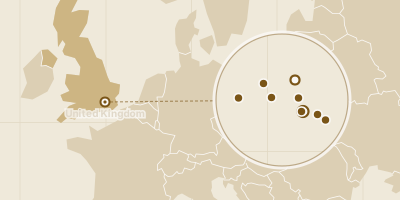
Wednesday Addams is sent to Nevermore Academy, a school for outcasts in the fictional Vermont town of Jericho. Netflix built that world in Romania: a castle above Bușteni, Bucharest interiors, a backlot town and a country mansion standing in for the Gates house. When season 2 moved production to Ireland in 2024, Nevermore gained a castle in County Offaly, a waterfall campsite and a Dublin cemetery. Much of the Irish shoot was based at Ashford Studios in County Wicklow.
This route follows the show's geography through the real places that played it, season by season. The pins mark filming locations, not invented Vermont addresses.
A baker's oven in Pudding Lane, a gale from the east and a city of timber and pitch: in four days in September 1666 the fire destroyed medieval London, including Old St Paul's. Samuel Pepys watched it from the Tower, from the river and from a church tower, and wrote it all down.
The route follows the fire from its first spark on Sunday morning to its end on Wednesday, then to the Monument and the Golden Boy that remember it. Where the sources give only an area, such as the refugee camps at Moorfields, the pin marks it loosely.
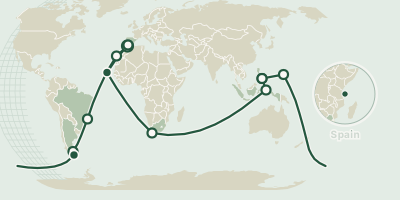
On 20 September 1519 five ships and about 270 men sailed from Spain to find a western sea road to the Spice Islands. Magellan died in the Philippines, but Juan Sebastián Elcano brought the Victoria home three years later with eighteen survivors and 26 tons of spices, having sailed all the way around the world.
The route follows the voyage from the mouth of the Guadalquivir past Port St. Julian, through the strait and across the Pacific to the Moluccas, then home past the Cape of Good Hope. Anchorages are often unrecorded, so most pins mark the nearest known place; the dates come from Pigafetta's journal and modern accounts.
Belfast built her, Southampton sailed her, and two tender ports filled her up before the Atlantic took her. This route follows the whole last leg of Titanic's maiden voyage in order — from the Belfast slipway where 100,000 people watched her leave the ways to the Halifax cemetery where 121 of her dead are buried.
Six stops: the shipyard that became a museum, the Southampton quayside and its memorial to the engineers who stayed at their posts, the two Channel ports where tenders ferried passengers out to a ship too big to come alongside, the wreck on the seabed at 12,500 feet, and the graves at Fairview Lawn. Only the wreck is out of reach; every other stop can be walked today.