A thousand years after the old world fell to Faro's machines, the American West is a land of scattered tribes and robotic machines. Aloy, a Nora outcast, travels from Colorado Springs to the California coast to uncover what destroyed the old world.
This route follows both Horizon games from the red rocks above Colorado Springs to the drowned streets of San Francisco, pairing each stop with the real landmark behind it. Guerrilla compresses the map — in-game locations are not exactly where they are in the real world — so the pins mark real stand-ins, not exact game coordinates.
In the spring of 1989, Henry leaves Boulder for a summer job as a fire lookout in Wyoming's Shoshone National Forest. His only company is Delilah, the voice on the other end of a walkie-talkie, until fireworks at a lake, a ransacked tower and a fenced research camp turn the job into a mystery.
The route follows the game's places and the real Wyoming behind them: the bar where Henry meets Julia, the Cody rodeo the characters talk about, the Shoshone forest still marked by the 1988 Yellowstone fires, and stand-ins for the fictional Two Forks tower, Jonesy Lake, Wapiti Station, Cave 452 and Thorofare Lookout.
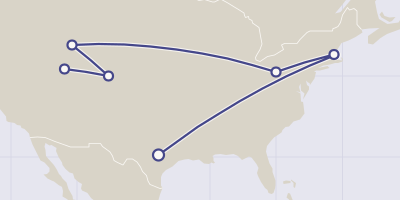
A smuggler named Joel is hired to carry fourteen-year-old Ellie — possibly immune to the fungus that ended the world — across a ruined America, from the Boston quarantine zone to a hospital in Salt Lake City. What starts as a delivery job becomes the closest thing either of them has left to family, ending in a hospital corridor with an impossible choice.
This route follows their road west in story order: outbreak night in Austin, the Boston handoff, Bill's trapped town, the Pittsburgh ambush, Tommy's dam settlement at Jackson, the deserted university in Colorado and the Salt Lake City hospital. The cities are real but the story sites are placed approximately, with real landmarks as pins.
Three student teachers in Minneapolis wrote The Oregon Trail in two weeks in 1971 for a history class. Its 1985 Apple II version, set in 1848, became a staple of American classrooms — buying oxen, fording rivers, hunting buffalo and, all too often, dying of dysentery — and the series has sold more than 65 million copies. The game was built around real landmarks of the real trail, a 2,170-mile wagon route that some 400,000 emigrants travelled to Oregon and California, mostly between 1846 and 1869, across the homelands of many Native nations.
The route follows the game's stops from Missouri to the Willamette Valley, with what stands at each place today.