Barcelona, 1945. A bookseller leads his ten-year-old son Daniel through a dark alley off the Ramblas to the Cemetery of Forgotten Books, a secret library where every child may adopt one book. Daniel chooses a novel by Julián Carax — and discovers that someone has spent years hunting down and burning every other copy.
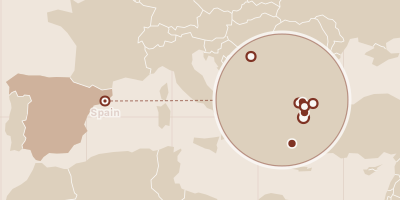
Carlos Ruiz Zafón's 2001 bestseller is a love letter to the old city, and its mystery runs through real streets: the Ramblas, the Gothic Quarter, the Ribera, Tibidabo and Montjuïc. The library, the bookshop, the hospice and the Aldaya mansion are invented, so those pins mark the streets where Zafón put them; the café, squares and castle are real and open to visitors.
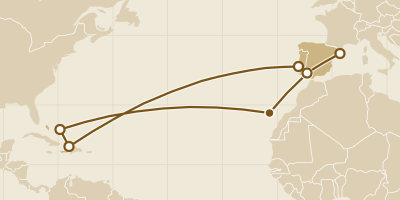
In August 1492 three small ships slipped down the Río Tinto from Palos with a plan to reach the Indies by sailing west. By mid-March 1493 Columbus was back in Palos without his flagship, which had been wrecked off Hispaniola, but with captives, samples of gold and plants unknown in Europe.
The route follows the voyage in order: the friary where the plan found friends, a stopover in the Canaries, the first landfall in the Bahamas, the wrecked flagship and the fort of La Navidad, a storm-driven stop in Lisbon, the return to Palos and the report to the monarchs in Barcelona. The landfall island and the fort site are both debated, and the pins say so.
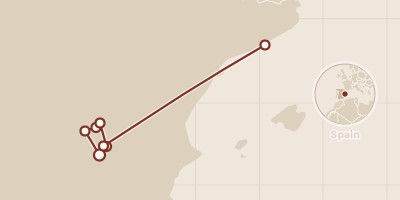
A gentleman of La Mancha, a head full of chivalry books, a plain full of mills: this route follows Don Quixote from the village argued to be his to the strand of Barcelona, keeping the order of the book.
It begins with the village whose name the narrator refuses to give, the inn where a landlord reading from his account book dubs him a knight, and the ridge of mills that shivered his lance to pieces. In Part II it follows him to Dulcinea's town by night, the cave where he sleeps an hour and believes three days have passed, the lakes of Ruidera, and finally Barcelona, where galley crews salute him three times and a bachelor from his own village unhorses him.
Which mills he charged, and where the inn of that first night stood, are guesses: Campo de Criptana and Puerto Lápice are the usual answers.
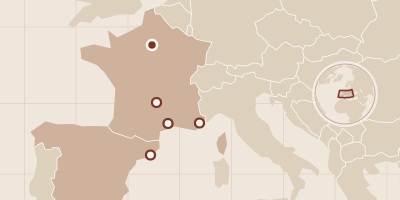
Patrick Süskind's Perfume follows Jean-Baptiste Grenouille, born in Paris in 1738, with a gift for scent and no scent of his own. His path runs from the Innocents cemetery to a mountain cave, and then to Grasse, where his craft turns murderous.
The route follows the book from Paris to the Plomb du Cantal, Montpellier and Grasse, and ends in Barcelona, where Tom Tykwer's film rebuilt Paris. Only a few places are named exactly; the rest are approximate.