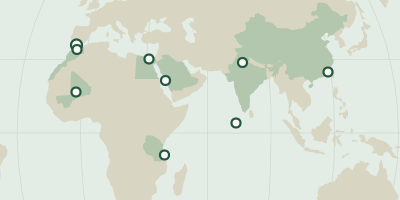
In June 1325 a 21-year-old law student left Tangier to make the pilgrimage to Mecca. He did not come home for 24 years. Ibn Battuta crossed the Islamic world and beyond — Arabia, East Africa, Anatolia, Central Asia, India, the Maldives, Sumatra and China — earning his keep as a judge and a guest of sultans, marrying and divorcing along the way. By some estimates he covered about 117,000 kilometres, more than any traveller before the age of steam.
Back in Morocco he dictated his memories, the Rihla, to a scholar who polished them and borrowed passages from older books, so not every scene was his own. The route picks out nine stops in the order he reached them; it is not one continuous road. There are no travel tips for Mecca or Mali.
On a Sunday evening in May 1857 Indian soldiers of the East India Company's army mutinied at Meerut and rode for Delhi. Within weeks much of northern India was in revolt — soldiers, princes dispossessed by the Company, and villagers with their own grievances. It took the British more than a year to crush it, and afterwards the Company itself was abolished and India placed under the Crown.
The rebellion goes by many names, from the Sepoy Mutiny to the First War of Independence. It was not one army on one road but a chain of uprisings, and the route visits its main centres in order: Meerut, Delhi, Kanpur, Lucknow, Jhansi, Kalpi and Gwalior. Both sides committed atrocities against civilians, and the texts name them plainly.
Two branches of one royal family, the five Pandava brothers and their hundred Kaurava cousins, quarrel over the throne of the Kuru kingdom. The Pandavas survive a murder plot, win the princess Draupadi, build a splendid capital, lose everything in a rigged game of dice and spend thirteen years in exile before the families meet in an eighteen-day war at Kurukshetra. The Sanskrit epic, one of the longest poems ever composed, also holds the Bhagavad Gita.
Northern India is dotted with places that tradition links to the story, several of them with real Iron Age remains. This route follows the Pandavas through those traditional sites. They are identifications of faith and local memory; archaeology has found ancient towns, but not the epic's events.