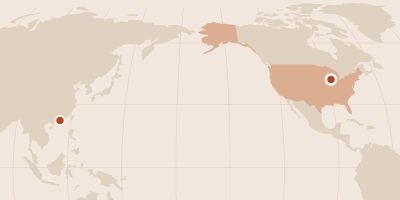
Bruce Lee was born in San Francisco, but Hong Kong was the city that shaped him: a Nathan Road childhood, Wing Chun lessons with Ip Man, and the film studios that made him a star. This route follows his documented life and the places where his films and legacy meet.
It runs from a Kowloon flat and school days, through a surviving Enter the Dragon location and the hospital where he died, to the statue and museum that remember him. Where accounts differ, the stop says so.
Two love stories shot in guerrilla style across Hong Kong in 1994: a policeman who buys cans of pineapple while he waits for a month to end, and a girl at a fast-food counter who sneaks into a policeman's flat.
The route follows the plot from a Tsim Sha Tsui nightclub to a block of guesthouses, then across the harbour to Lan Kwai Fong and the Mid-Levels escalator, and ends at Kai Tak, the old airport in Fallen Angels. Chungking Express stops are filming sites; the Midnight Express pin is approximate.
Sleeping Dogs sends an undercover cop into the Sun On Yee triad across a compact Hong Kong built from four real Island districts. The designers photographed the city for a week and then bent it to fit the story.
This route visits the four districts in turn, starting with Aberdeen, where the story opens. Pins mark whole districts, not mission sites: no source ties a specific mission to a street.
In 1986 the teenage martial artist Ryo Hazuki comes home to the family dojo in Yokosuka and watches his father, Iwao, die at the hands of Lan Di. Swearing revenge, Ryo follows the killer to Hong Kong in 1987 and on to the mountains of Guilin, and the two games turn that trail into one long walk through a living town, a harbor, a crowded Hong Kong district and a walled city.
The route follows Shenmue and Shenmue II in seven stops. Dobuita Street and Kowloon Walled City are real places the game draws on, the dojo and Bailu Village are invented, and every stop says how closely its pin matches the game.
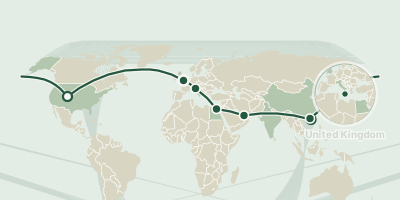
On the evening of 2 October 1872, the punctual and unflappable Phileas Fogg bets his fellow members of the Reform Club £20,000 — half his fortune — that he can go around the world in eighty days, and leaves that same night with his new French valet, Passepartout. On his heels comes Detective Fix, convinced that Fogg is a bank robber on the run. Jules Verne's novel appeared in 1872, when the opening of the Suez Canal and new railways across India and America had made such a race against the timetable just about possible.
The route follows the journey eastward in the novel's own dates, from Pall Mall back to Pall Mall.
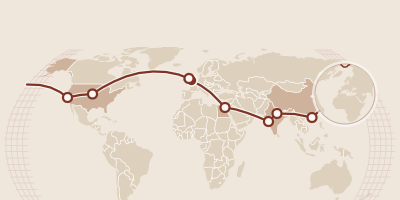
In autumn 1988 the BBC sent Michael Palin round the globe in the footsteps of Jules Verne's Phileas Fogg, with no aircraft allowed. It began and ended at the Reform Club in London and ran from 25 September to 12 December.
The route follows nine moments from his own day-by-day captions and diary excerpts: Venice, the Pyramids, a dhow from Dubai to Bombay, Hong Kong, a train to Shanghai, the Pacific, an Aspen balloon and a locked door in Pall Mall. Pins mark cities and landmarks; the real line of travel ran between them.
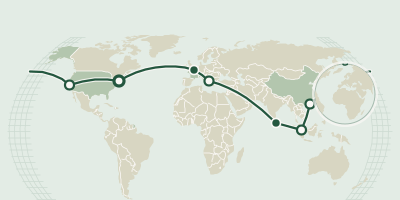
In 1888 Nellie Bly, the star reporter of Joseph Pulitzer's New York World, proposed turning Jules Verne's Around the World in Eighty Days into fact. On 14 November 1889, with two days' notice and as little luggage as she could manage, she sailed from Hoboken to beat Phileas Fogg's fictional record. She came home 72 days, 6 hours and 11 minutes later, a world record — briefly — and a celebrity, while the World's readers guessed her arrival time to the second.
The route follows her book of 1890, stop by stop, with the dates from her own record. She went east by steamer and train, through the Suez Canal and the British ports of Asia.
Gotham is Chicago. The film shot most of Batman's city on real streets and buildings in the Loop, dressing them up as Gotham, then flew the crew to Hong Kong for its one overseas detour. This route follows The Dark Knight in order, from the bank heist that opens it to the rooftop where Batman and the Joker have their last fight.
Along the way: the disused post office that doubled as a bank, the glass office where Wayne holds a fundraiser, the financial street of the convoy chase, the hospital the Joker destroys, an old Chicago bar, the pier where two ferries wait, and Hong Kong's International Finance Centre.
Lin Zexu's crackdown on the opium trade in Canton in 1839 set off a war that ended three years later with a treaty signed on a British warship in the Yangtze. The route follows it from the Pearl River to Nanjing.
Seven stops cover the confiscation, the destruction of the opium at Humen, the clashes at Chuenpi and Dinghai, the raising of the flag at Hong Kong, the fall of Zhenjiang and the treaty talks at Jinghai Temple. Several places have changed beyond recognition, which the notes mark.