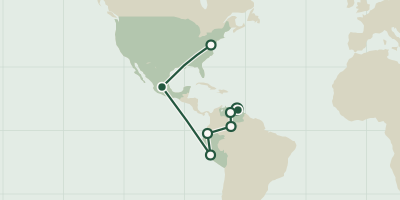
In 1799 the Prussian naturalist Alexander von Humboldt and the French botanist Aimé Bonpland sailed for Spain's American realms and spent five years measuring, collecting and climbing across them. They watched electric eels fight wild horses in Venezuela, pushed up Chimborazo, watched a planet cross the Sun from Peru and ended as Jefferson's guest at the White House.
This route follows eight stops from the landing at Cumaná to Washington in 1804. Several pins are approximate because the sources name a region or river rather than one spot.
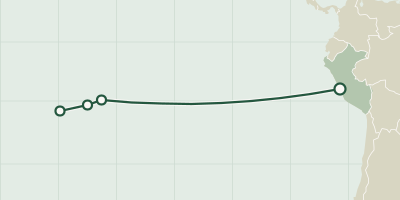
In April 1947 the Norwegian Thor Heyerdahl and five companions pushed off from Peru on a raft of nine balsa logs, built in the style of old Spanish drawings of South American rafts. They meant to prove that ancient people could have drifted from South America to Polynesia. After 101 days and almost 7,000 kilometres on the open Pacific, they crashed onto a coral reef in the Tuamotus — and all six walked ashore.
The voyage became a bestselling book and an Oscar-winning documentary. Heyerdahl's theory, though, has not survived: archaeology, language and genetics show that Polynesians came from the west, from Island Southeast Asia, as master navigators. The route follows the raft from Callao to Tahiti.
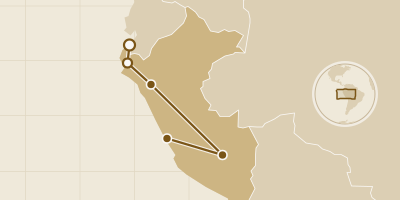
In November 1532 Francisco Pizarro reached Cajamarca with 110 foot soldiers and 67 cavalry. Within a day he had captured the Inca emperor Atahualpa, and a year later the Spanish entered Cusco, the Inca capital.
The route follows Pizarro from his first landfall at Tumbes in 1528 through the first Spanish town in Peru and the Ransom Room in Cajamarca to the Sun Temple in Cusco and, finally, Lima, the city he founded and where he was killed. The conquest is told from the places where it happened; the first two pins are only approximate.