Two of Mexico's best-known painters married in 1929 and spent decades making art in one city: she in the family house where she was born, he on the walls of its palaces.
The route runs from Frida's Blue House through Rivera's murals, the twin studio houses in San Ángel and the Trotsky house nearby, to the museum pyramid Diego built for his collection.
In Alfonso Cuarón's Roma, a live-in maid named Cleo moves through a year of heartbreak in Mexico City's Colonia Roma, from her employers' house on Tepeji Street to the street violence of 10 June 1971 and a rescue on the beach at Tuxpan. Cuarón built the story from his own childhood memories.
The route follows the film in order across five places: the house, the Teatro Metropólitan, a rebuilt cinema corner, the Corpus Christi massacre site and the beach. Several were rebuilt or filmed elsewhere, so the pins are marked approximate.
In April 1519 Cortés landed on the coast of Veracruz; in August 1521 the Aztec capital fell. In between came alliances, a massacre, a night of disaster on a causeway and an eight-month siege.
The route follows the campaign from Villa Rica to Tlatelolco and sets the Spanish accounts of Cortés and Díaz beside Tlaxcalan and Aztec ones where they are known. Where the accounts conflict, the stop says so.
A failed Spanish expedition to Florida left four survivors, and one of them, Álvar Núñez Cabeza de Vaca, walked and traded his way across the continent over roughly eight years before meeting Spaniards again in Mexico. He wrote his account from memory.
The route runs from Spain through Cuba, Florida and the Texas coast to Culiacán and Mexico City. Most stops are approximate, and the middle of the journey is not traced because historians cannot fix his route.
In 1613 a samurai from Sendai set out to Mexico in a galleon built for the mission to meet the King of Spain and the Pope. Hasekura Tsunenaga's embassy took seven years, crossed Mexico and the ocean, and came home to a Japan that was closing its doors to Christianity.
The route follows him from the port of Tsukinoura through Acapulco, Mexico City, Havana, Madrid, Saint-Tropez and Rome, then back via Manila to Nagasaki. Japanese dates are given in the Gregorian calendar. Most pins mark towns or harbours, not documented buildings.
On 16 September 1810 a parish priest in a small Mexican town called his parishioners to arms, and within weeks a vast, ill-armed army was marching on the capital. Miguel Hidalgo's revolt began Mexico's war of independence.
The route follows it from the plot in Querétaro and the Cry of Dolores through the storming of the Alhóndiga in Guanajuato, the near-miss at Mexico City and the defeat at Calderón Bridge, to the ambush in Coahuila and the execution in Chihuahua. Violence is part of the story and is named plainly.
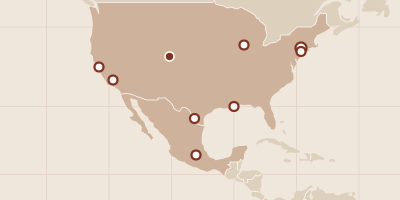
Between 1947 and 1950 Sal Paradise, a young writer from New Jersey, crosses America again and again — hitchhiking, by bus and in borrowed cars — usually in pursuit of his wild, magnetic friend Dean Moriarty. Jack Kerouac typed the story on a continuous scroll of paper in three weeks in April 1951, and it was published in 1957. Sal is Kerouac, Dean is Neal Cassady, and most of the trips really happened.
The route picks out the places the novel names, from a rainy false start on the Hudson to Mexico City and back to a New York street corner. The novel gives towns and streets rather than addresses, so most pins mark areas, not doors.
Macondo is not on any map, but its author grew up on Colombia's Caribbean coast. Gabriel García Márquez was raised in Aracataca by grandparents who treated the extraordinary as perfectly natural, and that deadpan voice became the novel.
The route runs from Riohacha, where the Buendías begin, through the marsh and sierra country around Macondo to the railway, the banana company and the massacre, and ends in Mexico City, where the book was written. Macondo itself is fictional, so its stops are real stand-ins.