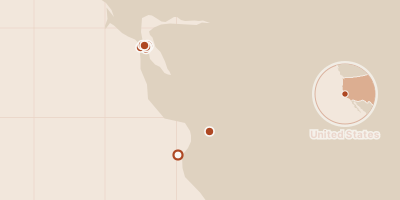
A retired detective with a fear of heights is hired to follow a friend's wife around San Francisco, because her husband fears she is possessed by Carlotta Valdes, a woman who died in 1857. Hitchcock's 1958 thriller was shot on location in San Francisco, at Mission San Juan Bautista, in Big Basin Redwoods State Park, at Cypress Point on 17-Mile Drive and at Paramount Studios in Hollywood.
This route follows the story in film order through nine places: a vanished restaurant, a Nob Hill apartment block, a mission cemetery and an art museum, a fort under the Golden Gate Bridge, a coastal kiss, a mission bell tower and a hotel with a green neon sign.
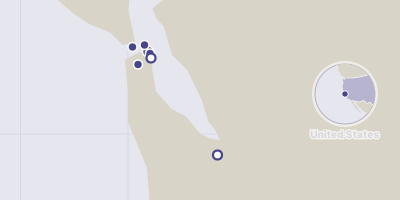
In Watch Dogs 2, the hacker Marcus Holloway and his crew DedSec set out to bring down the surveillance network run by the Blume corporation, across a fictional Bay Area that recreates San Francisco, Oakland, Marin County and Silicon Valley. Their campaign of break-ins and leaks plays out at real landmarks and at parodies of the region's tech giants.
This route follows the places where the story's operations happen, from Coit Tower and Embarcadero Center to Sutro Tower, the Googleplex, Ubisoft's own studio, the Golden Gate Bridge and Alcatraz.
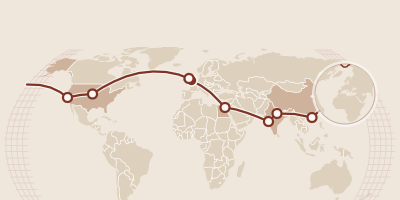
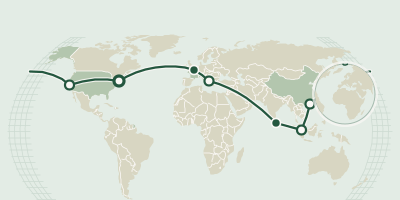
On the evening of 2 October 1872, the punctual and unflappable Phileas Fogg bets his fellow members of the Reform Club £20,000 — half his fortune — that he can go around the world in eighty days, and leaves that same night with his new French valet, Passepartout. On his heels comes Detective Fix, convinced that Fogg is a bank robber on the run. Jules Verne's novel appeared in 1872, when the opening of the Suez Canal and new railways across India and America had made such a race against the timetable just about possible.
The route follows the journey eastward in the novel's own dates, from Pall Mall back to Pall Mall.
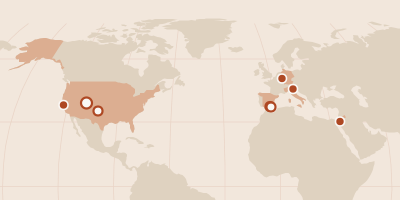
Indiana Jones and the Last Crusade (1989) sends Indy from a Boy Scout outing in the Utah desert to the rock-cut façade of Petra, chasing the Holy Grail and his missing father. Three trials guard the cup at the end. The film borrows its scenery from half of Europe, the Middle East and the American West.
Nine stops, most of them still standing: the Arches canyons of the opening, the church façade in Venice's Campo San Barnaba that plays the library, an Eifel castle dressed as Brunwald, a San Francisco building that played Berlin's Tempelhof airport, the Almería beach where Henry brings down a fighter with an umbrella, a Granada station playing Alexandretta, the Tabernas tank chase, the Treasury that fronts the Grail's temple, and the Texas sunset the film ends on. Dates are story time; filming ran from May 1988 to early 1989.
In 1888 Nellie Bly, the star reporter of Joseph Pulitzer's New York World, proposed turning Jules Verne's Around the World in Eighty Days into fact. On 14 November 1889, with two days' notice and as little luggage as she could manage, she sailed from Hoboken to beat Phileas Fogg's fictional record. She came home 72 days, 6 hours and 11 minutes later, a world record — briefly — and a celebrity, while the World's readers guessed her arrival time to the second.
The route follows her book of 1890, stop by stop, with the dates from her own record. She went east by steamer and train, through the Suez Canal and the British ports of Asia.
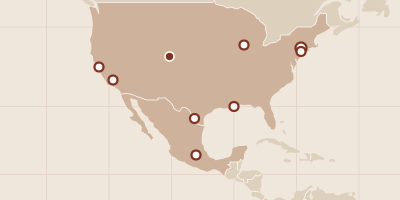
Between 1947 and 1950 Sal Paradise, a young writer from New Jersey, crosses America again and again — hitchhiking, by bus and in borrowed cars — usually in pursuit of his wild, magnetic friend Dean Moriarty. Jack Kerouac typed the story on a continuous scroll of paper in three weeks in April 1951, and it was published in 1957. Sal is Kerouac, Dean is Neal Cassady, and most of the trips really happened.
The route picks out the places the novel names, from a rainy false start on the Hudson to Mexico City and back to a New York street corner. The novel gives towns and streets rather than addresses, so most pins mark areas, not doors.