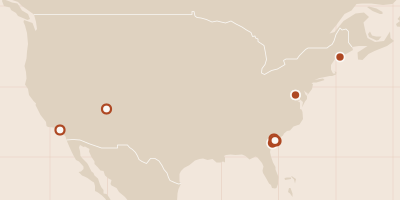
On the night of 14 April 1865 John Wilkes Booth shot President Abraham Lincoln at Ford's Theatre in Washington and escaped on horseback. Lincoln died the next morning in a house across the street; Booth was hunted down twelve days later in a Virginia barn, in what was then the largest manhunt in US history.
The route follows both threads in turn: the theater and the room where Lincoln died, then Booth's road south through the Navy Yard Bridge, a Maryland tavern, a doctor's farmhouse and a swamp, to the farm where it ended.
A feather drifts down onto a bench in Savannah, and a man starts to talk. His life unrolls across half a century of American history, from an Alabama childhood to the jungles of Vietnam, the Lincoln Memorial, the Watergate and a bayou shrimp boat.
This route follows the film in order, from the bench on Chippewa Square to the lighthouse in Maine and the desert where the running finally stops. It marks the real locations and the real stand-ins, since the fictional town of Greenbow and the Vietnam jungle were both played by South Carolina.
J. Robert Oppenheimer studies in Cambridge and Göttingen, builds a physics school at Berkeley, and is handed the one job nobody else wants: build the atomic bomb before the Nazis do. Christopher Nolan's Oppenheimer (2023) follows him from the Cavendish Laboratory to a secret mesa in New Mexico, through the Trinity test and the political fallout that ends his career.
This route follows the film's real places — Cambridge, Göttingen, LeConte Hall, Los Alamos, Trinity, the White House, the Institute for Advanced Study and the room where his security clearance was revoked. The film's own stand-ins, from Ghost Ranch to Kerckhoff Hall, Belen and Alhambra, are noted at each stop.
On 16 July 1969 a Saturn V lifted the Apollo 11 crew off a Florida launch pad; eight days later their capsule dropped into the Pacific. In between, the first people walked on another world while an estimated 600 million watched on Earth.
The route follows the mission through six stops: the launch pad in Florida, Mission Control in Houston, Tranquility Base on the Moon, the Australian dish that carried the moonwalk pictures, the splashdown and the capsule's museum home. The Moon stop has no pin because the map shows Earth only; its lunar coordinates are given in the text.
On 18 June 1937 three Soviet airmen took off from Moscow in a single-engine plane and landed in Washington State more than 63 hours later, having flown over the North Pole. It was the first non-stop flight from the Soviet Union to the United States.
The route follows the crew from the airfield near Shchyolkovo to the landing at Pearson Field, then to the general's table, the White House and the monument that still stands by the runway. The path over the Arctic is shown only as a symbolic pin.
The Supreme Court had ruled that segregated waiting rooms and lunch counters in terminals serving interstate buses were illegal, but across the Deep South the "whites only" signs stayed up. On 4 May 1961 thirteen volunteers of the Congress of Racial Equality, black and white together, set out from Washington, D.C., on two buses to test the ruling all the way to New Orleans. In Alabama they were met by mobs, a burning bus and police who looked away; hundreds more riders followed them into the jails of Mississippi.
The route follows the rides through the places where it happened, several of them now museums and part of a National Monument.
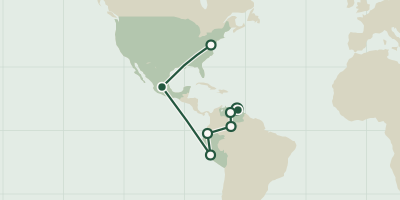
In 1799 the Prussian naturalist Alexander von Humboldt and the French botanist Aimé Bonpland sailed for Spain's American realms and spent five years measuring, collecting and climbing across them. They watched electric eels fight wild horses in Venezuela, pushed up Chimborazo, watched a planet cross the Sun from Peru and ended as Jefferson's guest at the White House.
This route follows eight stops from the landing at Cumaná to Washington in 1804. Several pins are approximate because the sources name a region or river rather than one spot.