Movies
Winnetou: Croatia's Wild West
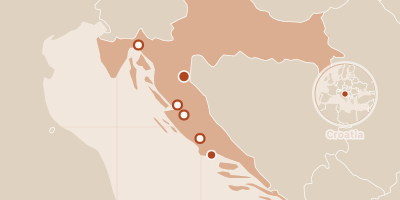
The Winnetou films of the 1960s are set in the Wild West but were shot in Croatia: the Silver Lake is Plitvice, the Apache pueblo stood above the Zrmanja canyon and Santa Fe is the town of Trogir.
This route follows three of the films (Der Schatz im Silbersee, Winnetou 1 and Winnetou 3, 1962 to 1965) from Plitvice and Paklenica to the Krka falls, Trogir and Mali Alan, where Winnetou dies. Most sets were torn down after filming, but the landscapes remain.
Timeline & locations
What do the location labels mean?
- Exact
- The pin marks the actual place where it happened or was filmed.
- Approximate
- The right area — a town, park or district — but not a precise spot.
The hunt for the Silver Lake in Der Schatz im Silbersee (1962) starts with a treasure map and ends at Plitvice. Shooting opened here on 6 August 1962. Lake Kaluđerovac played the Silver Lake, and the dramatic final scene, with Fred about to be hanged, was shot at the big waterfall on Lake Galovac. The Indians on screen were played by people from the village of Plitvička Jezera.
Visitor guidance: Kaluđerovac and Galovac are two of the Plitvice lakes.
Sources
- Der Schatz im Silbersee (Film)
- Locator:
- Handlung; Dreharbeiten und Endfertigung
- Der Schatz im Silbersee (Film)
The film opens in the little western town of Tulsa, where a robbed stagecoach rolls in. That town, the tramps' camp called El Doro and the Ghost Canyon scenes were all built or shot in the Paklenica gorge near Starigrad. The last shooting day of the film was 1 October 1962.
Location precision: The sources name the gorge near Starigrad, not the exact spot of the sets; the pin marks Paklenica.
Visitor guidance: The gorge lies just inland from Starigrad.
Sources
- Der Schatz im Silbersee (Film)
- Locator:
- Handlung; Dreharbeiten und Endfertigung
- Der Schatz im Silbersee (Film)
Mrs Butler's fortified farm holds the second half of the treasure map, so an attack by the bandits is expected. The set stood in the Grobnik valley (Grobničko polje) near Rijeka. The same plain returned in Winnetou 1 (1963), where the crew shot the Kiowa raid on the wagon train.
Location precision: The sources give the valley, not the exact field where the farm stood; the pin marks Grobničko polje.
Sources
- Winnetou 1. Teil
- Locator:
- Handlung; Hintergrund
- Der Schatz im Silbersee (Film)
- Locator:
- Handlung; Dreharbeiten und Endfertigung
- Winnetou 1. Teil
The Zrmanja became the Rio Pecos of the Winnetou films. For Winnetou 1 (1963), architect Vladimir Tadej built the Apache pueblo on a plateau above the river, though it was only a front. In the river itself Old Shatterhand fights the chief Intschu-tschuna. The view of the Zrmanja is one of the series' signature images. The pueblo was torn down right after filming, but the plateau, Pariževačka Glavica, is now a viewpoint.
Location precision: The pin is the Zrmanja river's reference point; the pueblo stood on the Pariževačka Glavica plateau above it, a few kilometres away.
Visitor guidance: Pariževačka Glavica is a viewpoint near Jasenice; nothing of the set remains.
Sources
- Winnetou 1. Teil
- Locator:
- Handlung; Hintergrund
- Zrmanja
- Locator:
- Filmdrehort
- Winnetou 1. Teil
After the fight, the wounded Old Shatterhand is nursed by Nscho-tschi, the chief's daughter. Their romantic scenes in Winnetou 1 were filmed at the Krka falls near Skradin. The Krka waterfalls, including Skradinski buk, and the river gorge were used for parts of the Winnetou films in the 1960s.
Location precision: The sources name the Krka falls near Skradin without saying which one; the pin marks Skradinski buk.
Visitor guidance: Skradinski buk is the best known of the Krka falls near Skradin.
Sources
- Winnetou 1. Teil
- Locator:
- Handlung; Hintergrund
- Nationalpark Krka
- Locator:
- Drehort
- Winnetou 1. Teil
In Winnetou 3 (1965) the governor's town of Santa Fe is Trogir. Winnetou and Old Shatterhand ride through its old streets to report to the governor, and the town hall stands in for the governor's palace. The crew picked this old town on an island for its well-preserved medieval look. Filming around Split ran from 14 June to 13 August 1965.
Visitor guidance: The old town is small enough to see on foot.
Sources
- Trogir
- Locator:
- Drehort
- Winnetou 3. Teil
- Locator:
- Handlung; Hintergrund
- Trogir
The series ends on a mountain. Director Harald Reinl chose a remote spot on Mali Alan for Winnetou's death scene: Winnetou throws himself into the path of Rollins' shot at Old Shatterhand and is fatally hit. Parts of the press criticised the plan, but the producers stuck to the book.
Not pinned on the mapNot currently visitableLocation precision: The source names the mountain Mali Alan only, not the exact spot, and it is not pinned.
Sources
- Winnetou 3. Teil
- Locator:
- Handlung; Hintergrund
- Winnetou 3. Teil