In early 1965 Black residents of Selma, Alabama, backed by the Southern Christian Leadership Conference and SNCC, pressed for the right to vote. After a state trooper shot Jimmie Lee Jackson in nearby Marion, activists called for a march to the state capital. Troopers stopped the first attempt on the Edmund Pettus Bridge on 7 March; the third march, under federal protection, reached Montgomery on 25 March.
The route follows the marchers from Marion to Selma's Brown Chapel and the bridge, across Lowndes County's muddy campsites and the City of St. Jude to the steps of the Alabama State Capitol. The Voting Rights Act followed that summer. The farm campsites are not pinned exactly.
On the night of 14 April 1865 John Wilkes Booth shot President Abraham Lincoln at Ford's Theatre in Washington and escaped on horseback. Lincoln died the next morning in a house across the street; Booth was hunted down twelve days later in a Virginia barn, in what was then the largest manhunt in US history.
The route follows both threads in turn: the theater and the room where Lincoln died, then Booth's road south through the Navy Yard Bridge, a Maryland tavern, a doctor's farmhouse and a swamp, to the farm where it ended.
On the night of 18 April 1775 Paul Revere was rowed across the Charles River, got a horse in Charlestown and rode west to warn John Hancock and Samuel Adams that British troops were on the move. He left three accounts of that night, and this route follows them rather than the poem.
It runs through nine places, from his house in North Square and the lanterns at Old North Church to the pasture in Lincoln where a British patrol stopped him, and on to Concord, which Samuel Prescott reached without him. Where a spot is only traditional, the stop says so.
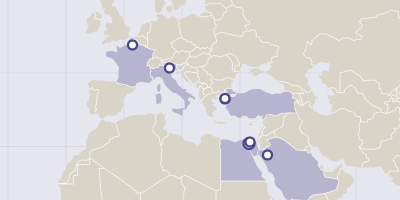
In June 1867 the steamship Quaker City left New York on what Mark Twain called his "Great Pleasure Excursion", a chartered trip to Europe and the Holy Land. A newspaper, the Alta California, paid for his place in exchange for fifty articles, and those letters grew into The Innocents Abroad.
This route follows eight stops: the Wall Street pier, the Azores, Tangier, Milan, Athens, a palace garden near Yalta, Jerusalem and the Sphinx. Each is told through Twain's own scenes, from donkey rides and hotel bills to the places that stopped his jokes. Where he does not name a spot, the pin marks the nearest known place.
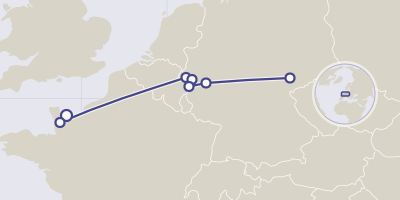
In December 1933, eighteen-year-old Patrick Leigh Fermor set off from the Hook of Holland to walk to Constantinople, carrying a few clothes, some letters of introduction, an anthology of English verse and a volume of Horace. He slept in barns and shepherds' huts, but gentry and aristocracy kept inviting him into their country houses. He wrote the journey up decades later in A Time of Gifts, Between the Woods and the Water and The Broken Road.
The route follows him through ten places the sources let us pin, from the Hook and a Stuttgart apartment to Melk, Vienna, Prague, the bridge into Hungary, an island on the Danube that now lies under water, Plovdiv and Istanbul. Many pins are approximate: the sources name a town, not the exact spot where he stood.
In June 1995 Cheryl Strayed, 26 and with no hiking experience, set out alone to walk 1,100 miles of the Pacific Crest Trail. Her memoir Wild reached No. 1 on the New York Times Best Seller list, and Reese Witherspoon played her in the 2014 film.
This route follows the hike north from the Mojave Desert to the Columbia River, using the memoir's outline and the film's best-known scenes. The film compresses and dramatises, so stops drawn from it say so, and pins mark areas rather than campsites.
In 1960 the novelist John Steinbeck fitted a pickup truck with a camper shell, named it Rocinante and set out from Long Island with his poodle, Charley. He wanted to see his country because he made his living writing about it, and his main question was what Americans are like today.
This route follows eight stops of the outer loop, from Sag Harbor through Maine, Niagara Falls and Minnesota to Montana, Yellowstone and Steinbeck's native Salinas Valley, then down to New Orleans. The book is a novelist's account: it has been challenged as partly fictionalised, so read the encounters as stories and the places as real.
On 10 November 1871, on the shore of Lake Tanganyika, the journalist Henry M. Stanley took off his hat in front of a crowd and said, as he tells it in his own book, "Dr. Livingstone, I presume?" The explorer many thought dead had been found, after nearly eight months on the road from the coast.
The route follows Stanley's account, How I Found Livingstone, over eight stops: from Zanzibar and Bagamoyo through Mpwapwa, Tabora and the Malagarasi to Ujiji, then up the lake to Mugere and back to the parting at Tabora. Stanley's camps are rarely identifiable today, so every pin is approximate.
At 11:30 a.m. on 29 May 1953 Edmund Hillary and Tenzing Norgay stood on the summit of Mount Everest, the first people confirmed to have done so. They were part of a British expedition led by Colonel John Hunt, which in the end amounted to over four hundred men, including twenty Sherpa guides and 362 porters.
The route follows that expedition from winter training in Wales through Kathmandu, Thyangboche, Base Camp, the Khumbu Icefall, the Western Cwm and the South Col to the summit, then to the telegraph runner's stop at Namche Bazaar. Pins above Base Camp mark the terrain, not the exact camps of 1953.
On 26 August 1768 the Endeavour left Plymouth with 94 people aboard, bound for Tahiti to watch Venus cross the Sun. Almost three years later she anchored off the Kent coast again, having reached New Zealand and the east coast of Australia, and with many of her people lost to disease on the way home.
The route follows James Cook's own journal and modern accounts through ten stops, from the anchorage at Plymouth to the Great Barrier Reef and Batavia. Dates follow modern accounts, which sometimes differ by a day from the journal.
In May 1804 William Clark and about 30 others left a winter camp on the Mississippi and turned up the Missouri, the first stage of an expedition sent to cross the newly acquired western part of the country. Captains Meriwether Lewis and Clark kept journals, and many of their entries are quoted here in their own spelling.
The route follows them from Camp Dubois past a sergeant's grave, a tense standoff with the Teton Sioux, a winter at Fort Mandan, the Great Falls, the Continental Divide and the snowbound Lolo Trail to the Pacific, then home by way of Clark's signature on Pompeys Pillar. Where a camp is lost to the river or to time, the pin marks the nearest place you can visit.
The Travels of Marco Polo runs from Venice and Acre to Kublai Khan's Xanadu, then south to Hangzhou and home again. In 1271 a seventeen-year-old Venetian set out with his father and uncle and did not come home for 24 years.
The route follows the book from Venice and Acre to the Persian Gulf, across the Pamir highlands and the desert to Kublai's summer and winter capitals, south to Hangzhou and the port of Zayton, and home again. Some of the roads are reconstructed by scholars, and Polo sometimes exaggerates, so each stop notes where the evidence is thin.
Hemingway wrote A Moveable Feast about his poor, happy early years in 1920s Paris, working from notebooks he had left in trunks at the Ritz in 1928. It was published in 1964, after his death.
This route walks the memoir's Paris: the flat on the rue du Cardinal-Lemoine, Gertrude Stein's salon, Sylvia Beach's bookshop, the cafés of Montparnasse and Saint-Germain, and the Ritz where the notebooks resurfaced. Hemingway himself said the book may be read as imagination, so treat its scenes as a memory, not a record.
Thelma & Louise runs from Arkansas to the Grand Canyon, but it was filmed in California and Utah, around Long Beach, Los Angeles, Arches and Dead Horse Point. One violent night at a roadhouse bar turns a weekend trip into a run for Mexico.
This route follows the story in film order through six real places: a Long Beach bar, a Los Angeles motel, a Colorado general store, the desert at Arches, the ghost town of Cisco and the cliff edge at Dead Horse Point. Almost all of them stand in for somewhere else, and each stop says where.
When the National Trust withdrew filming permission, Monty Python's Grail quest leaned on Doune Castle in Scotland for Camelot, Castle Anthrax and most other castles, with Kidwelly Castle in South Wales for the opening shot and Bodiam Castle in East Sussex for the Swamp Castle exterior. King Arthur sets out across Britain in AD 932 to find knights and, in the end, the Holy Grail.
This route follows the quest in film order through six locations: the castle of the opening shot in Wales, Doune Castle in Scotland standing in for the rest, a moated castle in East Sussex for one establishing shot, a mine, a glen and the island tower that ends the film.
Jesse and Céline are now a couple with twin daughters, on a summer holiday in southern Greece. Before Midnight, the third and final film of Richard Linklater's Before trilogy, was shot in 15 days on the Peloponnese coast and turns one last night into a long, honest argument about love.
The route follows the film from an airport farewell to a writer's house, a castle, a harbour town and a resort hotel. The filmmakers have named few exact addresses, so the Pylos and hotel stops are approximate.
Nine years after a night in Vienna, Jesse is on a book tour in Europe when Céline walks into his reading in a Paris bookshop. He has an hour before his flight, and they spend it wandering the city. Richard Linklater's 2004 film plays in real time: the story lasts about as long as the film, roughly eighty minutes.
It was shot in 15 days across Paris, and its locations jump about more than the dialogue admits. This route follows the film's order from the Left Bank bookshop through the Marais and the east of the city to the Seine and a gated courtyard in the Faubourg Saint-Antoine.
Private First Class Ronald "Red" Daniels lands on Omaha Beach on D-Day with the 1st Infantry Division and fights his way into Germany with one squad, until a friend is captured and the search for him ends at a concentration camp. Call of Duty: WWII is a 2017 game by Sledgehammer Games, and its campaign is set among real battles.
The route follows the missions in order: Omaha Beach, Marigny, Aachen, the Hürtgen Forest, the Ardennes, the bridge at Remagen and Berga, with the real battle each one echoes. Pins mark battle areas, not a mission's exact street.
Battlefield 1 sends its soldiers across the Western Front, the Italian Front, Gallipoli and Arabia. This route follows the War Stories and multiplayer maps that go with them, from the Suez Canal in 1915 to Monte Grappa in October 1918.
Stops run in the order of the real battles, not the game's menu. The maps are the game's own reconstructions, so each pin marks the real ground behind a level, and one stop is a village the game invented.
Forza Horizon 5 drops the Horizon Festival into a fictionalised Mexico, on a map 50% larger than Forza Horizon 4's. Creative director Mike Brown calls Mexico almost the whole world in one country: snowy peaks, tropical jungles, epic canyons, beautiful beaches, ancient architecture and modern cities.
This route visits seven real places the game recreates, from a sea arch at the tip of Baja to a canyon with a train, and says what the game does at each. The map is a condensed Mexico, so the pins mark the real sites, not their positions in the game.
Studio Ghibli's worlds feel lived-in because Miyazaki went to look at real places: a Welsh mining museum for the village in Castle in the Sky, Visby for the town of Kiki's Delivery Service, the harbour of Tomonoura before Ponyo. Other links are only rumoured, and he has denied at least one, the town of Jiufen in Taiwan for Spirited Away.
This route follows eight films in release order, from 1986 to 2008, and pairs each with the real place reported as its inspiration. Only some of these identifications come from Miyazaki himself, so every stop says whose claim it is, and none of them is a filming location.
A schoolgirl in Kyushu follows a stranger into an abandoned resort, opens a door that was meant to stay shut, and ends up chasing a cat across Japan, closing doors as she goes. Her last door stands in the hometown she lost to the 2011 tsunami.
The route follows her path in story order: Nichinan harbour, the Bungo-Mori roundhouse, Yawatahama port, a Kobe mountain, Ochanomizu and Hijiri Bridge in Tokyo, then Miyako and Orikasa Station in Iwate. The film is animated, so most pins mark places that Wikipedia says its scenes were modelled on, and the Kobe amusement park is disputed.
Twin Peaks is set five miles from the Canadian border, but its exteriors come from the Snoqualmie Valley, all around 25–30 miles from Seattle. David Lynch and Mark Frost found the places they had written into the pilot in Snoqualmie, North Bend and Fall City.
This route follows the series through five of them: the falls from the opening titles, the road with the welcome sign, the hotel, the sheriff's station and the diner. Most interiors were built on sets in a San Fernando Valley warehouse, so these stops are exteriors, and the Reinig Road pin marks the road, not one spot.
HBO's Game of Thrones prequel was filmed primarily in the United Kingdom, and its Velaryon world is Cornish: the island seat of Driftmark is a tidal island, and the Stepstones war camp is a cove on the Lizard peninsula. For the capital and the free city of Pentos, the crew went to western and southern Spain.
The route follows the story from the Stepstones war (season 1, episode 3) through the Driftmark episodes to King's Landing in season 2. Sources do not name the exact streets used in Cáceres, so that pin marks the old town.