Jesse and Céline are now a couple with twin daughters, on a summer holiday in southern Greece. Before Midnight, the third and final film of Richard Linklater's Before trilogy, was shot in 15 days on the Peloponnese coast and turns one last night into a long, honest argument about love.
The route follows the film from an airport farewell to a writer's house, a castle, a harbour town and a resort hotel. The filmmakers have named few exact addresses, so the Pylos and hotel stops are approximate.
Nine years after a night in Vienna, Jesse is on a book tour in Europe when Céline walks into his reading in a Paris bookshop. He has an hour before his flight, and they spend it wandering the city. Richard Linklater's 2004 film plays in real time: the story lasts about as long as the film, roughly eighty minutes.
It was shot in 15 days across Paris, and its locations jump about more than the dialogue admits. This route follows the film's order from the Left Bank bookshop through the Marais and the east of the city to the Seine and a gated courtyard in the Faubourg Saint-Antoine.
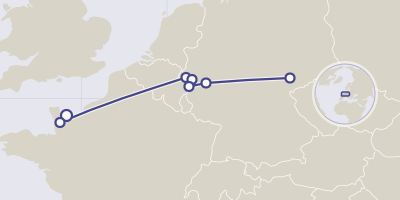
Private First Class Ronald "Red" Daniels lands on Omaha Beach on D-Day with the 1st Infantry Division and fights his way into Germany with one squad, until a friend is captured and the search for him ends at a concentration camp. Call of Duty: WWII is a 2017 game by Sledgehammer Games, and its campaign is set among real battles.
The route follows the missions in order: Omaha Beach, Marigny, Aachen, the Hürtgen Forest, the Ardennes, the bridge at Remagen and Berga, with the real battle each one echoes. Pins mark battle areas, not a mission's exact street.
The Kanto of Pokémon Red and Blue is based on the real Kantō region of Japan: fans match Pallet Town to Machida, Vermilion City to Yokohama, Celadon City to Shinjuku and Lavender Town to Narita. You start in a quiet town, beat eight gym leaders and take on Team Rocket.
This route follows the game's journey from Pallet Town to the final gym and sets each stop beside the real place it is said to resemble. The game's Kanto is inspired by the real one, not a copy of it, so every pin is an outside reading of the map, not an official location.
Rachel Chu, a Chinese American economics professor, flies to Singapore with her boyfriend Nick for his best friend's wedding and learns that Nick's family is among the richest in the country. Jon M. Chu's 2018 film follows her from the airport to a mahjong table where she faces down his mother.
This route visits nine places from the film, in story order. Several of the story's places were filmed in Malaysia instead of Singapore: the Young family estate in Kuala Lumpur, the island parties on Langkawi and the mahjong parlor in Penang.
Studio Ghibli's worlds feel lived-in because Miyazaki went to look at real places: a Welsh mining museum for the village in Castle in the Sky, Visby for the town of Kiki's Delivery Service, the harbour of Tomonoura before Ponyo. Other links are only rumoured, and he has denied at least one, the town of Jiufen in Taiwan for Spirited Away.
This route follows eight films in release order, from 1986 to 2008, and pairs each with the real place reported as its inspiration. Only some of these identifications come from Miyazaki himself, so every stop says whose claim it is, and none of them is a filming location.
A schoolgirl in Kyushu follows a stranger into an abandoned resort, opens a door that was meant to stay shut, and ends up chasing a cat across Japan, closing doors as she goes. Her last door stands in the hometown she lost to the 2011 tsunami.
The route follows her path in story order: Nichinan harbour, the Bungo-Mori roundhouse, Yawatahama port, a Kobe mountain, Ochanomizu and Hijiri Bridge in Tokyo, then Miyako and Orikasa Station in Iwate. The film is animated, so most pins mark places that Wikipedia says its scenes were modelled on, and the Kobe amusement park is disputed.
Bob is a fading American movie star in Tokyo to advertise whiskey; Charlotte is a disillusioned recent graduate, married for two years. Both are far from home, and they find each other at the Park Hyatt Tokyo.
The route follows their story in the film's order: the neon streets of Shinjuku, the hotel, Shibuya Crossing and a karaoke room, then Charlotte's day trip to Kyoto Station, Nanzen-ji and Heian Shrine. Coppola shot for just 27 days, many of its locations in real places of business and public areas. The karaoke branch is pinned approximately.
Where The White Lotus season 3 was filmed: its Thai resort is stitched from the Four Seasons on Ko Samui, the Anantara Mai Khao and the Rosewood in Phuket, and Frank's scenes in Bangkok at the Mandarin Oriental. It opens with gunshots and a body in a lake, then rewinds a week.
This route visits six real places in story order, from the Four Seasons on Ko Samui to a Bangkok hotel and a Muay Thai stadium. The on-screen resort was stitched together from several hotels, so no single place is the White Lotus.
Tony Soprano's mob is a New Jersey one, and the series made a point of it: the majority of its exterior scenes were filmed on location in the state, with most interiors built at Silvercup Studios in New York.
The route follows the opening titles from the Pulaski Skyway to the Soprano house, then the pork store, the Great Falls, the Bada Bing, the Pine Barrens and the diner of the finale. The Pine Barrens episode was filmed in New York, and the house is a private home, so its pin marks only the borough.
In AD 79 a mountain above the Bay of Naples blew apart. Pliny the Younger watched from Misenum across the water, lost his uncle, the admiral Pliny the Elder, to the eruption, and years later described it for the historian Tacitus in two letters: the only eyewitness account that survives.
The route follows the eruption in the order of its events, from the mountain's first column to Pompeii, Herculaneum, the beach at Stabiae and back to Misenum. Pliny's letters never mention Pompeii or Herculaneum, so those stops come from archaeology. The traditional date is 24 August, but newer evidence points to the autumn.
1066 in three battles: Fulford and Stamford Bridge in the north, then Pevensey, Hastings and Battle in the south, with Westminster at both ends. Edward the Confessor died childless that January; by Christmas Day Harold Godwinson had fallen and William of Normandy was crowned.
The route follows the crown from Westminster to the Yorkshire landing of Harald Hardrada, Fulford and Stamford Bridge, then to Pevensey, Hastings and the field at Battle, and back to Westminster on Christmas Day. The exact ground of several battles is debated, so those pins mark the best-known sites.
On 26 February 1815 Napoleon slipped away from Elba with some 1,000 men. Within a month he was back in the Tuileries, and by mid-July he had surrendered to the Royal Navy.
The route follows him stop by stop: his villa on Elba, the landing at Golfe-Juan, the meeting at Laffrey and the entry into Grenoble on the Route Napoléon, the Tuileries, the farms of Hougoumont and La Haye Sainte at Waterloo, then Malmaison and Île d'Aix, where his journey ended. The pins at Golfe-Juan and Grenoble mark the towns, not exact spots.
Robin Hood is known from medieval ballads, and the oldest of them are set as much in Yorkshire's Barnsdale and in Nottingham as in Sherwood. This route follows A Gest of Robyn Hode and its companions, from the Sorrowful Knight's first dinner in the greenwood to Robin's death at the priory.
None of these places can be proved: every identification is a tradition, and the legend is not history. Each stop names the ballad that tells its episode and says how firmly the place is tied to it.
King Arthur's legend has no single home: he is conceived at Tintagel and holds court at Caerleon, Cadbury Castle is claimed as Camelot and Glastonbury is linked to Avalon. The route follows Geoffrey of Monmouth, Malory and others from Merlin's dragons to the sword returned to the water.
Every pin marks a real place that tradition has attached to an episode, not a site proven by history, and each stop says where the link is doubted.
Netherfield Park is let at last, and Austen's novel follows Elizabeth Bennet from her family's village to a Kent parsonage and on to Derbyshire. The houses of the book are described rather than mapped, so this route follows the real places where the 2005 film and the 1995 BBC series found them.
Nine stops follow the story in order, from Longbourn to the inn at Lambton. Each pin is a real filming site standing in for a place in the book; only Gracechurch Street is the real London street the novel itself names.
Fitzgerald set The Great Gatsby on two invented peninsulas, West Egg and East Egg, but he built them from the Long Island he knew in Great Neck, where he lived from October 1922. Behind the glamour sit a dump, a station and a hotel suite that were all real.
This route follows Nick from the Eggs through the valley of ashes, Penn Station, the Queensboro Bridge and the Plaza Hotel. The Eggs, the valley and Gatsby's house are invented, so their pins mark the real places the novel is read against.
The Hound of the Baskervilles takes Sherlock Holmes across Dartmoor: Cabell's tomb at Buckfastleigh, the ten-thirty train from Paddington, Princetown's prison and Hound Tor. A spectral hound stalks the moor.
The route runs from the grave that may have inspired the legend and the ten-thirty train from Paddington to the convict prison at Princetown, the mire, the tors and the Stapletons' house. Baskerville Hall and Merripit House exist only in the book, so their pins mark a stand-in or nothing at all.
Les Misérables on a map: Jean Valjean's road from the bishop's house at Digne to Montreuil-sur-Mer, the Thénardiers' inn at Montfermeil, Marius's bench in the Luxembourg, the barricade of June 1832 and the sewers and bridges of Paris. Victor Hugo's 1862 novel follows the convict from the night a bishop's kindness turns him towards good to the street fighting in the capital.
Hugo hid two of the towns behind initials and the wine-shop barricade has been built over, so only the Luxembourg Garden is pinned exactly; the other stops mark real places standing in for the book's.
The Count of Monte Cristo on a map: from Notre-Dame de la Garde in Marseille to the Château d'If, the island of Monte Cristo and its treasure, Rome's catacombs and the Paris of the count's revenge. A young sailor is arrested at his own engagement party, escapes in a dead man's burial sack and comes back as a count to settle accounts.
Most of the stops can be visited; the island of Monte Cristo is a nature reserve with a years-long waiting list, and several scenes happen in places Dumas invented, so those pins mark the real landmark nearby.
In April 1625 an eighteen-year-old Gascon rides into the market town of Meung on a yellow pony, bound for Paris and the King's Musketeers. Dumas's novel follows D'Artagnan from that first quarrel through duels, a secret night in the Louvre, a bet made during a siege and a midnight ending on a river bank.
The route runs from the Loire to Paris, on to La Rochelle and Portsmouth, and back to the banks of the Lys. The streets, squares and palaces are real; most inns, houses and bastions are Dumas's, so several pins mark a town or a street rather than a building.
Ghost of Yōtei follows Atsu, a wandering mercenary who returns to Ezo — modern-day Hokkaido — in 1603 to hunt down the Yōtei Six, the band led by the samurai lord Nariaki Saito who slaughtered her family sixteen years earlier. Her revenge carries her across an island modelled on Hokkaido, from the grasslands at Mount Yōtei's foot to the frozen north and the Matsumae clan's castle in the south.
This route follows the game's regions and their real counterparts: the Yotei Grasslands around Lake Shikotsu, the Ishikari Plain, the Ainu country of the Nayoro Wilds, the Kitsune's Teshio Ridge, and the Tokachi Range, with Mount Yōtei and Matsumae Castle as its fixed points.
In 1581 the African slave Diogo comes to Kyoto with a Jesuit delegation and is handed to the warlord Oda Nobunaga, who renames him Yasuke and makes him a samurai. That year Nobunaga's army crushes the ninja province of Iga, where the young shinobi Naoe loses her father and inherits his Hidden Blade.
From there the two hunt the same conspiracy across Kansai: the port of Sakai, the temple at Honnō-ji where Nobunaga dies, a kofun in Settsu, the castle of Shōryūji at Yamazaki, the shrines of Yamato, and the Templar recruiting ground of Kii. Most stops are real castles, temples and tombs that the game rebuilds.
Watch Dogs 2 recreates the Bay Area: San Francisco, Oakland, Marin County and Silicon Valley, from Coit Tower and the Golden Gate Bridge to Alcatraz and a parody of the Googleplex, where the hacker Marcus Holloway and his crew DedSec set out to bring down the Blume corporation's surveillance network.
This route follows the places where the story's operations happen, from Coit Tower and Embarcadero Center to Sutro Tower, the Googleplex, Ubisoft's own studio, the Golden Gate Bridge and Alcatraz.