Mapped Chronicles

Catalog

All routes

More filters
Real JourneysApproximate

Amundsen and Scott: The Race to the South Pole

In 1910 two expeditions set out for the bottom of the world. Roald Amundsen's Norwegians, masters of skis and sled dogs, reached the South Pole on 14 December 1911. Robert Falcon Scott's party arrived on 17 January 1912, 34 days later, to find a Norwegian tent already standing. Amundsen sent his news from Hobart; Scott's party of five died on the return journey. The route follows both men from Cardiff and Madeira to their bases, up their two glaciers, to the Pole and to the endings: Amundsen's cables from Hobart and Scott's last camp. Antarctic pins mark glaciers and bays, not camps, and the ice has moved since.

10 locations1/10 visitable
Real JourneysApproximate

Captain Cook's First Voyage: Round the World in the Endeavour

On 26 August 1768 the Endeavour left Plymouth with 94 people aboard, bound for Tahiti to watch Venus cross the Sun. Almost three years later she anchored off the Kent coast again, having reached New Zealand and the east coast of Australia, and with many of her people lost to disease on the way home. The route follows James Cook's own journal and modern accounts through ten stops, from the anchorage at Plymouth to the Great Barrier Reef and Batavia. Dates follow modern accounts, which sometimes differ by a day from the journal.

10 locations7/10 visitable
MoviesApproximate

Vertigo: Hitchcock's San Francisco

A retired detective with a fear of heights is hired to follow a friend's wife around San Francisco, because her husband fears she is possessed by Carlotta Valdes, a woman who died in 1857. Hitchcock's 1958 thriller was shot on location in San Francisco, at Mission San Juan Bautista, in Big Basin Redwoods State Park, at Cypress Point on 17-Mile Drive and at Paramount Studios in Hollywood. This route follows the story in film order through nine places: a vanished restaurant, a Nob Hill apartment block, a mission cemetery and an art museum, a fort under the Golden Gate Bridge, a coastal kiss, a mission bell tower and a hotel with a green neon sign.

9 locations7/9 visitable
MoviesSpeculative

Studio Ghibli: The Real Places Behind Eight Films

Studio Ghibli's worlds feel lived-in because Miyazaki went to look at real places: a Welsh mining museum for the village in Castle in the Sky, Visby for the town of Kiki's Delivery Service, the harbour of Tomonoura before Ponyo. Other links are only rumoured, and he has denied at least one, the town of Jiufen in Taiwan for Spirited Away. This route follows eight films in release order, from 1986 to 2008, and pairs each with the real place reported as its inspiration. Only some of these identifications come from Miyazaki himself, so every stop says whose claim it is, and none of them is a filming location.

8 locations8/8 visitable
Real JourneysSpeculative

Magellan and Elcano: The First Circumnavigation

On 20 September 1519 five ships and about 270 men sailed from Spain to find a western sea road to the Spice Islands. Magellan died in the Philippines, but Juan Sebastián Elcano brought the Victoria home three years later with eighteen survivors and 26 tons of spices, having sailed all the way around the world. The route follows the voyage from the mouth of the Guadalquivir past Port St. Julian, through the strait and across the Pacific to the Moluccas, then home past the Cape of Good Hope. Anchorages are often unrecorded, so most pins mark the nearest known place; the dates come from Pigafetta's journal and modern accounts.

12 locations7/12 visitable
BooksFictional

The Great Gatsby: From the Eggs to the Plaza

Fitzgerald set The Great Gatsby on two invented peninsulas, West Egg and East Egg, but he built them from the Long Island he knew in Great Neck, where he lived from October 1922. Behind the glamour sit a dump, a station and a hotel suite that were all real. This route follows Nick from the Eggs through the valley of ashes, Penn Station, the Queensboro Bridge and the Plaza Hotel. The Eggs, the valley and Gatsby's house are invented, so their pins mark the real places the novel is read against.

7 locations4/7 visitable
BooksApproximate

The Three Musketeers: Meung, Paris and La Rochelle

In April 1625 an eighteen-year-old Gascon rides into the market town of Meung on a yellow pony, bound for Paris and the King's Musketeers. Dumas's novel follows D'Artagnan from that first quarrel through duels, a secret night in the Louvre, a bet made during a siege and a midnight ending on a river bank. The route runs from the Loire to Paris, on to La Rochelle and Portsmouth, and back to the banks of the Lys. The streets, squares and palaces are real; most inns, houses and bastions are Dumas's, so several pins mark a town or a street rather than a building.

8 locations4/8 visitable
MoviesApproximate

No Time to Die: From Matera to Safin's Island

Bond's final outing opens beside a lake in Norway and closes on an island in the Faroe Islands, with a long detour through southern Italy and a retirement in Jamaica in between. The story's geography is real: Matera's cave lanes, a bridge over the Gravina gorge, a railway station at Sapri, a waterfront house at Port Antonio, the Atlantic Ocean Road and the cliffs of Kalsoy. The route follows the film's order — the frozen-lake flashback, the grave and the bridge, the Matera car chase, the farewell at Sapri, five quiet years in Jamaica and the 'Cuban' harbour that is really Port Antonio, then the Norway drive and the villain's island in the Faroe Islands. The beach house in Jamaica and the lake house in Norway were sets, both since dismantled.

8 locations6/8 visitable
MoviesApproximate

Back to the Future: Hill Valley in Los Angeles

Hill Valley is fictional, but almost all of it is Los Angeles. The 1985 film sends Marty McFly thirty years back to a small California town, and the filmmakers built its square on a studio backlot and dressed real malls, schools, churches and houses around the city as Hill Valley. This route follows the story from the Twin Pines Mall car park in City of Industry through 1955 and back to the McFly home in Arleta. Each stop is a real place that played a piece of Hill Valley; the private homes are seen from the street only.

8 locations5/8 visitable
MoviesApproximate

Indiana Jones and the Last Crusade: From Utah to the Grail

Indiana Jones and the Last Crusade (1989) sends Indy from a Boy Scout outing in the Utah desert to the rock-cut façade of Petra, chasing the Holy Grail and his missing father. Three trials guard the cup at the end. The film borrows its scenery from half of Europe, the Middle East and the American West. Nine stops, most of them still standing: the Arches canyons of the opening, the church façade in Venice's Campo San Barnaba that plays the library, an Eifel castle dressed as Brunwald, a San Francisco building that played Berlin's Tempelhof airport, the Almería beach where Henry brings down a fighter with an umbrella, a Granada station playing Alexandretta, the Tabernas tank chase, the Treasury that fronts the Grail's temple, and the Texas sunset the film ends on. Dates are story time; filming ran from May 1988 to early 1989.

9 locations8/9 visitable
HistoryApproximate

D-Day: The Five Normandy Beaches

Just after midnight on 6 June 1944, gliders landed beside a canal bridge at Bénouville, and by mid-morning Allied troops were ashore on five code-named beaches — Utah, Omaha, Gold, Juno and Sword — along the Normandy coast. This route visits the places where that day was won and lost, and what stands there today. It starts with the glider coup de main at Pegasus Bridge, then runs along the coast from west to east: the museum built on the sand at Utah, the Rangers' climb at Pointe du Hoc, the American cemetery above Omaha, the concrete of the Mulberry harbour at Arromanches, the Canadian centre behind Juno and the Grand Bunker above Sword.

7 locations7/7 visitable
MoviesFictional

La La Land: Mia and Seb's Los Angeles

A jazz pianist and an aspiring actress argue through the windows of their cars in a Los Angeles traffic jam, and the city itself becomes the romance: a night on a funicular, a broken projector, a kiss in a planetarium. Damien Chazelle shot La La Land in 40 days across Los Angeles in the summer of 2015, and most of the places the couple reaches for are still there. This route follows Mia and Sebastian from the freeway ramps where they shout at each other to the jazz bar Seb finally gets to open — the 105/110 connector ramps, the Burbank café on the Warner lot, the Lighthouse Café and the pier beside it, the Rialto in South Pasadena, Griffith Observatory and Angels Flight. The film rarely names its own locations, so a few pins mark the real building that stood in for the one on screen.

9 locations5/9 visitable
MoviesApproximate

Roman Holiday: A Princess in Rome

Crown Princess Ann, on a goodwill tour of Rome, slips out of her embassy for one night of ordinary life. Reporter Joe Bradley finds her asleep in the street, recognises her from a newspaper photograph, and secretly guides her through the city to land an exclusive — a day of ice cream, a Vespa and the Mouth of Truth that turns into something neither of them planned. William Wyler's 1953 comedy was shot almost entirely in Rome. The route follows Ann and Joe through the real locations: the palace that played the embassy, Joe's flat on Via Margutta, the Trevi and the barber by the Spanish Steps, the Colosseum, the Bocca della Verità, the riverside dance beside Castel Sant'Angelo and the closing press conference at Palazzo Colonna.

9 locations8/9 visitable
BooksApproximate

Three Men in a Boat: Kingston to Oxford

Jerome K. Jerome's 1889 comic novel sends three friends, J., George and Harris, and the dog Montmorency up the Thames in a rowing skiff, from Kingston to Oxford, camping out for a fortnight. What follows is one of the funniest books ever written about getting nowhere fast: a hedge maze with a guide who cannot find the exit, a punt run down at sunset, a dog who treats every cat as a personal enemy, and a provision-buying procession that staggers the whole town. The route follows the boat in the book's own order: Kingston's back streets, Hampton Court's maze, the lock opposite Weybridge where George joins them, the island where King John is said to have signed the Charter, tea below Cookham, a night in Marlow, Henley before the regatta, the old walls of Wallingford, and the difficult last mile into Oxford.

9 locations8/9 visitable
MoviesApproximate

Pachinko: From Yeongdo to Osaka

Sunja grows up in her mother's boarding house on Yeongdo, an island in the harbour of Busan, under Japanese rule. Pregnant by a married man, she marries a gentle minister instead and leaves with him for Osaka, where Koreans live poor and despised in a neighbourhood called Ikaino. The Apple TV+ series (2022–2024), based on Min Jin Lee's 2017 novel, follows four generations of her family from 1915 to 1989. The route follows the family through real places in Korea and Japan, in story order. Homes, shops and offices in the series are fictional, so the pins mark the neighbourhoods and cities where the story is set, not filming locations.

7 locations3/7 visitable
Real JourneysApproximate

Ibn Battuta: From Tangier to China

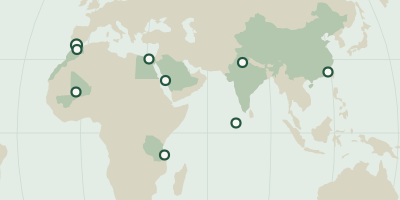
In June 1325 a 21-year-old law student left Tangier to make the pilgrimage to Mecca. He did not come home for 24 years. Ibn Battuta crossed the Islamic world and beyond — Arabia, East Africa, Anatolia, Central Asia, India, the Maldives, Sumatra and China — earning his keep as a judge and a guest of sultans, marrying and divorcing along the way. By some estimates he covered about 117,000 kilometres, more than any traveller before the age of steam. Back in Morocco he dictated his memories, the Rihla, to a scholar who polished them and borrowed passages from older books, so not every scene was his own. The route picks out nine stops in the order he reached them; it is not one continuous road. There are no travel tips for Mecca or Mali.

9 locations7/9 visitable
Real JourneysApproximate

Bashō's Narrow Road to the Deep North

In spring 1689 the poet Matsuo Bashō gave up his hut in Edo and set off on foot with his friend and disciple Kawai Sora into Oku, the remote north of Japan. For about 156 days and some 2,400 kilometres they walked to the places the old poets had made famous — a barrier gate, a bay of pine islands, a battlefield, a mountain temple — and Bashō answered them with haiku. The travel diary he made of it, Oku no Hosomichi, published in 1702, is one of the classics of Japanese literature, and its stops are still pilgrimage sites. Bashō polished the facts for art; Sora's own diary shows where. Dates follow the old lunar calendar, so they are given here by season.

9 locations9/9 visitable
HistoryApproximate

The First Crusade: Road to Jerusalem

In November 1095 Pope Urban II, answering a Byzantine emperor's plea for help against the Seljuk Turks, called western Christians to an armed pilgrimage to Jerusalem. Tens of thousands answered — knights, foot soldiers and poor pilgrims. Their armies took separate roads to Constantinople, then marched together across Anatolia and Syria. Almost four years after the call, they stormed Jerusalem and massacred much of its population. The route follows the main armies in order, from Clermont to Jerusalem, using the participants' own chronicles as summarised by modern historians. Violence against Jews in the Rhineland and against the people of the cities on the way is part of the story and is named plainly. There are no travel tips for Syria or the Lebanese border area.

8 locations3/8 visitable
HistoryApproximate

The Long March: Retreat Across China

In October 1934 the Chinese Communists' main army, beaten by Chiang Kai-shek's Nationalists, broke out of its base in Jiangxi and fled west. A year and some 9,000 kilometres later, after river crossings under fire, snow passes and a high-altitude swamp, a few thousand survivors reached northern Shaanxi. On the way, Mao Zedong rose to lead the party, and the retreat became its founding legend. The route follows the Central Red Army, the best-known of several Long March columns, in date order. Official histories have polished some episodes, and historians still argue about how much fighting there was at Luding Bridge; the texts note where accounts disagree. Most stops now have memorials and museums.

8 locations5/8 visitable
BooksFictional

The Thirty-Nine Steps: Hannay on the Run

John Buchan's The Thirty-Nine Steps sends Richard Hannay from a flat behind London's Langham Place onto the 7.10 from St Pancras and north to Galloway's Cairnsmore of Fleet and the spa town of Moffat, while a German spy ring hunts him. Hannay has three weeks to survive before he can warn the government. The title comes from a real stair in Broadstairs: 78 steps, not 39. This is John Buchan's 1915 novel, not Hitchcock's very different film. London, St Pancras, Cairnsmore of Fleet and Moffat are named in the book; Hannay's hiding places on the moors and the Kent resort of Bradgate are not real, but the steps that gave the book its title are.

7 locations4/7 visitable
BooksApproximate

The Kite Runner: Kabul, Exile, Return

In 1970s Kabul, Amir, the son of a rich merchant, and Hassan, the son of his father's Hazara servant, grow up as near-brothers and fly fighting kites together. In the winter of 1975 Amir wins the city's kite tournament — and fails Hassan at the moment Hassan needs him most. War sends Amir into exile in California; a phone call from Peshawar a quarter of a century later sends him back into Taliban Kabul to make amends. Khaled Hosseini's 2003 debut follows real places in Afghanistan, Pakistan and California. Homes and alleys in the story are not identified, so those pins mark neighbourhoods; the route offers no travel advice for Afghanistan or Peshawar.

7 locations2/7 visitable
BooksFictional

Dracula: From Transylvania to Whitby

Dracula crosses Transylvania's Borgo Pass and Whitby's harbour, steps and churchyard, then Purfleet on the Thames and London Zoo. A young English solicitor becomes the Count's prisoner; Dracula ships himself to England in fifty boxes of earth and is hunted back to his mountains by Van Helsing's band. Stoker never visited Transylvania; he built its geography from books and maps, and the English half from places he knew. The route follows the novel's diaries and letters stop by stop: the inn at Bistritz, the Borgo Pass, the Black Sea port of Varna, the harbour, steps and churchyard of Whitby, Purfleet on the Thames, London Zoo and the final race up the Danube at Galatz.

9 locations5/9 visitable
HistoryApproximate

Freedom Riders: Washington to Jackson, 1961

In 1961 the Freedom Riders took two buses from Washington, D.C. through Rock Hill, Anniston, Birmingham and Montgomery to Jackson, Mississippi, to test the Supreme Court's ruling against segregated bus terminals. In Alabama a mob burned a bus while police looked away; hundreds more riders ended up in Mississippi's jails and Parchman Farm. The route follows the rides through the places where it happened, several of them now museums and part of a National Monument.

8 locations7/8 visitable
Real JourneysApproximate

The Odyssey of Christopher McCandless

Into the Wild tells the true story of Christopher McCandless: he graduated from Emory University in Atlanta in 1990, paddled the Colorado River into Mexico, worked in Carthage, South Dakota, and in April 1992 walked onto the Stampede Trail outside Healy, Alaska. He died in an abandoned bus that August, aged 24. Jon Krakauer wrote the book in 1996; Sean Penn filmed it in 2007. The route follows his documented trail. The Stampede Trail is dangerous, and this route is not an invitation to retrace the last part of it.

8 locations4/8 visitable