A retired detective with a fear of heights is hired to follow a friend's wife around San Francisco, because her husband fears she is possessed by Carlotta Valdes, a woman who died in 1857. Hitchcock's 1958 thriller was shot on location in San Francisco, at Mission San Juan Bautista, in Big Basin Redwoods State Park, at Cypress Point on 17-Mile Drive and at Paramount Studios in Hollywood.
This route follows the story in film order through nine places: a vanished restaurant, a Nob Hill apartment block, a mission cemetery and an art museum, a fort under the Golden Gate Bridge, a coastal kiss, a mission bell tower and a hotel with a green neon sign.
When the National Trust withdrew filming permission, Monty Python's Grail quest leaned on Doune Castle in Scotland for Camelot, Castle Anthrax and most other castles, with Kidwelly Castle in South Wales for the opening shot and Bodiam Castle in East Sussex for the Swamp Castle exterior. King Arthur sets out across Britain in AD 932 to find knights and, in the end, the Holy Grail.
This route follows the quest in film order through six locations: the castle of the opening shot in Wales, Doune Castle in Scotland standing in for the rest, a moated castle in East Sussex for one establishing shot, a mine, a glen and the island tower that ends the film.
Gil Pender is a screenwriter with a nostalgia problem, in Paris with a fiancée and her wealthy parents. Every night at midnight a 1920s car pulls up and carries him back to the 1920s, among the Fitzgeralds, Hemingway and the surrealists. By day he is stuck in 2010.
This route follows the film from Monet's garden at Giverny to Pont Alexandre III, with the stops placed from a film-locations guide: where the 1920s scenes are shot you can still sit, eat and shop today. The party and flea-market scenes are approximate.
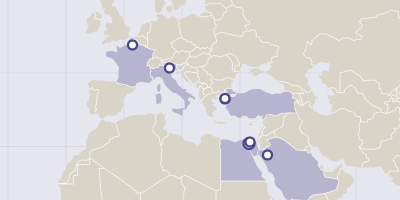
Battlefield 1 sends its soldiers across the Western Front, the Italian Front, Gallipoli and Arabia. This route follows the War Stories and multiplayer maps that go with them, from the Suez Canal in 1915 to Monte Grappa in October 1918.
Stops run in the order of the real battles, not the game's menu. The maps are the game's own reconstructions, so each pin marks the real ground behind a level, and one stop is a village the game invented.
Bob is a fading American movie star in Tokyo to advertise whiskey; Charlotte is a disillusioned recent graduate, married for two years. Both are far from home, and they find each other at the Park Hyatt Tokyo.
The route follows their story in the film's order: the neon streets of Shinjuku, the hotel, Shibuya Crossing and a karaoke room, then Charlotte's day trip to Kyoto Station, Nanzen-ji and Heian Shrine. Coppola shot for just 27 days, many of its locations in real places of business and public areas. The karaoke branch is pinned approximately.
Tony Soprano's mob is a New Jersey one, and the series made a point of it: the majority of its exterior scenes were filmed on location in the state, with most interiors built at Silvercup Studios in New York.
The route follows the opening titles from the Pulaski Skyway to the Soprano house, then the pork store, the Great Falls, the Bada Bing, the Pine Barrens and the diner of the finale. The Pine Barrens episode was filmed in New York, and the house is a private home, so its pin marks only the borough.
On 20 September 1519 five ships and about 270 men sailed from Spain to find a western sea road to the Spice Islands. Magellan died in the Philippines, but Juan Sebastián Elcano brought the Victoria home three years later with eighteen survivors and 26 tons of spices, having sailed all the way around the world.
The route follows the voyage from the mouth of the Guadalquivir past Port St. Julian, through the strait and across the Pacific to the Moluccas, then home past the Cape of Good Hope. Anchorages are often unrecorded, so most pins mark the nearest known place; the dates come from Pigafetta's journal and modern accounts.
In AD 79 a mountain above the Bay of Naples blew apart. Pliny the Younger watched from Misenum across the water, lost his uncle, the admiral Pliny the Elder, to the eruption, and years later described it for the historian Tacitus in two letters: the only eyewitness account that survives.
The route follows the eruption in the order of its events, from the mountain's first column to Pompeii, Herculaneum, the beach at Stabiae and back to Misenum. Pliny's letters never mention Pompeii or Herculaneum, so those stops come from archaeology. The traditional date is 24 August, but newer evidence points to the autumn.
Ghost of Yōtei follows Atsu, a wandering mercenary who returns to Ezo — modern-day Hokkaido — in 1603 to hunt down the Yōtei Six, the band led by the samurai lord Nariaki Saito who slaughtered her family sixteen years earlier. Her revenge carries her across an island modelled on Hokkaido, from the grasslands at Mount Yōtei's foot to the frozen north and the Matsumae clan's castle in the south.
This route follows the game's regions and their real counterparts: the Yotei Grasslands around Lake Shikotsu, the Ishikari Plain, the Ainu country of the Nayoro Wilds, the Kitsune's Teshio Ridge, and the Tokachi Range, with Mount Yōtei and Matsumae Castle as its fixed points.
L.A. Noire rebuilds Los Angeles in 1947 with fanatical care: the studio mapped the real streets, modelled building interiors on the originals, and filled the map with the city's landmarks. Detective Cole Phelps drives that recreation through traffic, homicide, vice and arson cases, and much of the city he moves through is still standing.
This tour follows the real places behind the game's map, from Union Station and Bunker Hill to Wilshire's art deco and the Hollywood movie palaces, then down to the river where the story ends. Every pin marks a real site the game put on its streets.
Assassin's Creed Valhalla brings the Viking Eivor and their clan to Anglo-Saxon England, where Hytham asks for help ridding the land of the Order of the Ancients. Following tip-offs from an informant who signs himself the "Poor Fellow-Soldier of Christ", Eivor hunts Order members from Grantebridge to Jorvik and Wincestre.
The route visits the real places behind the game's: Cambridge, where the jarlskona Soma takes back her town; York, the capital of Viking Britain; the docks of Repton, where the Great Heathen Army wintered; Alfred's Winchester; the battle at Chippenham in 878; and Athelney, where the informant's identity is finally revealed. All six can be visited today.
In March 1976 a film crew came to southern Tunisia and turned it into another planet. George Lucas had selected Tunisia to provide the desert planet setting for Star Wars, and filming in Tunisia began on March 22, 1976: a troglodyte hotel became the Lars homestead, the salt flats became a moisture farm, and the streets of Ajim on Djerba became the Mos Eisley spaceport.
When the prequels called, the crews came back: locations at Onk Jemal in Tozeur, Ksar Ouled Soltane and Ksar Hadada were used for Tatooine scenes in the 1998 shoot, from the Boonta Eve podrace track to the slave quarters where the boy Anakin lived. Abandoned sets for the filming have been left in the desert but can be visited — this route links all eight sites, from the droids' landing dunes to the granary-courtyard slave quarters.
Greece, 431 BC: Athens and Sparta are tearing the Greek world apart, and you are a Spartan mercenary caught between them. Assassin's Creed Odyssey sends you across the Aegean with a broken spear and an eagle at your side, hunting your lost family and the masked Cult of Kosmos that destroyed it.
This route follows the Eagle Bearer's trail from the hot gates of Thermopylae to the oracle at Delphi, the Acropolis of Athens, the sanctuary at Olympia, warrior Sparta and finally Mount Taygetos. Every stop is a real place you can visit, recreated in the game's vast open world.
Puyi became emperor of China at the age of two, lost the throne at six, and spent the rest of his life being used by others: as a puppet emperor for Japan in Manchuria, then as a war criminal re-educated in a Communist prison, and finally as an ordinary citizen working in a Beijing garden. Bernardo Bertolucci's 1987 epic, which won all nine Oscars it was nominated for, was the first Western feature film allowed to shoot inside the Forbidden City.
The route visits the real places of Puyi's life, most of them museums today. The film compresses and softens his story, and some of its scenes were shot in Italy.
In about 1986 a boy of five or six fell asleep on an empty train in central India and woke up nearly 1,500 kilometres away in Calcutta, unable to name his home town. Adopted by a couple in Tasmania, Saroo Brierley found his way back 25 years later by tracing railway lines on Google Earth. His memoir A Long Way Home became the 2016 film Lion, with Dev Patel as the grown-up Saroo and Nicole Kidman as his adoptive mother.
The route follows the real journey, which the film tells closely, from Khandwa station to Burhanpur, Howrah and Hobart, and back to Khandwa. Family homes are private and not pinned.
Bond is shot off a train in Turkey and left for dead, while a former agent with a grudge against M attacks MI6 from within. Sam Mendes's 2012 film — the 23rd Bond and the highest-grossing of them all — was shot between November 2011 and May 2012 in London, Turkey and Scotland, with much of "Shanghai" and "Macau" faked in England.
The route follows the story from the rooftops of the Grand Bazaar to the railway viaduct where Bond falls, a beach bar in Fethiye, MI6's real headquarters, a Turner in the National Gallery, an abandoned Japanese island, a disused Tube platform and the glen where Bond takes M home. Skyfall Lodge itself was a set in Surrey.
Troy has fallen. Aeneas, a Trojan prince, carries his old father out of the burning city and sets sail with the survivors to find the new homeland the gods have promised them. Virgil's Aeneid, written for Augustus in the 20s BC, follows years of wrong turns, storms and prophecies until the exiles land in Italy, where their descendants will one day found Rome.
This route follows the voyage in the order it happens, which is not the order Virgil tells it: the poem opens in Carthage and lets Aeneas recount the earlier wanderings to Queen Dido. Every stop is a real ancient site, most now open as archaeological parks; Aeneas himself belongs to legend. Quotations are from John Dryden's 1697 translation.
In Indiana Jones and the Great Circle (MachineGames, 2024), set in 1937, the trail of a stolen mummified cat runs from the Vatican and Giza to Shanghai and Sukhothai. Indy races the Nazi archaeologist Emmerich Voss around this "Great Circle" of sacred sites — a story Todd Howard conceived for the game.
The circle and its secret are pure adventure fiction, but its stops are real: the Vatican, Giza, wartime Shanghai, the ruined Thai capital of Sukhothai and the ziggurat of Ur. The designers rebuilt them from books and photographs as they would have looked in the 1930s. This route follows the main story.
In 1791 Saint-Domingue was France's richest colony, a sugar and coffee economy worked by hundreds of thousands of enslaved Africans under brutal conditions. Thirteen years later it was Haiti, the first nation born from a successful slave revolt and the first independent Black-led state in the Americas. The cost was enormous: some 200,000 Black Haitians died, and tens of thousands of French and British soldiers, most of them from yellow fever.
The route follows the turning points, from the ceremony that tradition places at Bois Caïman to the declaration at Gonaïves, with a detour to the French mountain fortress where Toussaint Louverture died. Fighting was savage on all sides, and the texts say so plainly. The route offers no travel advice for Haiti.
Exit West sends Saeed and Nadia through magic doors from a city at war to a tent camp on Mykonos, an empty mansion in Kensington, London, and Marin County, north of San Francisco. Mohsin Hamid's 2017 novel skips the refugees' dangerous journeys and keeps only the arrivals.
The doors are magic, but Hamid calls the book "geographically autobiographical": every stop is a place he has lived in or loved. The home city is never named, though he says it was based in many ways on Lahore, so that pin is speculative.
On the evening of 2 October 1872, the punctual and unflappable Phileas Fogg bets his fellow members of the Reform Club £20,000 — half his fortune — that he can go around the world in eighty days, and leaves that same night with his new French valet, Passepartout. On his heels comes Detective Fix, convinced that Fogg is a bank robber on the run. Jules Verne's novel appeared in 1872, when the opening of the Suez Canal and new railways across India and America had made such a race against the timetable just about possible.
The route follows the journey eastward in the novel's own dates, from Pall Mall back to Pall Mall.
Nellie Bly's 1889 record run began at a Hoboken pier, detoured to Jules Verne's house in Amiens, and crossed America by special train from San Francisco. The New York World reporter set out to turn Around the World in Eighty Days into fact and beat Phileas Fogg's record in 72 days, 6 hours and 11 minutes.
The route follows her book of 1890, stop by stop, with the dates from her own record. She went east by steamer and train, through the Suez Canal and the British ports of Asia.