A young bear stows away from Peru, turns up at Paddington station and is taken in by the Brown family. Paul King's 2014 film follows him through a cosy London of antique shops and a gentlemen's club, while a taxidermist closes in.
Most of it was shot on real London streets. This route runs from the station to Primrose Hill, Portobello Road, Pall Mall and the Natural History Museum, with one caveat: the film's station front door is borrowed from Marylebone.
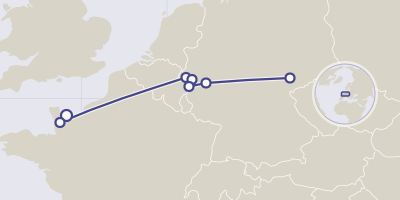
Private First Class Ronald "Red" Daniels lands on Omaha Beach on D-Day with the 1st Infantry Division and fights his way into Germany with one squad, until a friend is captured and the search for him ends at a concentration camp. Call of Duty: WWII is a 2017 game by Sledgehammer Games, and its campaign is set among real battles.
The route follows the missions in order: Omaha Beach, Marigny, Aachen, the Hürtgen Forest, the Ardennes, the bridge at Remagen and Berga, with the real battle each one echoes. Pins mark battle areas, not a mission's exact street.
HBO's Game of Thrones prequel was filmed primarily in the United Kingdom, and its Velaryon world is Cornish: the island seat of Driftmark is a tidal island, and the Stepstones war camp is a cove on the Lizard peninsula. For the capital and the free city of Pentos, the crew went to western and southern Spain.
The route follows the story from the Stepstones war (season 1, episode 3) through the Driftmark episodes to King's Landing in season 2. Sources do not name the exact streets used in Cáceres, so that pin marks the old town.
On 20 September 1519 five ships and about 270 men sailed from Spain to find a western sea road to the Spice Islands. Magellan died in the Philippines, but Juan Sebastián Elcano brought the Victoria home three years later with eighteen survivors and 26 tons of spices, having sailed all the way around the world.
The route follows the voyage from the mouth of the Guadalquivir past Port St. Julian, through the strait and across the Pacific to the Moluccas, then home past the Cape of Good Hope. Anchorages are often unrecorded, so most pins mark the nearest known place; the dates come from Pigafetta's journal and modern accounts.
1066 in three battles: Fulford and Stamford Bridge in the north, then Pevensey, Hastings and Battle in the south, with Westminster at both ends. Edward the Confessor died childless that January; by Christmas Day Harold Godwinson had fallen and William of Normandy was crowned.
The route follows the crown from Westminster to the Yorkshire landing of Harald Hardrada, Fulford and Stamford Bridge, then to Pevensey, Hastings and the field at Battle, and back to Westminster on Christmas Day. The exact ground of several battles is debated, so those pins mark the best-known sites.
King Arthur's legend has no single home: he is conceived at Tintagel and holds court at Caerleon, Cadbury Castle is claimed as Camelot and Glastonbury is linked to Avalon. The route follows Geoffrey of Monmouth, Malory and others from Merlin's dragons to the sword returned to the water.
Every pin marks a real place that tradition has attached to an episode, not a site proven by history, and each stop says where the link is doubted.
Netherfield Park is let at last, and Austen's novel follows Elizabeth Bennet from her family's village to a Kent parsonage and on to Derbyshire. The houses of the book are described rather than mapped, so this route follows the real places where the 2005 film and the 1995 BBC series found them.
Nine stops follow the story in order, from Longbourn to the inn at Lambton. Each pin is a real filming site standing in for a place in the book; only Gracechurch Street is the real London street the novel itself names.
The Hound of the Baskervilles takes Sherlock Holmes across Dartmoor: Cabell's tomb at Buckfastleigh, the ten-thirty train from Paddington, Princetown's prison and Hound Tor. A spectral hound stalks the moor.
The route runs from the grave that may have inspired the legend and the ten-thirty train from Paddington to the convict prison at Princetown, the mire, the tors and the Stapletons' house. Baskerville Hall and Merripit House exist only in the book, so their pins mark a stand-in or nothing at all.
The Count of Monte Cristo on a map: from Notre-Dame de la Garde in Marseille to the Château d'If, the island of Monte Cristo and its treasure, Rome's catacombs and the Paris of the count's revenge. A young sailor is arrested at his own engagement party, escapes in a dead man's burial sack and comes back as a count to settle accounts.
Most of the stops can be visited; the island of Monte Cristo is a nature reserve with a years-long waiting list, and several scenes happen in places Dumas invented, so those pins mark the real landmark nearby.
In April 1625 an eighteen-year-old Gascon rides into the market town of Meung on a yellow pony, bound for Paris and the King's Musketeers. Dumas's novel follows D'Artagnan from that first quarrel through duels, a secret night in the Louvre, a bet made during a siege and a midnight ending on a river bank.
The route runs from the Loire to Paris, on to La Rochelle and Portsmouth, and back to the banks of the Lys. The streets, squares and palaces are real; most inns, houses and bastions are Dumas's, so several pins mark a town or a street rather than a building.
Hill Valley is fictional, but almost all of it is Los Angeles. The 1985 film sends Marty McFly thirty years back to a small California town, and the filmmakers built its square on a studio backlot and dressed real malls, schools, churches and houses around the city as Hill Valley. This route follows the story from the Twin Pines Mall car park in City of Industry through 1955 and back to the McFly home in Arleta.
Each stop is a real place that played a piece of Hill Valley; the private homes are seen from the street only.
A shy waitress at a Montmartre café staffed and frequented by eccentrics finds a metal box of childhood memorabilia hidden behind a bathroom tile and gets drawn into the lives around her: practical jokes on the nasty greengrocer Collignon, street scenes described aloud to a blind man, and a dropped photo album belonging to Nino, a collector of discarded photo-booth pictures.
The route follows her Paris from the café on Rue Lepic to the photo booths of the Gare de l'Est and the blue arrows on the steps of the Sacré-Cœur, taking in skipping stones on the Canal Saint-Martin and a surge of love on the Pont des Arts along the way. Nearly every stop is a real place you can visit.
Forza Horizon 4, released on 2 October 2018, turns Great Britain into one giant racetrack: an open world with condensed representations of Edinburgh, the Scottish Highlands, the Lake District and the Cotswolds, where seasons change every week and Derwentwater freezes hard enough to drive across. Microsoft counted 24 million players by November 2020, and Polygon found the game world a theme-park version of England where everything has "the faint whiff of an idealised 1950s about it, a place of ordered pub gardens and rosebushes".
This route drives the real Britain behind the game, north to south: Edinburgh's Old Town, Bamburgh Castle on its coastal crag, three Lake District stops at Derwentwater, Ambleside and Tarn Hows, and the honey-coloured village of Broadway in the Cotswolds. Every stop can be visited today.
The Galar region is Britain played back as a game: a fictional land inspired by the United Kingdom, dotted with landmarks that recall Bath and York, crowned by a London of clock towers and football-stadium gyms. Eight gym cities, eight badges, and then the Champion's Cup in Wyndon, where Leon waits and the Darkest Day breaks.
This route walks the real Britain behind that map, south to north and then beyond: a chalk giant, a lighthouse, Roman baths, a minster, a national stadium and a clock tower, plus the two downloadable lands, the Isle of Man and the snows of Scotland. Every identification is a fan or developer reading, never confirmed in the games, so every pin here is speculative.
A famous American actress walks into a Notting Hill travel bookshop, and its shy owner falls for her: that is the whole of Notting Hill, and somehow it is enough. Hugh Grant stammers, Julia Roberts glows, and London plays itself, from the market street of Portobello Road to a midnight garden and a press conference at the Savoy.
The route follows the film in story order, from the bookshop at 142 Portobello Road and the blue door at 280 Westbourne Park Road to the Ritz, a birthday party, the private garden, the Henry James set at Kenwood House and the Savoy finale. The flat interiors were studio sets and the garden is private, so some pins are for looking rather than entering.
Assassin's Creed IV Black Flag sets its pirate Caribbean in Havana, Nassau, Kingston and Port Royal. Edward Kenway steals a dead Assassin's name, takes the Jackdaw, builds a brotherhood in Nassau, loses his friends and chases the Observatory, a device that can watch anyone on earth.
Black Flag sets all of it in real ports — Havana, Nassau, Kingston, Port Royal — and then leaves the Caribbean for the Maya ruins of Tulum, an island in the Gulf of Guinea and a final scene in London. The route follows Edward from the harbour where Torres's plot starts, through the pirate republic and the governor who ends it, to the Kingston house where Mary Read drops the disguise, the jail at Port Royal, Príncipe, where the Sage is waiting, and Covent Garden. Most stops mark a real landmark in the town the game rebuilds.
A gentleman of La Mancha, a head full of chivalry books, a plain full of mills: this route follows Don Quixote from the village argued to be his to the strand of Barcelona, keeping the order of the book.
It begins with the village whose name the narrator refuses to give, the inn where a landlord reading from his account book dubs him a knight, and the ridge of mills that shivered his lance to pieces. In Part II it follows him to Dulcinea's town by night, the cave where he sleeps an hour and believes three days have passed, the lakes of Ruidera, and finally Barcelona, where galley crews salute him three times and a bachelor from his own village unhorses him.
Which mills he charged, and where the inn of that first night stood, are guesses: Campo de Criptana and Puerto Lápice are the usual answers.
A jazz pianist and an aspiring actress argue through the windows of their cars in a Los Angeles traffic jam, and the city itself becomes the romance: a night on a funicular, a broken projector, a kiss in a planetarium. Damien Chazelle shot La La Land in 40 days across Los Angeles in the summer of 2015, and most of the places the couple reaches for are still there.
This route follows Mia and Sebastian from the freeway ramps where they shout at each other to the jazz bar Seb finally gets to open — the 105/110 connector ramps, the Burbank café on the Warner lot, the Lighthouse Café and the pier beside it, the Rialto in South Pasadena, Griffith Observatory and Angels Flight. The film rarely names its own locations, so a few pins mark the real building that stood in for the one on screen.
Los Santos feels like Los Angeles because it is Los Angeles, compressed. Grand Theft Auto V squeezes the city's most famous miles into one playable map, from a hillside sign to a Venice boardwalk.
This tour visits seven real stand-ins behind the fiction: the hillside sign, a movie palace, a luxury shopping street, an observatory, a pier, a beach and a towered folk-art park. Every pin marks the real place, and each stop names the game location it doubles for. Expect crowds at the beach and on Hollywood Boulevard, and quiet at the towers.
Puyi became emperor of China at the age of two, lost the throne at six, and spent the rest of his life being used by others: as a puppet emperor for Japan in Manchuria, then as a war criminal re-educated in a Communist prison, and finally as an ordinary citizen working in a Beijing garden. Bernardo Bertolucci's 1987 epic, which won all nine Oscars it was nominated for, was the first Western feature film allowed to shoot inside the Forbidden City.
The route visits the real places of Puyi's life, most of them museums today. The film compresses and softens his story, and some of its scenes were shot in Italy.
King Pelias sends his nephew Jason to fetch the Golden Fleece from Colchis, at the far end of the Black Sea, hoping he will never come back. Jason builds the Argo, gathers the greatest heroes of his day, Heracles among them, and sails east. Apollonius of Rhodes told the voyage in his Argonautica in the 3rd century BC, and he filled it with real coasts, harbours and local legends.
This route follows the outward voyage to Colchis. The way home is left out: ancient writers sent the Argo back by wildly different routes, up rivers into the Adriatic and even across Libya. The heroes and the fleece are myth; the shores, islands and ancient cities are real. Quotations are from R. C. Seaton's 1912 translation.
Troy has fallen. Aeneas, a Trojan prince, carries his old father out of the burning city and sets sail with the survivors to find the new homeland the gods have promised them. Virgil's Aeneid, written for Augustus in the 20s BC, follows years of wrong turns, storms and prophecies until the exiles land in Italy, where their descendants will one day found Rome.
This route follows the voyage in the order it happens, which is not the order Virgil tells it: the poem opens in Carthage and lets Aeneas recount the earlier wanderings to Queen Dido. Every stop is a real ancient site, most now open as archaeological parks; Aeneas himself belongs to legend. Quotations are from John Dryden's 1697 translation.
Ida Pfeiffer's 1846–1848 journey around the world passed through Hamburg, the Brazilian forest, Tahiti and Baghdad, as her own book A Woman's Journey Round the World recounts. A 48-year-old Viennese widow with little money, she travelled mostly alone by cargo ship, horseback and caravan, and came home to a Vienna in revolution.
The route follows her first world journey in order, from her own book, A Woman's Journey Round the World: Hamburg, the Brazilian forest, Cape Horn and Valparaíso, Tahiti, Canton, Baghdad, Persia and home. There are no visitor tips for Iraq or Iran.
In December 1831 a 22-year-old Cambridge graduate with a passion for beetles and rocks sailed from Plymouth as an unpaid naturalist on HMS Beagle, a ten-gun survey brig. The voyage was meant to take two years and took five. Charles Darwin came home with crates of fossils, skins and notebooks — and with questions about the islands that would lead him, two decades later, to On the Origin of Species.
The route follows the ship around the world in order, using Darwin's own Journal of Researches for dates and details: the volcanic Cape Verde islands, the Brazilian forest, the fossil beds of Argentina, Tierra del Fuego, a great Chilean earthquake, the Galápagos, Cape Town and home to Falmouth.