Grigori Rasputin's story runs from the village of Pokrovskoye to Saint Petersburg's Alexander Nevsky Lavra, Peterhof and the Yusupov Palace on the Moika, where he was killed in December 1916.
The route follows the peasant who became the tsar's controversial confidant: his birthplace, his first steps in the capital, his meeting with Nicholas II, the murder, the bridge where his body was found and his burial at Tsarskoye Selo. Much about his death is disputed, and the stops say so.
Marie Antoinette was born in Vienna's Hofburg, married at the Palace of Versailles, played at country life in the Petit Trianon and was held in the Conciergerie before her execution on the Place de la Concorde in Paris.
This route follows the youngest daughter of Empress Maria Theresa from the Habsburg palaces of Vienna to the royal court of France and the guillotine, in six stops you can still visit.
The Shawshank Redemption was filmed mostly in Ohio: Shawshank State Prison is the Ohio State Reformatory in Mansfield, the opening trial is the Wyandot County Courthouse in Upper Sandusky, and the final beach is on Saint Croix.
The route follows Andy Dufresne from his trial to the Mansfield prison, the woodshop where Red hears Figaro, Brooks's halfway house and the Caribbean beach that stands in for Zihuatanejo.
Henry VIII's six marriages played out in a handful of English palaces: Greenwich, Hampton Court, Whitehall, the Tower of London and Hever Castle, plus Peterborough Cathedral and Syon Abbey. Follow where he was born, where his wives lived, and where two of them ended.
This route takes seven stops from Henry's birth in 1491 to Catherine Howard's last months in 1542, and says what you can still visit today. Several Tudor buildings have gone, so those pins mark the site.
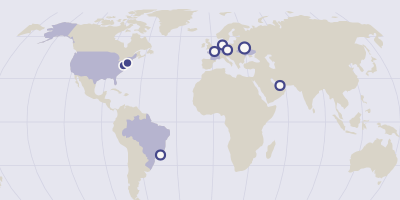
Max Payne 3 is set in São Paulo, Brazil, with scenes in Hoboken, New Jersey, a yacht attack on the Panama Canal and an ending in the state of Bahia.
Max, a retired NYPD cop, leaves New York for a security job with the wealthy Branco family in São Paulo, and a kidnapping pulls him into the city's favelas. The route follows the story from Hoboken to São Paulo, the Panama Canal and Bahia. It contains spoilers.
The game names cities and regions rather than streets, and its favela is invented, so the pins are approximate.
Gran Turismo, Forza and Assetto Corsa race on real circuits: the Nürburgring Nordschleife, Spa-Francorchamps, Monza, Le Mans, Suzuka and Laguna Seca.
This route lists six tracks you can drive in racing games, with what each game does with them and the real circuit behind the screen. Game appearances differ by title and year.
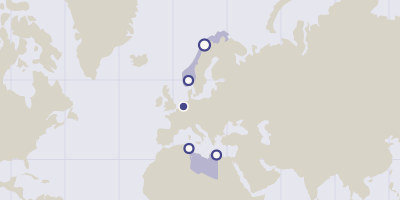
Battlefield V sends you to Narvik in Norway, Tobruk in Libya, Kasserine Pass in Tunisia, Rjukan in Norway and the Nijmegen railway bridge in the Netherlands, all real places of the war.
The game's prologue jumps between fronts, and the "Nordlys" war story follows a Norwegian resistance fight over heavy water. This route lines up those settings with the real history of each place. Only the places named in the game's own plot summary are included.
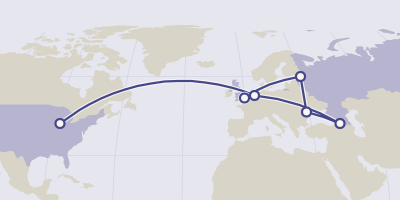
Call of Duty: Modern Warfare (2019) and Modern Warfare II (2022) are set in real cities such as London, Saint Petersburg, Amsterdam and Chicago, plus Moldova and Georgia, alongside invented countries.
The route follows the campaigns in story order: the attack on Piccadilly Circus and the Camden Town raid, the trail through Saint Petersburg, Baurci and Borjomi, then the courier chase in Amsterdam and the finale in Chicago. Invented countries are left off the map, and the pins mark each real city or town, not a mission's exact setting.
Call of Duty 4: Modern Warfare and its sequels Modern Warfare 2 and 3 are set in real cities, from Pripyat and Rio de Janeiro to Washington, D.C., New York, Hamburg, Paris, Prague and Dubai.
This route follows the story of Price, Soap and Makarov across eight settings. The games' levels are invented layouts, so most pins mark the city rather than a mission spot.
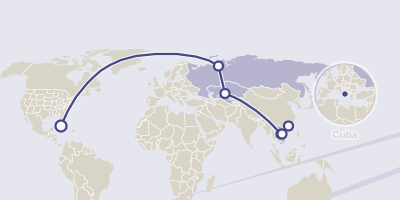
Call of Duty: Black Ops sends CIA operative Alex Mason from the Bay of Pigs in Cuba to the Vorkuta gulag, Baikonur Cosmodrome, Huế in Vietnam and Kowloon Walled City in Hong Kong.
Mason's story is told in flashbacks from an interrogation room, in order, from April 1961 to 1968. This route follows seven real places behind the campaign, and what happened at each one in real history. The game's levels are fiction, so most pins are approximate. Spoiler notice: the last stop reveals the campaign's twist.
Chitty Chitty Bang Bang (1968) was filmed at Cobstone Windmill near Turville in Buckinghamshire, at Cap Taillat in the South of France, in Rothenburg ob der Tauber and at Neuschwanstein Castle in Bavaria.
The route follows the film from the Potts family's windmill home to the beach picnic, then on Caractacus's story to Vulgaria, with the castle of Baron Bomburst as the finale. Several pins are approximate because the guides name an area, not a spot.
Twister is set in Oklahoma, and was filmed there at Fairfax, Kaw Lake, Wakita and Guthrie before the finale moved to Eldora, Iowa. Storm chasers Jo and Bill race tornadoes across the plains.
This route follows the story from the opening farm to the F5 climax. Several stops are towns rather than single sites, and the Eldora finale house is private.
The Silence of the Lambs is set in Virginia, Baltimore and Memphis but was filmed largely in and around Pittsburgh, Pennsylvania, with the FBI Academy at Quantico, the Carnegie Museum of Natural History and the Soldiers and Sailors Memorial Hall as real stops.
This route follows Clarice Starling from her FBI training to Lecter's cell and the hunt for Buffalo Bill. Two sites are private or gone, so the map marks them with a caveat.
Field of Dreams is set on a corn farm in Dyersville, Iowa, and the baseball field built for the film is still there. Ray Kinsella follows a voice from the cornfield to Fenway Park in Boston and on to Chisholm, Minnesota, played on screen by Galena, Illinois.
The route follows the film from the farm to the ballgame in Boston, the search for Moonlight Graham, and the closing line of headlights back at Dyersville. Some details differ from the real Graham, and the Chisholm scenes were not shot in Minnesota.
Catherine the Great was born in Stettin (now Szczecin, Poland), crowned in the Moscow Kremlin and lived at Oranienbaum, the Winter Palace and Tsarskoye Selo near Saint Petersburg.
The route follows the German princess from her birth in 1729 through the 1762 coup and her coronation to her English garden and the Bronze Horseman statue she commissioned. Birthplace sources differ, so the first pin is approximate.
The Roswell UFO incident of July 1947 began on a ranch near Corona, New Mexico, and ran through Roswell Army Air Field, Fort Worth and Wright Field in Ohio. The official explanation was a Project Mogul balloon.
This route follows the debris from the Alamogordo balloon launch to the Hangar 18 legend and the International UFO Museum in Roswell. Several stops are approximate, because the sources do not name exact spots.
The Loch Ness Monster, or Nessie, is reported around Loch Ness in the Scottish Highlands, from the River Ness and Foyers to Urquhart Castle.
The route follows the legend from Saint Columba's water beast in AD 565 through the sightings of 1888 and 1933, the 1934 "surgeon's photograph" later shown to be a hoax, and the 1977 photo taken beside Urquhart Castle. The stories are claims and legends, not proven facts.
The RMS Lusitania was torpedoed on 7 May 1915 11.5 nautical miles off the Old Head of Kinsale, Ireland, on a voyage from New York to Liverpool. This route follows her final journey through Liverpool, New York, Kinsale and Cobh.
It starts at Cunard's home port, moves to Pier 54 in New York, then to the Old Head of Kinsale and Cobh, where the survivors and the dead were brought and where a memorial now stands. Several stops are approximate because the ship went down at sea.
The Via Francigena is the medieval pilgrim road from Canterbury Cathedral through France and Switzerland to St Peter's in Rome, recorded by Archbishop Sigeric around 990. This route follows it from Canterbury over the Great St Bernard Pass to Lucca, Siena and Viterbo.
Sigeric's return trip ran to 80 stages of about 20 km each, some 1,700 km in all. Pilgrims still walk it today. Stops are landmarks on the route, not proven overnight stays.
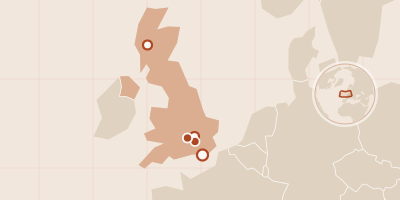
Harry Potter and the Goblet of Fire was filmed at Seven Sisters in East Sussex, Ivinghoe Beacon in the Chiltern Hills, Black Park in Buckinghamshire, New College and the Divinity School in Oxford, and Steall Falls in Glen Nevis.
From the Portkey landing before the Quidditch World Cup to the dragon task and the Yule Ball lessons, this route follows the 2005 film in story order. Scenes at Hogwarts itself and at the studio are not covered here.
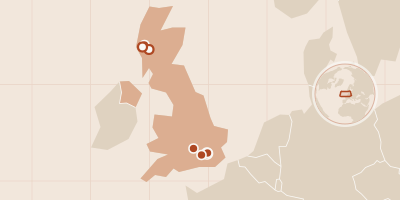
Harry Potter and the Prisoner of Azkaban was filmed on Lambeth Bridge and Stoney Street in London, the Glenfinnan Viaduct and Glen Coe in Scotland, Virginia Water in Surrey and the Divinity School in Oxford.
The third film was the first to use real locations extensively, so this route follows the story in film order, from the Knight Bus in London to the Dementors on the Highland train and the hospital wing in Oxford. Several lakes stood in for the Black Lake, so some pins are approximate.
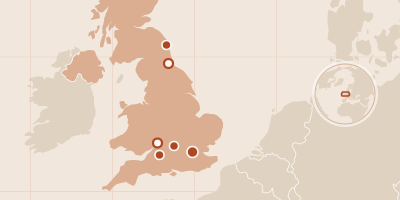
Where was Harry Potter and the Chamber of Secrets filmed? Hogwarts is Alnwick Castle, Lacock Abbey, Gloucester and Durham cathedrals and Oxford's Bodleian Library, while King's Cross plays Platform 9¾.
The route follows the 2002 film from the blocked barrier to the hunt for the heir of Slytherin, six real places across England. Most scenes were built at Leavesden Studios, so some pins mark where a location was used, not one exact scene.
Gone Girl is set in the made-up town of North Carthage, Missouri, but David Fincher shot it almost entirely in Cape Girardeau: The Bar on Themis Street, the Common Pleas Courthouse, the old federal building and the Bill Emerson Memorial Bridge over the Mississippi.
The route follows Nick Dunne's first days as the husband of a missing woman, from the bar to the press conference, the vigil, the police station and the bridge. One stop, the Drury Lodge, is marked approximately: it has closed and the pin sits on its street.
The moai of Easter Island (Rapa Nui) were carved at Rano Raraku quarry and raised on platforms such as Ahu Tongariki and Ahu Akivi, and the island's legends explain them: a founder who landed at Anakena, seven scouts turned to stone, statues that walked, and a birdman race at Orongo.
The route follows those stories from the landing beach to the quarry, the restored platforms and the cliff village above the sea. Oral traditions are told as traditions, not as proven history.