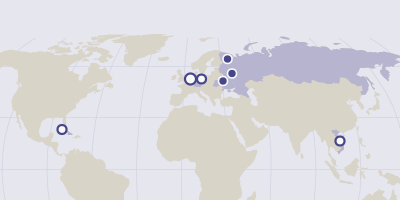
Bayside Shakedown is set in Tokyo's fictional Wangan Precinct, and its real home is Odaiba: Fuji Television's headquarters, the island and the Rainbow Bridge that gives the second film its title.
The police comedy began on Fuji TV in 1997, the year the network moved to Odaiba, then a half-empty district. This route follows the show from the studio to Tokyo Teleport Station, the shot-in-Shiomi precinct and a Kyoto road junction that doubled for the bridge.
The Texas Chain Saw Massacre was filmed around Austin in the summer of 1973, and its main sites can still be visited: Bagdad Cemetery in Leander, the Last Chance Gas Station in Bastrop, and the Quick Hill farmhouse, now Hooper's restaurant in Kingsland. This route follows the film from the grave-robbing opening to Sally's escape on a Round Rock road, then ends inside the house where Leatherface's family sat down to dinner.
Tobe Hooper shot the $140,000 film on 16mm over 13 days, using a real farmhouse, a working gas station and a country cemetery instead of sets. Temperatures reached 110°F during the shoot.
Zhmurki (Dead Man's Bluff, 2005) is set in 1990s Nizhny Novgorod, and Aleksei Balabanov filmed it there: in the Kovalikhinsky Baths, at Vodnik Stadium, by the Church of Elijah and in the Sirotkin House.
This route follows seven locations of Balabanov's black comedy about bandits of the 1990s, from the bathhouse that played a morgue to the house of the final showdown. Several stops have changed since the shoot, and one is closed to visitors.
TBS's spy thriller VIVANT is set in the fictional Republic of Balka but was filmed in Mongolia, at Sükhbaatar Square in Ulaanbaatar and the Gobi's Bayanzag cliffs, then across Japan, from Kanda Myojin in Tokyo to Izumo Grand Shrine. Its Mongolian shoot alone ran two and a half months.
This route follows Nogi's story from Balka to Tokyo and back through Shimane, with stops in Mongolia and Japan. Some of the Japanese sets are offices and are not for visiting.
Morioh in JoJo's Bizarre Adventure: Diamond Is Unbreakable is based on Sendai, Japan, the hometown of the creator Hirohiko Araki. Its place names come from real streets such as Kōtōdai and Jōzenji, and its coast from the area around Matsushima.
The route walks from Araki's birthplace through the park and tree-lined avenue that lend the town its names, to the Mediatheque that hosted the JoJo exhibitions, the Lawson that became OWSON, and the suburbs and coast that supplied Morioh's look. Morioh itself is fictional, so most stops are real names and real models, not scene locations.
The Walking Dead was filmed across Georgia, with downtown Atlanta, Bellwood Quarry, the Cobb Energy Centre and Senoia standing in for its apocalyptic sets.
This route follows the show from Rick's first ride into Atlanta, through the survivors' camp at the quarry and the CDC, then south to the town that became Woodbury and to Rick's home town, and on to Alexandria and the Kingdom. Most of the stops are on public streets or in public parks; the two studio-lot stops sit on private land.
The Fast and the Furious (2001) turned real Los Angeles places into Dom Toretto's world: Dodger Stadium, Bob's Market in Echo Park, the house on East Kensington Road and Neptune's Net in Malibu.
This route follows nine of those places in story order, from the opening test at Dodger Stadium to the final race on Terminal Island, with a detour to Race Wars at San Bernardino. Some are working shops, homes or airport ground; the film's streets are still the draw.
Stand by Me moves King's Castle Rock from Maine to Oregon: Rob Reiner shot the 1986 film in Brownsville, along the Row River railway and at a California trestle. Four boys walk out of town to find a missing boy's body, and the trip changes them.
This route follows the film in story order, from Brownsville's Main Street and the treehouse to the saloon and diner where the trip is set in motion, the Row River Trail bridge near Cottage Grove, a Junction City general store, the 80-foot trestle above Lake Britton and the Calapooia River bridge where the boys part. Most stops are in Oregon; the trestle is in California.
Gaidai's 1965 comedy was shot at Mosfilm and around Moscow, including the Moscow Power Engineering Institute and Vavilov Street, then in Odesa when autumn weather turned. Fans have since put Shurik and Lida in bronze in Ryazan and Krasnodar.
The film is three comic novellas about the student Shurik. The route follows where the film was made and the statues it left behind.
The Boy's Word: Blood on the Asphalt is set in Kazan but was filmed in Yaroslavl; its story comes from the real Kazan phenomenon of teenage gangs in Sukonnaya Sloboda, Privolzhsky District, Novo-Tatarskaya Sloboda and Sotsgorod.
The route follows the real history behind the 2023 series, from street fights in the 1940s to the 1978 motorcycle run, then to Naberezhnye Chelny and Yaroslavl, where the series was cast and shot. The series invents its gang territories, so all pins are approximate.
Office Romance (1977) is set in Moscow, and its statistical office is assembled from three places: the Petrovka 3/6 facade, Mosfilm studio sets and a rooftop in Bolshoy Gnezdnikovsky Lane.
Eldar Ryazanov's comedy follows a shy statistician and his stern boss, with a city chosen carefully to show who lives where.
This route visits the film's real locations, the studio where the office was built, and the homes and station that give each character a place in Moscow.
Terminator 2: Judgment Day was shot across Los Angeles and beyond in 1990 and 1991: the Sixth Street Bridge, the Santa Monica Place mall, the Bull Creek spillway and the Kaiser Steel mill in Fontana all appear in the film.
This route follows nine of those real places in story order, from the biker bar where the T-800 picks up its clothes to the steel mill where it dies. Some have vanished — the Sixth Street Viaduct was demolished and the Corral Bar is now a library — and one is in Fremont, not Los Angeles at all.
Jaws was filmed on Martha's Vineyard, which stood in for Amity Island: Edgartown, State Beach and the Jaws Bridge.
Steven Spielberg began shooting there on 2 May 1974, using the island's whaling town, its barrier beaches and the little Chappaquiddick ferry as the summer resort the shark terrorises. This route follows the film from the opening bonfire at South Beach to the last shot off Cape Poge Light. In between are Brody's beach-closing signs at Water and Main, the Kintner attack at Joseph Sylvia State Beach, the shark's run under the American Legion Memorial Bridge into Sengekontacket Pond, Quint's vanished workshop at Menemsha and the open water between Oak Bluffs and East Chop where the Orca hunts.
Home Alone's Kevin McCallister lives at a real three-storey house at 671 Lincoln Avenue in Winnetka, Illinois; his family's Christmas dash was filmed at Chicago's O'Hare, and Home Alone 2 sends him to the Plaza Hotel, Central Park and the Rockefeller Center tree.
The route follows both films in order, from the Winnetka house and the two churches where Kevin meets Old Man Marley to the Chicago buildings that stood in for Duncan's Toy Chest and the New York landmarks of the sequel. Every stop is a documented filming location; the house is a private home, so visitors should not disturb the residents.
From 1968 Carlos Castaneda published best-sellers about his apprenticeship to don Juan Matus, a Yaqui sorcerer from Sonora: peyote, power, and finally a leap into an abyss. They came out as anthropology and earned him UCLA degrees. Most scholars now read them as fiction, and the author reinvented his own life story too.
This route follows two maps at once. One holds the places the records confirm: Cajamarca, Lima, UCLA and Westwood. The other holds the places the books name, from a Greyhound depot in Nogales to a bench in Oaxaca and the Toltec warriors of Tula. Each stop's accuracy label tells you which map it belongs to.
Two Naughty Dog adventures, two treasure hunts: Nathan Drake chases Marco Polo's Cintamani Stone from an Istanbul museum through Borneo and Nepal to the legend of Shambhala, then follows Francis Drake's secret to a lost city in the Arabian sands.
The route follows both games in order. The legendary cities are invented or borrowed, and the game rarely names a real site, so every pin marks the country, city or region behind the chapter.
In September 1978, an 18-year-old photographer named Reza Shirazi comes home to Tehran and is pulled into the last days before Black Friday. The developers built the game from interviews with forty Iranians who lived through the revolution and from photographs by Michel Setboun; the streets, the cinema hideout and the prison are real places, filled with a fictional cast.
This route follows the game's 1978 story in order, from a Hasanabad rooftop to the shooting at Jaleh Square, then ends in the Evin Prison interrogation that frames the whole game. It is a route through the city the game recreates, not a walking itinerary.
Age of Empires II follows Joan of Arc from a French army camp at Vaucouleurs to the stake at Rouen. The designers said they deferred to history wherever it did not interfere with gameplay, and the campaign's spine — Orléans, Patay, Reims, Paris — is close to the record. But the game also bends the story, placing Joan at a battle she missed and turning a failed assault on Paris into a betrayal. This route follows the campaign's stops in order and sets each one beside what the sources say happened there.
The Driver series began in 1999 as a car-chase game and grew into a tour of real cities: Miami, Los Angeles and New York in the first game, Havana, Las Vegas and Rio de Janeiro in Driver 2, Nice and Istanbul in Driver 3, and a fictionalised San Francisco in the 2011 sequel. Tanner's undercover work runs from a Miami parking garage to a presidential car, a Rio climax beneath Christ the Redeemer and the Golden Gate Bridge.
This route follows the series city by city, from Ocean Drive's Art Deco hotels to the Las Vegas Strip and the Bosphorus. Some stops are city-level pins because the games recreate whole urban areas rather than single buildings; only Christ the Redeemer and the Golden Gate Bridge are pinned exactly.
Test Drive Unlimited sent players around Oʻahu's 1,000 miles of roads in 2006; The Crew Motorfest returned to a scaled-down island in 2023, with a car-culture festival at its centre. Both treat the island as a stage, one for a free-roam lifestyle racer and the other for a themed racing playground.
This route follows a road-trip loop from Honolulu Airport through Waikiki, Diamond Head, Hanauma Bay and the North Shore to Haleʻiwa, then back south to Pearl Harbor. Pins mark the real places; the games shrink the island and invent some of the roads in between.
Horizon Zero Dawn and Forbidden West cross the American West from Colorado Springs and Denver to Yellowstone and drowned San Francisco. A thousand years after the old world fell to Faro's machines, Nora outcast Aloy travels to uncover what destroyed it.
This route follows both Horizon games from the red rocks above Colorado Springs to the drowned streets of San Francisco, pairing each stop with the real landmark behind it. Guerrilla compresses the map — in-game locations are not exactly where they are in the real world — so the pins mark real stand-ins, not exact game coordinates.
Akito wakes after a traffic crash in a Shibuya emptied by a masked occultist's fog, sharing his body with the spirit KK and able to see the Marebito that now fill the streets. Tango Gameworks built the district as a condensed, walkable stage rather than a straight copy, keeping landmarks, borrowing back streets and folding in a few districts from elsewhere in Tokyo.
The route follows the game from the scramble crossing and the station through Center Gai, Dōgenzaka and the 109 stand-in, then north to a borrowed Yanaka Ginza and across town to the Tokyo Tower finale. Pins mark the real places; the game's map moves some of them closer together.
In the spring of 1989, Henry leaves Boulder for a summer job as a fire lookout in Wyoming's Shoshone National Forest. His only company is Delilah, the voice on the other end of a walkie-talkie, until fireworks at a lake, a ransacked tower and a fenced research camp turn the job into a mystery.
The route follows the game's places and the real Wyoming behind them: the bar where Henry meets Julia, the Cody rodeo the characters talk about, the Shoshone forest still marked by the 1988 Yellowstone fires, and stand-ins for the fictional Two Forks tower, Jonesy Lake, Wapiti Station, Cave 452 and Thorofare Lookout.
In January 1981 a CIA team led by Russell Adler hunts Perseus, a Soviet spy Adler believed dead. The trail runs from an Amsterdam bar and a Vietnam flashback to East Berlin, the KGB's Lubyanka and a Cuban firefight, before reaching the Solovetsky Islands. The route follows the campaign's real places in mission order and keeps the game's story apart from the real history of each place. A final stop marks the alternate ending at Duga.